Looking for the best gigabit router for smooth gaming, 4K streaming, and reliable home Wi‑Fi? This guide highlights top options that deliver true gigabit speeds, strong coverage, and easy setup. The choices below are best for gamers, home offices, larger homes, or mixed-use households where multiple devices need fast, stable connections. Each product section notes who it’s best for, plus a practical limitation to consider.
Summary of selected products:
| Product | Best For |
|---|---|
| TP-Link AXE5400 Archer AXE75 | High-end gaming and streaming with 6 GHz band |
| TP-Link AX1800 Archer AX21 | Balanced performance and reliability for medium homes |
| NETGEAR Nighthawk CAX30 | Wooded or dense homes needing a modem/router combo |
| TP-Link Archer AX55 | Solid performance with VPN and MU‑MIMO for households |
| TP-Link Deco X55 Mesh System | Whole-home coverage and flexibility in larger spaces |
TP-Link AXE5400 Tri-Band WiFi 6E Router Archer AXE75

Best for gamers and power users who need maximum headroom. The Archer AXE75 is a tri-band WiFi 6E router with a brand-new 6 GHz band, delivering up to 5400 Mbps across the three bands (6 GHz 2402 Mbps; 5 GHz 2402 Mbps; 2.4 GHz 574 Mbps). The 6 GHz spectrum reduces interference, enabling near-zero latency for competitive online gaming and high‑quality video calls. OFDMA technology increases device capacity, supporting more simultaneous transmissions. For households with many smart devices, this model offers strong performance, future-proofing and robust security features. Caution: 6 GHz performance is optimal when clients support WiFi 6E; older devices won’t utilize the 6 GHz band.
Best for: Gamers, streamers, and tech enthusiasts who want top-tier speeds and the latest 6 GHz band. Why selected: best overall maximum throughput and newest standard for congested networks.
TP-Link AX1800 WiFi 6 Router Archer AX21 V5

Better for mid-sized homes that want a reliable Wi‑Fi 6 experience without premium features. The AX21 is a dual-band router offering up to 1.8 Gbps total bandwidth (up to 1200 Mbps on 5 GHz and 574 Mbps on 2.4 GHz). It uses OFDMA to improve efficiency when many devices are connected and supports simple mesh setups for expanded coverage. Limitations include the absence of a 6 GHz band, which means less headroom in networks with many high‑demand devices. Best for: households wanting solid performance and easy expansion at a balanced price point.
NETGEAR Nighthawk Modem Router Combo CAX30

Recommended for homes that want an all-in-one modem and router solution. The CAX30 integrates DOCSIS 3.1 cable modem with a WiFi 6 router, delivering AX2700 performance and broad coverage. It’s best for households with a preexisting cable plan and a desire to reduce equipment clutter. A potential limitation is that some providers may require bridge mode for optimal configuration. Best for: users seeking a streamlined setup with combined modem and router capabilities.
TP-Link Archer AX55 Dual-Band Wi‑Fi 6 Router
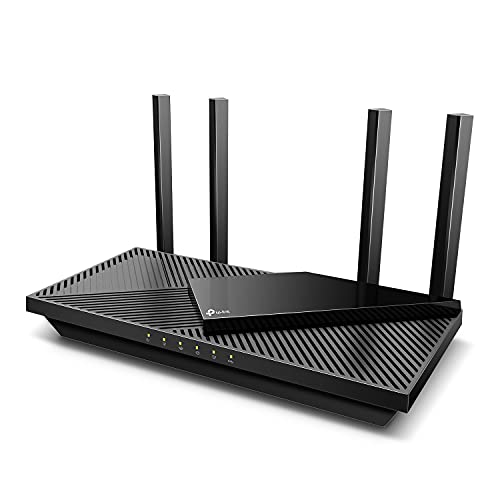
Choose this if you want strong gigabit performance with robust security features and VPN support. The AX55 delivers up to 2402 Mbps on the 5 GHz band and 574 Mbps on 2.4 GHz, with MU‑MIMO and OFDMA to handle multiple devices efficiently. It includes VPN server/client capabilities and supports EasyMesh for scalable coverage. Limitation: it does not support the 6 GHz band found on Wi‑Fi 6E routers, so it won’t leverage the newest spectrum in crowded environments. Best for: families needing reliable performance with security features and optional remote access.
TP-Link Deco X55 AX3000 Mesh System

Best for whole-home coverage and flexibility. Deco X55 is a mesh WiFi 6 AX3000 system designed to eliminate dead zones up to 2500 square feet per unit. It can function as a standalone router or integrate into an existing TP-Link mesh network. If you have a large home or multi‑story layout, this setup minimizes weak signals and provides seamless roaming. Limitation: a single unit may not cover extremely large homes; add more Deco units as needed. Best for: large homes seeking consistent, uniform Wi‑Fi across multiple floors.
Buying Guide
What to prioritize in a gigabit router
- Wi‑Fi standard: Wi‑Fi 6/6E provides better efficiency and throughput; 6E adds the 6 GHz band.
- Speed vs. real-world performance: Look for combined speeds that match or exceed your internet plan, but also consider OFDMA and MU‑MIMO for multi‑device efficiency.
- Band configuration: Tri-band and mesh systems help in busy households, while dual-band setups can be sufficient for smaller spaces.
- Coverage: Consider home size and wall materials; mesh systems scale coverage with additional nodes.
- Security and features: VPN support, WPA3 security, parental controls, and built‑in threat protection can be important for households with kids or remote work.
- Modem compatibility: If you need a standalone router, ensure compatibility with your ISP or consider a modem/router combo if space matters.
How to choose between standalone routers and mesh systems
- Standalone routers are typically simpler and cost-effective for smaller homes or apartments.
- Mesh systems excel in larger homes, multi‑level layouts, or areas with signal drop-offs, providing seamless roaming between nodes.
- For mixed usage (gaming plus streaming across many devices), a mesh system with good backhaul performance can maintain stability more consistently.
Practical setup considerations
- Placement matters: central position away from thick walls and metal appliances improves coverage.
- Channel selection and interference: use automatic channel tuning or a setup wizard to minimize interference from neighbors.
- Security settings: enable WPA3 if available and configure a strong unique network password.
FAQ
- What is gigabit Wi‑Fi? It refers to wireless networks capable of delivering data at speeds near or above 1 Gbps under optimal conditions.
- Do I need Wi‑Fi 6E for gaming? Not strictly, but 6E can improve latency and throughput in crowded networks when clients support it.
- Should I buy a modem/router combo? It reduces equipment clutter but may limit future flexibility; consider your ISP’s compatibility and the desired upgrade path.
- Is a mesh system better than a single router for a large home? Yes, for continuous coverage across multiple floors or thick-walled homes, mesh minimizes dead zones.
- Do mesh systems require multiple internet plans? No, but adding more nodes may require ensuring your ISP plan supports the higher speeds you want to utilize.
- Can all devices pick up 6 GHz signals? Only devices with Wi‑Fi 6E support can access the 6 GHz band; older devices will use 2.4 GHz or 5 GHz.