Answering the common buyer question: which wireless gateway modem best balances speed, compatibility, and coverage for a typical American home? This guide highlights five solid options, each suited to different needs—from multi-gigabit plans to simple, reliable Wi‑Fi in mid-size homes. If you want to minimize rental fees while keeping strong wired backhaul or expand your wireless coverage, one of these gateways could be the right pick. The table below provides a quick snapshot of each product.
| Product | Best For |
|---|---|
| Arris Touchstone DG3450 Cable Modem Wireless Gateway | Multi‑gigabit households needing DOCSIS 3.1 with robust Wi‑Fi and MoCA backhaul |
| ARRIS SURFboard SB8200 DOCSIS 3.1 Modem | Users who want the fastest modem backbone with reliable gigabit service (no built‑in Wi‑Fi) |
| NETGEAR Nighthawk Cable Modem with Built‑In WiFi 6 Router (CAX80) | Homes needing Wi‑Fi 6 performance with strong coverage and compatibility |
| GL.iNet GL-BE6500 (Flint 3e) | Power users needing VPN support and long‑range coverage in large spaces |
| Hitron CODA56 Cable Internet Modem Only | Cable internet users who already have a router and just need a DOCSIS 3.1 modem |
Arris Touchstone DG3450 Cable Modem Wireless Gateway

The Arris DG3450 combines a DOCSIS 3.1 modem with dual‑band Wave 2 AC Wi‑Fi and MoCA 2.0. This model supports multi‑gigabit downloads and seamless 4K streaming. With 4×4 MU‑MIMO on the Wi‑Fi side and four rear Gigabit Ethernet ports, it provides strong wired backhaul for desktops, gaming consoles, and IPTV devices. Best for households seeking high wireless throughput and reliable wired connections in a single device. Caution: some users may prefer a pure modem if their router upgrade plan is separate.
ARRIS SURFboard SB8200 DOCSIS 3.1 Modem
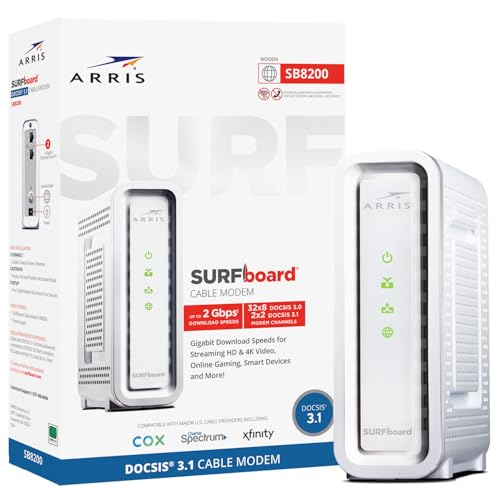
The SB8200 is a modem‑only solution designed for multi‑gigabit cable plans. It supports DOCSIS 3.1 with two 1‑Gbps Ethernet ports to handle high‑speed devices and mesh nodes. Best for users who want maximum modem performance and already own a router or want to pair with a separate Wi‑Fi system. Limitation: does not include built‑in Wi‑Fi, so a separate router is required.
NETGEAR Nighthawk Cable Modem with Built‑In WiFi 6 Router (CAX80)

The CAX80 combines a DOCSIS 3.1 modem with a built‑in WiFi 6 router, delivering broad coverage and high device capacity. It is suitable for homes with many connected devices, streaming, and gaming across multiple rooms. Best for users seeking an all‑in‑one gateway with modern Wi‑Fi 6 performance. Caution: some high‑density homes may benefit from additional mesh nodes for optimal coverage in far corners.
Hitron CODA56 Cable Internet Modem Only

The CODA56 is a DOCSIS 3.1 modem that requires a separate router for Wi‑Fi. It is best for users who want to source a personalized router setup or upgrade a legacy gateway while keeping their preferred Wi‑Fi technology. Limitation: no built‑in Wi‑Fi; ensure you have a compatible router to achieve wireless coverage.
GL.iNet GL-BE6500 (Flint 3e)

The GL-BE6500 is a high‑end gateway router designed for VPN heavy users with WireGuard and OpenVPN. It supports long‑range Wi‑Fi and a large number of connected devices, suitable for homes with extensive streaming, gaming, and work‑from‑home needs. Best for tech‑savvy buyers who value strong security features and flexible VPN options. Caution: VPN setup can be complex for casual users.
Buying Guide
What is a wireless gateway modem?
A wireless gateway modem combines a cable modem with a built‑in router, sometimes offering advanced features like Wi‑Fi 6/5, MU‑MIMO, MoCA backhaul, or VPN support. It simplifies setup by providing both Internet access and wireless coverage from a single device.
Key considerations: compatibility and plan speeds
- DOCSIS standard: For future‑proofing, DOCSIS 3.1 supports multi‑gigabit plans, while DOCSIS 3.0 handles most current speeds.
- Wi‑Fi standard: Wi‑Fi 6 (AX) offers higher device capacity and better performance in busy homes; Wi‑Fi 5 (AC) remains solid for many setups.
- Ethernet backhaul: Check the number of Gigabit ports; some devices add 2.5G ports or MoCA for wired backhaul.
- Router versus gateway needs: Decide if you want an all‑in‑one device or a separate router to pair with a modem.
Space, coverage, and number of devices
- Large homes benefit from gateways with high throughput and extra antennas, or adding mesh nodes in areas with weak signal.
- VPN and security needs: Models like GL.iNet support WireGuard/OpenVPN, which is important for privacy and remote work.
Reliability vs. flexibility
Modem‑only options may deliver more straightforward upgrades as ISP plans evolve, while gateways offer convenience and potential cost savings by eliminating separate devices.
Installation and ISP compatibility
Verify that the gateway modem you choose is compatible with your provider and plan. Some devices list compatibility with major providers and plan speeds, while others focus on general DOCSIS features.
FAQ
- Do I need a gateway modem if I already have a router? A gateway modem includes a built‑in router, but if you already own a high‑quality router, a modem‑only option may offer better performance or flexibility.
- Is DOCSIS 3.1 necessary for my home? If you have or plan to upgrade to multi‑gigabit service, DOCSIS 3.1 is preferable for future compatibility and throughput.
- Should I choose Wi‑Fi 6 or Wi‑Fi 5? Wi‑Fi 6 is better for busy homes with many devices, providing higher capacity and efficiency; Wi‑Fi 5 remains adequate for smaller households.
- What is MoCA backhaul? MoCA uses your home’s coaxial cabling to create a fast, wired link between devices, which helps improve reliability in areas far from the router.
- Are there downsides to gateways? Some models lack advanced customization options or may be less flexible than separate, upgradeable components.
- Can I avoid rental fees? Yes, owning a modem or gateway typically eliminates monthly rental charges from ISPs, but verify plan compatibility with your provider.