Wireless flood lights offer flexible installation, battery power options, and remote control features that enhance home security and lighting convenience. This guide highlights five top options, comparing brightness, sensor ranges, and installation needs. Each product is presented with a quick overview, key features, and practical usage notes to help you choose the right model for garages, yards, porches, or pathways.
| Product | Power | Heads | Sensor | Waterproof | Special |
|---|---|---|---|---|---|
| Tuffenough Solar Outdoor Lights | 2500 lm | 3 | PIR up to 26 ft | IP65 | Remote + 3 modes |
| LEPOWER Battery Powered Flood Light | 1500 lm | 3 | 180° up to 72 ft | IP65 | Battery operated |
| TOOWELL Battery Powered Flood Lights | — | — | 30 ft | IP65 | Remote control |
| intelamp Solar Outdoor Lights | 1200 lm | 3 | Dual sensors 180° | — | 270° wide arc |
| WdtPro Solar Lights Outdoor | 3500 lm | 3 | PIR motion sensor | — | Cob LEDs |
Tuffenough Solar Outdoor Lights 2500LM

The Tuffenough solar flood lights combine three adjustable heads with a remote and three operation modes. A 210-LED array delivers up to 2500 lumens with 6500 K color temperature, designed to illuminate large areas such as courtyards or driveways. The unit uses IP65 weatherproofing and offers flexible mounting options for walls or eaves. It detects motion and adjusts lighting intensity through a wireless remote, enabling quick changes to meet security or energy-saving goals.
Key features include a wide 270-degree lighting reach, a 26-foot sensing distance, and three modes: strong light sensor, dim light sensor, and strong long light. The combination of remote control and three heads provides customizable coverage critical for security lighting along fences, garages, and garden paths.
LEPOWER Battery Powered LED Flood Light Outdoor

This LEPOWER model runs on four D batteries, eliminating the need for wiring or electrical power during installation. It provides up to 1500 lumens with three flexible light panels, enabling targeted coverage for garages, yards, or porches. A 180-degree sensing angle allows a broad scan, while the 72-foot detection range helps catch distant motion. The light offers three modes: auto motion-sensing, eco-mode, and off, balancing brightness with energy use and battery life for security lighting during outages or in remote areas.
TOOWELL Battery Powered Flood Lights With Remote
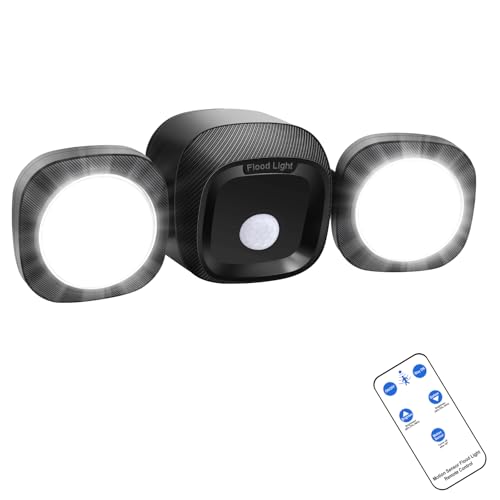
TOOWELL focuses on installation ease and remote operation. The battery-powered design means no wiring, and it runs on four D cells. A wireless remote allows quick mode switching, brightness adjustment, and on/off control, making it convenient for frequent light use around garages, backyards, or stairways. The motion sensor supports up to 30 feet detection in a wide 180-degree angle, helping to illuminate walkways and entry points when needed. It’s suitable for areas without reliable power and where occasional outages occur.
intelamp Solar Outdoor Lights With Dual Sensors

The intelamp solar flood lights emphasize a 270-degree wide lighting angle and dual motion sensors for comprehensive coverage. Each lamp delivers around 1200 lumens through a high-efficiency solar panel and a large internal battery designed for extended operation after a full day of charging. Three modes adjust brightness and motion activation, allowing dusk-to-dawn or motion-focused lighting patterns. Dual sensors prevent blind spots by detecting motion from multiple angles, making it a solid option for yards, driveways, and entryways where consistent coverage matters.
WdtPro Solar Lights Outdoor Motion Sensor

The WdtPro solar flood lights feature a triple-head design with a robust COB LED array delivering up to 3500 lumens. The unit uses high-efficiency solar charging and a 2500 mAh battery to extend operation through evenings with limited sun. Its three independent heads provide multi-directional lighting, and the motion sensor supports dusk-to-dawn and motion-activated modes. The design emphasizes sustainability and modern, glare-free illumination for yards, pathways, and perimeters, with a focus on consistent daytime charging for winter or overcast days.
Buying Guide: Key Purchase Considerations
When selecting wireless flood lights, consider power source, brightness, and sensor capabilities. Battery-powered units offer easy installation but require battery replacement or recharging cycles; solar-powered models emphasize sustainability but need sufficient sun exposure for reliable performance. Look for lumen output in the 1000–3500 lm range for general outdoor use, and ensure the color temperature aligns with the area’s needs (warm tones for residential comfort, cool whites for security and visibility).
Sensor range and angle determine how much area is covered. A 180-degree sensor with a 30–72 ft range typically provides strong security coverage for entryways and yards, while a 270-degree wide arc captures more peripheral movement. Adjustable heads and flexible mounting options help tailor light spread to driveways, sidewalks, and corners.
Weatherproof ratings are important for exterior use. An IP65 rating or better protects against rain and dust, ensuring long-term reliability. Remote control capabilities add convenience, enabling mode changes without climbing ladders or reaching into dark corners. For power outages, battery or solar options provide resilience and continuity of lighting during critical times.
Durability, warranty, and efficiency also matter. Quality LEDs with good heat dissipation extend lifespan, and models with large batteries or dual sensors often deliver steadier performance in varying weather. Compare total installed cost, replacement parts availability, and maintenance needs to choose a model that balances upfront price with long-term reliability.
In summary, choose wireless flood lights that match your space: solar models for low-maintenance setups, battery-powered lights for flexible placement, and lights with multiple heads and motion zones for comprehensive security coverage.