For players seeking mobility on stage or during practice without sacrificing tone or timing, a wireless guitar system is essential. This guide highlights top wireless transmitter systems that deliver clean signal, low latency, and solid range, along with practical buying considerations. Each option below is designed to minimize interference and preserve the original guitar sound across styles—from blues to metal.
| Product | Brand | Type | Range | Notes |
|---|---|---|---|---|
| JOYO JW-06 Wireless System | JOYO | 5.8GHz | Long battery life; up to 6 hours | Charging box design; versatile jacks |
| LEKATO 5.8GHz Wireless System | LEKATO | 5.8GHz | About 100 ft | Low latency; rechargeable |
| New Bee 2.4GHz Wireless System | New Bee | 2.4GHz | Over 20 m | Rotatable plug; multiple channels |
| Getaria 2.4GHz Wireless System | Getaria | 2.4GHz | Up to 100 ft | Supports 6 devices; 280° rotatable plug |
| JOYO JW-03 2.4GHz System | JOYO | 2.4GHz | Over 20 m | Easy pairing; wide compatibility |
Choosing the right wireless guitar system involves balancing frequency stability, latency, compatibility, and practical features like charging options and battery life. The products below are selected for their relevance to a variety of playing environments—from home studios to live stages—while staying mindful of signal integrity and ease of use.
JOYO JW-06 5.8GHz Wireless Guitar System

The JOYO JW-06 uses a 5.8GHz band to deliver clean, low-noise guitar signal with minimal latency. This system emphasizes stable performance with a charging box design that houses a rechargeable battery capable of powering the transmitter and receiver twice and providing up to 6 hours of operation after a full charge. Its connector shape is designed for broad compatibility with most 6.35mm mono jacks, including guitars with vibrato systems and various effect pedals. The combination of a compact charging solution and solid battery life makes it a practical option for gigs and long practice sessions.
LEKATO 5.8GHz Wireless Guitar System
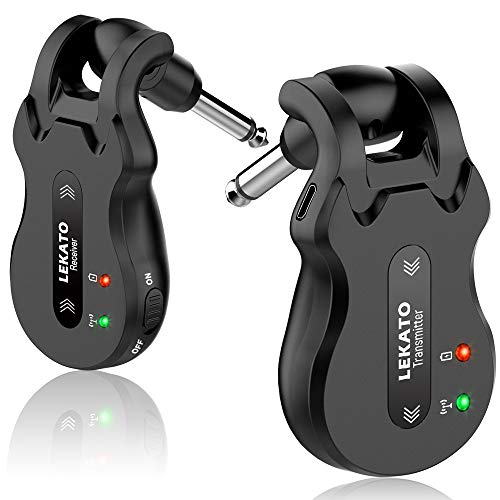
This 5.8GHz LEKATO system emphasizes robust anti-interference performance with 24-bit/48KHz audio transmission. It offers a low latency experience (under 6 ms) and an effective range of about 100 feet, preserving the original guitar sound with minimal dropouts. A built-in rechargeable battery powers the transmitter and receiver, and a dual USB cable enables convenient recharging. The system is designed for reliable live performance and can support frequent use across multiple gigs without frequent battery changes.
New Bee 2.4GHz Wireless Guitar System
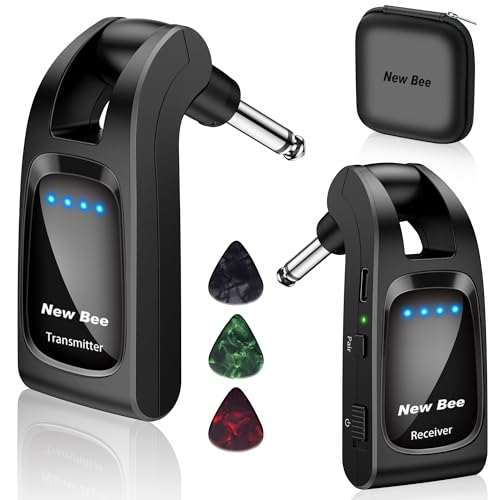
The New Bee system operates on the 2.4GHz band and features a low-latency, high-quality signal with a reliable range of over 20 meters. It emphasizes plug-and-play simplicity without sacrificing sound clarity. The device includes a 280-degree rotatable plug design for flexible positioning and compatibility with a wide range of electric guitars, basses, and other digital instruments. With rechargeable power, it supports extended practice and performance sessions, though users should note the potential for varied interference depending on the environment.
Getaria 2.4GHz Wireless System

The Getaria wireless system operates on 2.4GHz with a claimed range up to 100 feet and 24-bit/48KHz stereo transmission for high-quality sound. It supports up to six devices working simultaneously, enabling one transmitter to feed multiple receivers without interference. The 280° rotatable plug enhances playing comfort and instrument compatibility. This setup suits players who juggle multiple instruments on stage or in rehearsal spaces where channel management is essential.
JOYO JW-03 2.4GHz Wireless System

The JW-03 from JOYO uses the 2.4GHz band with a focus on easy pairing and broad instrument compatibility. With a stated range over 20 meters and low latency, this system is suitable for practicing at home or performing in small venues. The rotating plug design and straightforward pairing process make it a user-friendly choice for players who want reliable wireless operation without a steep learning curve.
Buying Guide: Key Considerations for Wireless Guitar Systems
- Frequency band and interference: 2.4GHz systems are common and widely compatible, while 5.8GHz bands can offer less interference in crowded environments. Consider your typical venue and nearby wireless devices.
- Latency and audio quality: Look for systems advertising sub-6 ms latency and 24-bit/48kHz or equivalent audio fidelity to preserve your tone and timing.
- Range and signal stability: Match the range to your space—rehearsal rooms, small clubs, or large stages. Real-world range varies with walls, interference, and power.
- Battery life and charging: Systems with rechargeable batteries and included charging options reduce downtime. Confirm how many hours of operation you can expect on a full charge.
- Plug design and compatibility: Rotatable 1/4″ plugs and broad instrument compatibility improve ergonomics and versatility across guitar, bass, and other electro-acoustic setups.
- Number of channels and multi-linking: Some systems support multiple receivers or simultaneous transmitters, useful for multi-instrument players or teaching scenarios.
- Durability and build quality: Physical design, clampability, and protection against drops or tugs matter for live performance.
When evaluating options, balance your priority on tone fidelity with practical concerns like battery life and ease of use. If you perform in environments with heavy wireless traffic, a higher-frequency system and devices with robust interference rejection may yield more reliable performance. For home practice, a compact, easy-to-set-up system with long battery life can be a better value, while stage use may benefit from a system that supports multiple receivers and quick pairing.
Beyond the core features, assess the availability of accessories and after-sales support. Manufacturers often provide replacement batteries, spare charging cases, and firmware updates that extend the life of a wireless system. The right choice will depend on your instrument setup, gig frequency, and your tolerance for occasional signal interruptions.