Water leaks can hide behind walls, ceilings, and cabinetry, often causing hidden damage and costly repairs. A reliable thermal imaging camera helps detect moisture-related hot or cold spots before they become big problems. This guide highlights top picks for leak detection, balancing image clarity, sensor resolution, ease of use, and data-sharing capabilities. The selections below emphasize devices that deliver actionable heat signatures and reliable scene detection to pinpoint hidden leaks quickly.
Summary of chosen products:
| Product | Brand | Key Benefit For Leaks | IR Resolution | Link |
|---|---|---|---|---|
| HF96V Thermal Camera | HSFTOOLS | Intelligent scene detection for rapid leak localization | 96×96 | View |
| Thermal Master Thor 002 | Thermal Master | High resolution imaging with precise temperature readouts | 512×384 (X³ IR) | View |
| MILESEEY TR10 | MiLESEEY | Super resolution for detailed moisture hotspots | 240×240 | View |
| BETTITOPE Thermal Camera 256×192 | BETTITOPE | Upgraded sensor with precise measurements and data transfer | 256×192 | View |
| Flir One Pro | FLIR | Mobile convenience with MSX detail merging | 480×360 (MSX upscaled) | View |
HF96V Thermal Camera With Visual Camera
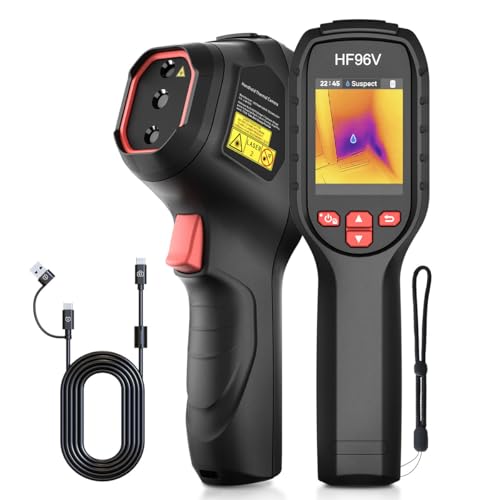
The HF96V from HSFTOOLS combines a 96×96 infrared sensor with a 640×480 visible camera, delivering three imaging modes: Fusion, Thermal, and Visual. This flexibility helps differentiate moisture-induced temperature anomalies from background clutter. Seven color palettes let technicians tailor visualization to specific leak scenarios, which can speed up identification inside walls or behind cabinetry. Its intelligent IntellFault scene recognition uses deep learning to flag potential leaks and insulation gaps, streamlining the inspection workflow. The device also includes a built-in laser pointer to mark suspect areas during inspections.
For field use, the HF96V is designed as a compact, all-in-one tool with straightforward controls: power, menu navigation, image capture, video recording, and palette switching. The included accessories—manual, wrist strap, and USB-C cables—facilitate quick setup and on-site data transfer. With an IP54 rating, it provides splash resistance in rough construction environments, making it suitable for inspections around plumbing, basements, and crawl spaces.
Thermal Master Thor 002 Handheld Thermal Imager

The Thermal Master Thor 002 expands professional-grade inspection capabilities with a 3.5-inch IPS display and 640×480 resolution, boosted by X³ IR technology to 512×384. A 60 Hz refresh rate ensures smooth thermal video and rapid assessment of leaks, while a broad -4°F to 1022°F temperature range enables detection of common residential moisture issues, including early-stage leaks in cold and hot plumbing lines. Six points can be measured simultaneously, and emissivity settings adapt readings to various materials. Wireless data transmission supports PC, smartphone, and tablet workflows, enhancing on-site documentation and reporting.
External storage and device versatility are emphasized with 8 GB RAM and 32 GB storage, making it easy to store and review thermal footage. The included USB connectivity aids real-time analysis, and the device’s portability fits tight crawlspaces and utility closets where leaks often occur. For leak-focused inspections, the combination of high resolution, fast refresh, and precise localization tools helps identify subtle moisture patterns that may indicate hidden leaks or insulation issues.
MILESEEY TR10 Thermal Imaging Camera

The MILESEEY TR10 delivers 240×240 infrared resolution with Super Resolution to enhance detail beyond the native sensor. Its 25 Hz refresh rate provides smooth real-time monitoring, ideal for tracing moisture migration along walls and ceilings. A temperature range from -4°F to 1022°F and an accuracy of ±2°C support reliable moisture assessments. The device automatically highlights maximum, minimum, and center-point temperatures, enabling rapid hotspot identification. This model emphasizes ease of use with a simple interface and clear heatmaps designed for quick decision-making in water intrusion scenarios.
The TR10 also features fast anomaly recognition via alarms for unusual temperature patterns, helping inspectors flag potential leaks early. This can be particularly useful during post-storm checks or in spaces where insulation inconsistencies might mask moisture. A compact handheld form and straightforward data export options support efficient on-site reporting and later analysis on a computer or tablet.
BETTITOPE Thermal Camera 256×192 IR Pixels

The BETTITOPE BET500 upgrades traditional handheld IR imaging with 256×192 native resolution and a 25 Hz refresh rate, delivering clear heat maps for moisture tracking. The device supports up to 40 mk sensitivity and an accuracy around ±2°C, making it suitable for identifying subtle leak signatures. The camera supports flexible data storage and easy transfer via USB, aiding post-inspection analysis and documentation. Its 3.2-inch color display provides comfortable viewing, and multiple color palettes enable researchers to visualize moisture patterns with different contrast levels.
Highlights for leak work include a robust lens design, automatic center-point and hot/cold spot tracking, and straightforward one-click capture of images and videos. The unit’s built-in fusion and dual-light capabilities help distinguish moisture from other heat sources in challenging environments, such as attic spaces or basements with limited lighting. The device’s rugged construction supports on-site use in HVAC and building diagnostics contexts.
Flir One Pro – Thermal Imaging For iOS

The Flir One Pro integrates a high-detail camera with MSX technology that blends thermal and visible images for enhanced surface detail—useful when tracing leaks behind walls. This model is compatible with iPhone 15 and newer using USB-C, fitting mobile workflows for quick assessments and reporting. The Pro version offers upscaled thermal resolution to 480×360, delivering sharper leakage visualization on the go. Flir’s guidance within the app provides a structured approach to inspecting typical leak sources, such as windows, doors, and plumbing connections.
This option is particularly appealing for contractors and homeowners who need portable, smartphone-based inspection capability without heavy equipment. It supports field notes and image capture for direct sharing with contractors or insurance providers, making it a practical complement to larger, dedicated handheld cameras when quick checks are required.
Buying Guide: Key Purchase Considerations For Water Leak Detection
- Resolution and sensitivity: Higher IR resolution (preferably 240×240 or greater) and lower NETD values improve the ability to resolve small moisture patterns through walls or ceilings.
- Temperature range and accuracy: Leaks often involve modest temperature differentials. A device with a broad range (-4°F to 1022°F) and ±1–3°C accuracy helps pinpoint subtle hotspots without false readings.
- Imaging modes and palettes: Fusion or MSX modes, plus multiple color palettes, aid in distinguishing moisture signatures from background heat and wiring. Visual camera integration helps correlate thermal data with real-world features.
- Intelligent scene detection: Features like automated leak and insulation gap recognition speed up identification and reduce interpretation errors, especially for DIY users.
- Ease of use and portability: Lightweight, handheld units with intuitive controls and export options improve on-site efficiency. For smartphone-based models, compatibility with iOS or Android devices matters for your setup.
- Data handling: Onboard storage, USB/Wi-Fi transfer, and companion software enable efficient documentation and reporting. Consider 8 GB RAM and ample storage when evaluating models with video capture.
- Durability and IP rating: An IP54 or higher rating helps withstand dust and water exposure in job sites, crawlspaces, and basements.
- Accessory ecosystem: Bundled accessories like tripods, straps, and charging cables save time during inspections and reduce the risk of equipment damage.
When choosing a thermal imaging camera for water leak detection, balance resolution, sensitivity, and workflow needs. Professional-grade devices offer precise readings and robust scene analysis, but carry higher costs. For faster field checks, smartphone-integrated options provide portability and quick sharing, though they may compromise on certain professional features. Consider a mix of devices if your weekly workload includes both quick leak checks and detailed building diagnostics.