The night sky offers endless opportunities for planetary photography, from capturing lunar textures to streaming distant planets in sharper detail. This guide highlights five capable telescopes designed for adults, beginners, and casual stargazers who want to snap pictures of planets. Each pick emphasizes solid optics, user-friendly setups, and practical accessories like phone adapters for quick sharing. Read on to compare performance, setup, and what to look for when choosing your first or next planetary-imaging telescope.
| Product | Brand | Key Benefit |
|---|---|---|
| HETEKAN Telescope for Adults High Powered | HETEKAN | Strong 90mm aperture, versatile eyepieces, phone adapter |
| FAMIROSA Telescope for Adults High Powered | FAMIROSA | Wide magnification range, solid optics, ready for astrophotography |
| NACATIN 90mm EQ Refractor Telescope | NACATIN | Equatorial mount for tracking, 1000mm focal length |
| Educational Insights GeoSafari Starview | Educational Insights | Beginner-friendly, kid-friendly design, included activity guide |
| Slokey Discover The World Telescope | Slokey Discover The World | Flexible optics, multiple magnifications, stable tripod |
Hetekan Telescope For Planets And Moon

The Hetekan telescope is designed for both adults and beginners who want a clear view of the Moon and planets. It uses a 90 mm aperture to gather ample light for brighter images while maintaining a practical size for handheld setups or home use. The optical system features fully multi-coated glass lenses to minimize reflections and protect eyesight, delivering vivid lunar textures and planetary details. With a focal length of 900 mm, the scope supports a wide range of targets—from lunar maria to planetary bands—with comfortable viewing at multiple magnifications.
Magnification ranges from 36X to 450X thanks to three eyepieces (25 mm, 10 mm, 6 mm) and a 3x Barlow lens. The package includes a 5×24 finder scope for easier object locating, a phone adapter for quick imaging, and a stargazing mount for stability. The setup is approachable for beginners, yet capable enough for more detailed planetary observations when paired with the phone camera or simple astrophotography workflows.
FamiroSa 90mm Refractor For Planets And Stars
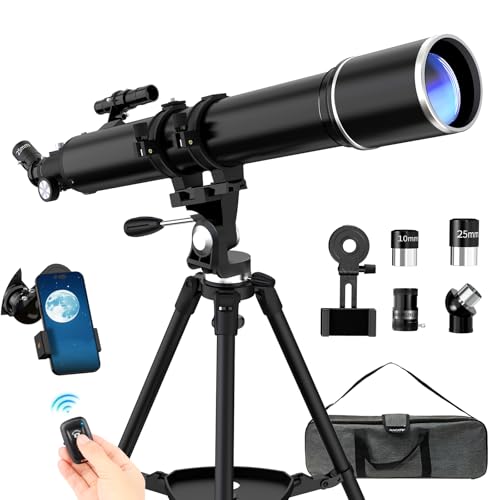
The FAMIROSA telescope combines a 90 mm aperture with a 900 mm focal length to deliver crisp planetary and deep-sky views. Its fully coated optics ensure bright, high-contrast images while preserving eye comfort. The instrument offers a magnification range of 36X to 270X via two eyepieces (H10mm and H25mm) and a 3x Barlow lens, enabling both wide-field surveying and close-up planetary observations. An included bag aids transport and storage, making it suitable for field use or travel. The device supports easy auto-shooting with a phone adapter so you can capture and share planetary moments with minimal setup.
Ideal for budding astronomers and hobbyists who want a reliable entry into astrophotography without extensive equipment. It combines practical optics with portability and value, supporting both day and night viewing for versatile use.
Nacatin 90mm Spot-On Portable Refractor

This NACATIN model emphasizes crisp lunar and planetary imaging with a 90 mm aperture and 800 mm focal length, designed for both moon craters and planetary features. It comes with a smartphone adapter to quickly capture photos and videos, making it convenient for social sharing. The kit emphasizes bright, high-contrast images thanks to multi-coated optics and includes the essential tools for beginners—an easy-to-use finder scope and user-friendly assembly. The telescope is well suited for entry-level astrophotographers who want to document planetary detail and lunar textures with minimal fuss.
Users benefit from straightforward operation, portable design, and the capacity to grow into more advanced imaging by adjusting eyepieces and mounting options as needed.
Educational Insights Starview Kids Telescope

The GeoSafari Starview is a kid-friendly, beginner-oriented telescope designed to introduce young observers to space. It features adjustable magnifications with 10x and 50x eyepieces and an activity journal to guide exploration. While primarily aimed at youth, it can serve as a stepping-stone for families wanting to cultivate early interest in astronomy and planetary observation. The design emphasizes ease of use, quick setup, and a hands-on learning experience that reinforces basic concepts like constellations, lunar phases, and planetary movement.
For parents seeking an approachable device to spark curiosity, this telescope prioritizes simplicity while still enabling meaningful views of the Moon and bright planets during ideal viewing windows.
Slokey Discover The World Telescope

The Slokey Discover The World telescope offers a versatile optical system suitable for adult beginners and intermediate users who want portability and performance. It provides a magnification range of 20x to 250x using three eyepieces (25 mm, 10 mm, 6 mm) along with a 3x Barlow lens. The tripod is stainless steel, contributing to stable, shake-free viewing, an essential trait for sharper planetary images. With multiple magnification options, observers can transition from wide-sky surveys to detailed planetary scrutiny, making it a flexible choice for those exploring both the Moon and visible planets. Quick setup and sturdy construction support consistent imaging sessions.
Buying Guide: Key Points For Planetary Photography
- Aperture matters: A 90 mm aperture lenses gather more light for brighter planetary details, especially when using high magnification. Larger apertures improve contrast and reveal finer textures on the Moon and bright planets.
- Focal length and magnification: A longer focal length (around 900–1000 mm) helps achieve higher magnification of planetary features. Pair with a versatile set of eyepieces and a Barlow lens to adjust for different targets.
- Optical quality: Look for fully multi-coated optics to minimize reflections and maximize light transmission. Quality coatings reduce glare and protect eyesight during prolonged viewing sessions.
- Mount and tracking: An equatorial or stable alt-azimuth mount with slow-motion controls helps maintain target alignment, essential for longer exposures or video capture. A simple tracking mechanism reduces field rotation during imaging.
- Imaging accessories: A phone or camera adapter enables quick astrophotography, letting you capture moments of planetary detail without complex setups. A dedicated tripod that minimizes vibrations improves image sharpness.
- Portability and storage: Consider weight, balance, and ease of transport if you plan to travel to darker skies or set up in different locations.
- Ease of use for beginners: A telescope that offers intuitive assembly, straightforward object locating, and clear manuals will shorten the learning curve and increase ongoing engagement with planetary imaging.
- Future upgrades: Some models support additional eyepieces, a motorized drive, or a more robust mount. If you anticipate expanding into astrophotography, verify compatibility with upgrades to maximize long-term value.
When choosing between these options, consider your target strength: Moon imagery benefits from crisp detail and high-contrast optics, while outer planets require steadier mounts and higher magnification. For families and beginners, balance ease of use with potential growth, opting for a model that includes a smartphone adapter and a stable base. For experienced hobbyists, prioritize a robust equatorial mount and higher focal length to minimize star drift during longer exposures and to better resolve planetary bands and surface features.