Choosing the right near-field studio monitors can dramatically improve accuracy in recording, mixing, and mastering. This guide highlights five reliable options favored by creators for desktop and near-field setups, balancing clarity, bass presence, and integration with common interfaces. Each pick is evaluated for sound quality, connectivity, and practical studio use, helping you decide which monitors best fit your workflow.
| Product | Brand | Type | Key Strength |
|---|---|---|---|
| PreSonus Eris 3.5 | PreSonus | Near-field Studio Monitors | Accurate sound with compact footprint |
| Mackie CR3.5 | Mackie | Creative Reference Monitors | Tone control for flexible tuning |
| JBL 305P MkII | JBL | 2-Way Powered Monitors | Wide sweet spot, clear imaging |
| M-AUDIO BX3 | M-AUDIO | 3.5″ Studio Monitors | High output with detailed highs and lows |
| Edifier MR4 | Edifier | Near-Field Studio Monitors | Near-flat response with flexible inputs |
PreSonus Eris 3.5 Studio Monitors

HONEST. Eris 3.5 near field studio monitors deliver studio-quality, accurate sound ideal for music production and multimedia reference. EXPRESSIVE. Clear, accurate audio with a solid low end thanks to woven-composite woofers for tight bass and clean overall sound. POWERFUL. Compact design with 50 watts of Class AB dual amplification (25W per side) preserves tonal balance while delivering ample output for near-field setups.
Mackie CR3.5 Creative Reference Monitors

Mackie CR3.5 Creative Reference Monitors blend studio-quality sound with a built-in tone knob and location switch for flexible tuning. They connect toTRS, RCA, and 3.5 mm inputs, plus a headphone output for silent monitoring. The tone knob allows boosting bass and adding high-end sparkle, supporting immersive gaming, casual listening, or critical listening sessions in compact spaces.
Ortizan C7 Dual-Mode 2.0 Studio Monitors

These near-field monitors offer multiple inputs, including RCA and Bluetooth 5.3 for wireless streaming. A built-in 24-bit DAC improves digital accuracy when connected via USB, and the 3.5-inch carbon fiber driver coupled with a silk dome tweeter provides clear mid-low frequencies with smooth highs, suitable for content creation and monitoring.
Ortizan C7 Dual-Mode 2.0 (White)
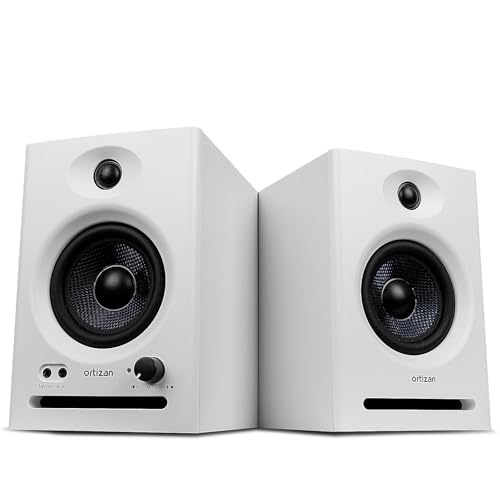
This white variant mirrors the dual-mode design and input flexibility of the black version, offering similar 2.0 stereo performance with Bluetooth 5.3 and a 24-bit DAC for cleaner digital audio. The 3.5-inch carbon fiber speaker and silk tweeter arrangement emphasizes clarity across a range of studio tasks, from critical listening to casual media consumption.
PreSonus Eris 3.5BT Studio Monitors

DOUBLE-HEADED PERFORMANCE. The 3.5BT variant adds Bluetooth 5.0 for convenient wireless playback while maintaining the same studio-oriented traits: accurate sound, compact size, and 50W total amplification. This makes it a versatile choice for small studios that require both wired accuracy and wireless listening options.
JBL 305P MkII 5″ Monitors

JBL 305P MkII delivers crystal-clear imaging with the patented Image Control Waveguide for a wide sweet spot. Powered by dual 41-Watt Class-D amplifiers, these monitors offer deep bass through a 5-inch woofer and enhanced low-end reach via the Slip Stream port. Their balance and imaging make them a strong choice for music production and podcasting in near-field setups.
M-AUDIO BX3 Studio Monitors

BX3 monitors provide 120W of output in a compact design with 3.5″ Kevlar drivers and 1″ silk dome tweeters. They feature a front-ported design, rear ports for extended bass, and a built-in acoustic optimization for precise imaging. A computer-optimized tweeter waveguide helps align sound for digital workstations, gaming, and streaming.
Edifier MR4 Powered Studio Monitors
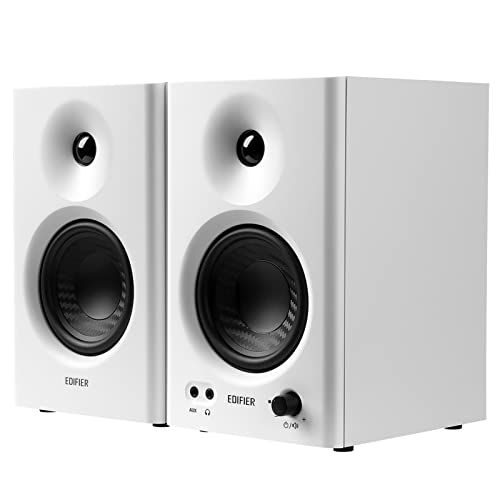
Edifier MR4 monitors offer a near-flat response and a 4″ woofer complemented by 1″ silk dome tweeters. An MDF cabinet minimizes resonance, helping to reveal accurate detail. Flexible input options include balanced TRS, RCA, and AUX, plus a front headphone jack for silent monitoring in compact studios.
Buying Guide: Key Purchase Considerations
- Size and room compatibility: Near-field monitors excel in small to medium spaces. Opt for 3″ to 5″ woofer sizes to balance bass output with room acoustics.
- Connectivity: Look for a mix of TRS, XLR, RCA, and AUX inputs to interface with audio interfaces, mixers, computers, and consumer devices.
- Bias toward accuracy: Monitors labeled as near-field or reference are designed for flat, honest sound rather than boosted bass or bright treble for general listening.
- Sound tuning features: Some models offer tone controls or adjustable high/low shelving to tailor the response to your room and taste.
- Build and isolation: A sturdy MDF cabinet with proper acoustic isolation reduces unwanted resonances, improving mix translation across playback systems.
- Active vs. passive: All options here are powered (active) monitors, which simplifies setup by combining amplification and drivers in a single box.
- Budget and upgrade path: If you anticipate growing your studio, consider a monitor with a wider sweet spot or compatibility with subwoofers for low-end extension.
- Room treatment: Regardless of monitor choice, acoustic treatment (diffusers, absorbers, bass traps) enhances accuracy and translation across listening environments.