Answering the most common buyer question: which speaker cables best suit a guitar amp setup? This guide highlights five solid options that balance durability, signal integrity, and ease of use for guitar players. Best for home practice, stage rigs, and studio work, these cables offer sturdy construction, low noise, and compatibility with 1/4″ guitar amp outputs. The list includes models tuned for clean signal transfer and reduced interference. Below is a quick reference table of the chosen products to compare key specs at a glance.
| Product | Brand | Length | Key Benefit |
|---|---|---|---|
| Ernie Ball Speaker Cable, 3 ft | Ernie Ball | 3 ft | High-purity copper, durable dual-stranded 16 AWG |
| Pig Hog PHSC5, 5 ft | Pig Hog | 5 ft | High-performance 14 AWG, robust rubber jacket |
| GLS Audio 6 ft, 1/4″ to 1/4″ | GLS Audio | 6 ft | Premium materials, flexible rubber jacket |
| AA AUDIO ACCESSORY 3.3 ft, 12 AWG | AA AUDIO ACCESSORY | 3.3 ft | Triple shielding, silver solder, high-purity copper |
| KOMITASUI 3 ft, 12 AWG | KOMITASUI | 3 ft | 12 AWG heavy-duty for high power, gold-plated jacks |
Ernie Ball Speaker Cable, Straight/Straight, 3ft

The Ernie Ball 3 ft speaker cable uses 99.99% oxygen-free copper and dual-stranded 16 AWG conductors. This construction minimizes resistance and corrosion, which helps preserve guitar amp signal integrity over short to medium runs. Best for players needing a compact, reliable patch cable from amp to cabinet. Limitations: longer runs may benefit from thicker gauge to reduce potential losses. Ideal for small setups or pedalboards with compact amps.
Pig Hog PHSC5 High Performance 14 Gauge 9.2mm 1/4″ Cable, 5 Ft

Pig Hog PHSC5 offers a high-performance 14 AWG conductor with an 8mm rubber outer jacket. The thicker gauge helps maintain signal strength for longer runs or more demanding amps, making it a solid choice for small to mid-sized stages and practice rooms. Choose this if you prioritize durability and robust shielding. Caution: the 5 ft length may be less flexible in tight setups compared with shorter cables.
GLS Audio Speaker Cable 1/4″ to 1/4″ 6 Ft

GLS Audio uses premium copper with a flexible 10.5 mm rubber jacket. The cable is designed to last in high-use environments and suits guitar or bass amps connected to cabinets. Best for players needing reliable 1/4″ to 1/4″ connectivity with a balance of flexibility and durability. Limitation: some users may prefer thicker gauge for longer runs.
KOMITASUI Professional 3 Ft 12 Gauge TS Cables
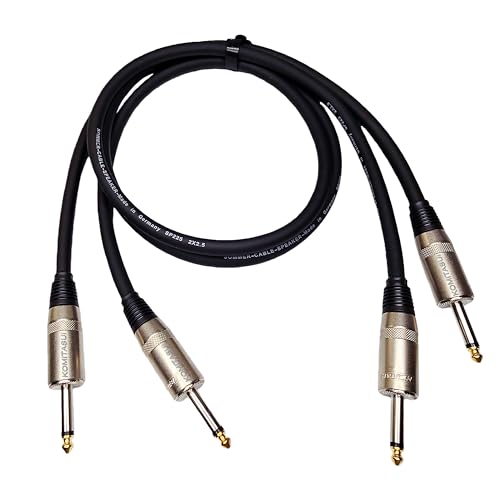
KOMITASUI provides a rugged 12 AWG design with premium 1/4″ TS connectors, rated for high-power applications. The 3 ft length is ideal for direct amp-to-cabinet connections in louder setups or studio patches. Best for high-output gear, but note the heavier gauge may be less flexible in tight spaces. A solid choice when signal fidelity and power handling are priorities.
Buying Guide
What to look for when choosing a guitar amp speaker cable?
- Conductor gauge: Heavier gauges (12–14 AWG) carry more power with reduced resistance, useful for longer runs or high-wattage amps. Lighter gauges (16 AWG) work well for short patch runs with minimal loss.
- Shielding: Multi-layer shielding (foil plus braid) minimizes hum and interference, especially in venues with ambient noise or nearby electrical gear.
- Connectors: Ensure 1/4″ TS connectors are gold-plated or corrosion-resistant for longevity and stable contact.
- Jacket durability: Rubber or rubber-like jackets offer flexibility and abrasion resistance, suitable for stage use and road trips.
- Length vs. flexibility: Shorter cables are easier to manage; longer cables reduce signal loss only when the gauge supports it.
- Usage context: For home practice, a compact patch cable may suffice; for live performances, a rugged, shielded, and high-power-rated cable is preferable.
Frequently Asked Questions
- What gauge should I use for a guitar amp to cabinet setup?
Answer: For short runs, 16–14 AWG is common; for longer runs or higher power, 12–14 AWG is preferable to reduce resistance and maintain signal quality. - Is shielding important for guitar amp cables?
Answer: Yes, triple or multi-layer shielding helps prevent hum and interference, especially in live venues or crowded studios. - Can I use any 1/4″ cable with a guitar amp?
Answer: Yes, as long as the connectors are compatible; for best results, use cables designed for instrument-level signals and speaker-level connections as appropriate. - Should I avoid certain materials?
Answer: Cheaper cables with thin jackets and poor shielding can introduce noise and wear out quickly; look for copper conductors with solid shielding and durable jackets. - What is the advantage of heavier gauge cables?
Answer: Heavier gauge cables handle higher wattage with less resistance, supporting clearer signal at louder volumes and longer distances. - Are gold-plated connectors necessary?
Answer: They resist corrosion and can improve long-term contact reliability, especially with frequent plug-in and unplug cycles.