In compact studios and on-the-go setups, small MIDI controllers offer essential keys, pads, and knobs without crowding your workspace. This guide highlights five compact options, focusing on portability, velocity-sensitive keys, and practical DAW control. Each product is evaluated for ease of use, software compatibility, and standout features that help you produce, layer sounds, and perform with confidence.
| Product | Key Feature | Best For | Notes |
|---|---|---|---|
| Akai MPK Mini MK3 | 25 mini keys, 8 pads, 8 knobs, NKS integration | Beat production and virtual synth control | Compact classic with robust software ecosystem |
| Donner N-25 Mini MIDI | 25 velocity-sensitive keys, 4 banks, arpeggiator | Beginner-friendly setup | Great value for learning basics |
| Donner DMK 25 Pro | 25-key mini controller, OLED display, scale modes | Hip, versatile scales for portable rig | Smart scale features aid playability |
| Akai LPD8 | 8 RGB drum pads, 8 assignable knobs | Beat making and launching clips | Ideal for hardware-like control |
| Akai LPK25 | 25-key mini controller, arpeggiator | Expressive melodic writing | Simple, USB-powered |
Akai MPK Mini MK3 25 Key USB MIDI Keyboard Controller

The MPK Mini MK3 is a compact USB-powered MIDI controller with 25 mini velocity-sensitive keys, 8 backlit drum pads, and 8 assignable knobs. It supports virtual synthesizer control and beat production, making it a versatile option for small studios. A notable feature is the four-way thumbstick for dynamic pitch and modulation, plus a built-in arpeggiator with adjustable resolution and modes. Native Kontrol Standard (NKS) integration lets users Kontrol from within supported software installations, streamlining workflow for producers who rely on NI libraries and plugins.
Akai MPK Mini MK3 (Black) 25 Key USB MIDI Keyboard Controller
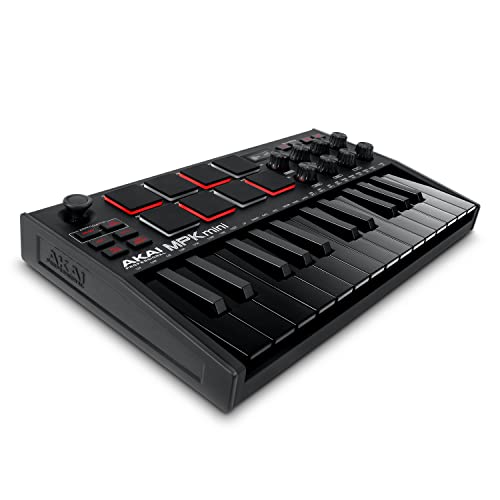
This second MPK Mini MK3 listing reinforces its compact design and core features: 25 velocity-sensitive keys, 8 backlit pads, 8 knobs, and NKS integration for a streamlined workflow with Native Instruments. The included software and sound package enhance immediate usability for beginners and seasoned producers alike. Its lightweight form factor supports mobile rigs and limited desk space, while the 4-way thumbstick adds hands-on control for expressive playing and sound shaping.
Donner N-25 Mini MIDI Keyboard

The Donner N-25 is a compact 25-key MIDI keyboard designed for beginners. Its velocity-sensitive keys enable expressive playing, while the 4 user-programmable banks provide practical preset organization. The device supports Mac, iOS, and PC connections via USB-MIDI and can connect to iPhone or iPad apps with an OTG adapter, offering versatility for mobile setups. Arpeggiator, sustain, octave, and tap tempo features add essential production tools without overwhelming new users.
Donner DMK 25 Pro USB-C MIDI Keyboard Controller

The DMK 25 Pro expands on the compact format with features like OLED display and Smart Dynamic Scale Mode, offering 16 scale tones to simplify playing across genres. Its real-time multi-mode control includes arpeggio and chord functions, enabling on-the-fly creativity. Aimed at creators who want portable performance with more musical flexibility, this controller stands out for its scale-aware playing and straightforward DAW integration across devices.
Akai LPD8 USB MIDI Controller

The LPD8 focuses on hands-on control with 8 RGB drum pads and 8 assignable Q-Link knobs for DAW parameter mapping. Its compact design is ideal for beat makers and performance setups, where tactile control over samples, effects, and virtual instruments is beneficial. The device includes preset mappings that quickly recall configurations for different projects, aiding workflow efficiency in small studios.
Midiplus AKM320 MIDI Keyboard Controller

The AKM320 offers a 32-note velocity-sensitive keyboard with pitch and modulation wheels. It includes octave and transpose controls, plus sustain support. USB connectivity enables easy computer integration, making it a practical option for users who want a slightly larger mini keyboard feel. While not feature-packed, its straightforward design suits entry-level producers seeking a basic, portable controller.
Akai LPK25 – USB MIDI Keyboard Controller

The LPK25 is a 25-key mini controller designed for expressive songwriting and melody creation. It includes an arpeggiator and a built-in clock for syncing with software instruments and DAWs. A sustain button adds expressive options for performances and arrangements, all powered via a single USB connection. This model emphasizes portability and simplicity for quick setup and playability.
Buying Guide: Key Purchase Considerations for Small MIDI Controllers
- Key size and feel: Decide between full-sized versus mini keys. Mini keys save space but may require an adjustment period for players with larger hands.
- Keys, pads, and knobs: Consider the balance of keys for melody, pads for drum programming, and knobs for real-time parameter control. Also check the quality and sensitivity of pads.
- DAW and software compatibility: Look for controllers with robust DAW integration and bundled software that matches your workflow, including arpeggiators and scale features for easier playability.
- Connectivity: USB-powered models are convenient for laptops and on-the-go use. Some may offer USB-C, Bluetooth, or iOS compatibility—evaluate what fits your setup.
- Portability vs. features: If space is the main constraint, prioritize compact form factors. If you perform live, consider battery or wireless options and robust build quality.
- Arpeggiator and scale features: Arpeggiators and scale modes can simplify complex melodies and genre switching, especially for beginners or quick idea capture.
- Expansion and future use: Check if the device supports expansion via software libraries or NI/NKS ecosystems, and whether it can grow with your production needs.
- Price-to-value: Compare build quality, key/pad/knob count, and included software to determine the best value for your budget and goals.