Looking for a reliable scientific calculator for physics? This guide highlights five top choices ideal for solving physics problems, from algebraic manipulation to graphing and advanced calculations. Each option is evaluated for clarity, ease of use, and suitability for different study levels—whether you’re a high school student, college major, or working professional. Read on to find the right model for you and compare key capabilities at a glance.
| Product | Best For |
|---|---|
| Texas Instruments TI-30XS MultiView Scientific Calculator | Everyday physics problems, fractions and scientific notation |
| Texas Instruments TI-84 Plus CE Color Graphing Calculator | Graphing, data visualization, complex equations |
| Casio fx-115ES Plus 2nd Edition | Advanced functions, natural textbook display |
| Texas Instruments TI-36X Pro Engineering/Scientific | Academic coursework with non-graphing requirement |
| CATIGA CS-121 Scientific Calculator with Graphic Functions | Graphing and multi-mode calculations in one |
Texas Instruments TI-30XS MultiView Scientific Calculator

The TI-30XS MultiView is a compact, non-graphing scientific calculator designed for clear, multi-step calculations. It offers a dedicated MathPrint mode that displays fractions, exponents, and square roots in standard notation, along with the ability to view calculations in common math notation on one screen. This model is best for students and professionals who want a straightforward device for quick physics computations, unit conversions, and pattern checks without graphing features.
Best for: students or professionals who need reliable scientific functions with multiple-entry views and quick fraction/decimal toggling. The device supports entering more than one calculation to compare results on the same screen, which helps verify physics problem steps. Caution: it lacks graphing and advanced statistical tools, so not ideal for coursework requiring visualization or large data sets.
Texas Instruments TI-84 Plus CE Color Graphing Calculator, Black
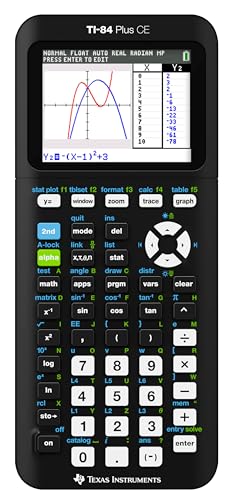
The TI-84 Plus CE is a high-resolution color graphing calculator with a rechargeable battery and a bright backlit display. It supports horizontal and vertical split-screen modes, preloaded apps, and interactive zoom features. This model is well-suited for physics courses that require graphing, data analysis, and visual interpretation of equations or experimental results. Best for: physics students who need graphing capabilities, dynamic visualization, and a broader app ecosystem. Limitation: it may be more advanced than necessary for basic physics tasks and requires more storage and power management.
Texas Instruments TI-30XIIS Scientific Calculator

The TI-30XIIS continues TI’s legacy of reliable scientific calculations with a 2-line display showing the entry and result simultaneously. It handles 1- and 2-variable statistics, and includes multiple angle modes (degrees, radians, grads) plus scientific and engineering modes. It’s a solid pick for physics coursework requiring statistical calculations and angle measurements. Best for: students needing a robust, no-frills scientific calculator with clear statistics capabilities. Caution: lacks graphing features for visual physics problems.
Casio fx-115ES Plus 2nd Edition

The Casio fx-115ES Plus 2nd Edition is an advanced scientific calculator featuring more than 280 functions and NATURAL TEXTBOOK DISPLAY℠. It handles complex number calculations, linear regression, integrations, permutations, and combinations. It is ideal for physics students and professionals dealing with calculus, statistics, and engineering concepts where textbook-style input and results improve comprehension. Best for: physics coursework requiring extensive mathematical operations and a natural input/output format. Caution: some users may prefer a dedicated graphing model for visualization tasks.
Texas Instruments TI-36X Pro Engineering/Scientific Calculator

The TI-36X Pro is designed for curricula where graphing technology isn’t permitted, yet students require multi-functional scientific calculations. The MultiView display shows multiple calculations simultaneously and MathPrint presents math expressions as they appear in textbooks. This model is best for exams and courses that restrict graphing while still needing high-quality scientific computation. Best for: exam environments or courses with graphing restrictions. Caution: lacks graphing and higher-level calculus features found in graphing models.
CATIGA CS-121 Scientific Calculator with Graphic Functions

The CATIGA CS-121 combines scientific and graphing capabilities in one device with multiple modes and more than 360 functions. It supports plotting, solving equations, and analyzing graphs—useful for algebra, calculus, and physics visualization tasks. Best for: students needing integrated graphing with a compact form factor. Caution: features breadth can be overwhelming for beginners; consider starting with a simpler non-graphing model if you’re new to calculators.
Buying Guide: Key Considerations for Physics Calculators
- Purpose and coursework: Do you need graphing, statistics, calculus, or a straightforward scientific calculator? Graphing models are great for visualizing physics problems, while non-graphing ones keep things simple for exams.
- Display and input style: Natural textbook display helps interpret fractions, equations, and constants quickly. Multi-line displays assist with entering long expressions and checking intermediate results.
- Power and duration: Rechargeable batteries reduce battery waste and maintenance. Check if a model ships with USB charging or replaceable batteries.
- Math and science capabilities: Ensure the calculator supports essential physics operations—scientific functions, trigonometry, logarithms, exponents, fractions, and unit conversions. For advanced topics, look for linear algebra, calculus, and statistics support.
- Exam compatibility: Some courses restrict graphing calculators. If you need a device for exams, consider TI-36X Pro or TI-30XS MultiView for non-graphing requirements, or verify institution guidelines.
- User interface and ergonomics: A comfortable keypad layout with responsive keys reduces input errors during long study sessions or labs.
- Extendability: Preloaded apps or software features can enhance problem-solving, data analysis, and graphing capabilities. Consider devices with easy future upgrades or software access.
FAQ
- What is the best non-graphing calculator for physics basics?
The Texas Instruments TI-30XS MultiView is a strong pick for non-graphing needs, offering clear math notation, multi-entry view, and useful fraction-to-decimal toggling for core physics calculations.
- Which calculator is best for graphing physics problems?
The TI-84 Plus CE Color Graphing Calculator provides high-quality graphing, color display, and preloaded apps suited for data analysis and visualization in physics coursework.
- Do I need natural textbook display for physics?
Natural Textbook Display℠, found on Casio fx-115ES Plus 2nd Edition and fx-300ES, makes input and interpretation easier by showing fractions, roots, and equations as in textbooks, which helps reduce entry errors in physics problems.
- Are graphing calculators allowed on exams?
Some exams restrict graphing calculators. If graphing is not allowed, consider non-graphing TI-36X Pro or TI-30XS MultiView as alternatives to stay compliant while still handling physics calculations.
- Which calculator supports advanced statistics and calculus?
Casio fx-115ES Plus 2nd Edition and Casio fx-300ES Plus offer extensive functions, including calculus, regression, and statistics, suitable for physics data analysis and lab work.
- Is a rechargeable calculator better for frequent use?
Rechargeable models like TI-84 Plus CE reduce battery maintenance, especially in long study sessions or labs. For portability, consider models with USB charging and efficient power use.