Finding a reliable scanner for books means balancing page flattening, OCR accuracy, and speed. The following selections focus on bound-page capture, glare reduction, and broad compatibility with Windows and macOS. This guide compares five standout models to help you choose a device that fits your reading room, library, or archival workflow.
| Product | Brand | Key Benefit |
|---|---|---|
| CZUR Aura Pro Book & Document Scanner | CZUR | Fast page scans with AI lighting and foldable portability |
| CZUR ET MAX Professional Book Scanner | CZUR | High-resolution 38MP sensor with curved-page flattening |
| CZUR ET24 Pro Professional Book Scanner | CZUR | Advanced flattening, 24MP camera, broad OS support |
| CZUR Aura Pro Portable Book Scanner | CZUR | Portable A3 scanner with laser-like flattening and AI processing |
| ScanSnap SV600 Overhead Book Scanner | ScanSnap | Archival-grade overhead scanning without unbinding |
Each option below highlights core capabilities, from page flattening to OCR support, to help you assess performance for your book collection, journals, or bound documents. The focus is on devices designed for books and thicker pages, with careful attention to image quality, speed, and cross-platform compatibility.
CZUR Aura Pro Book & Document Scanner

The Aura Pro combines foldable portability with AI-based processing to optimize book scanning. It supports A3 and A4 sizes and delivers rapid two-second-per-page scans. Output formats include JPG, Word, PDF, and searchable PDFs, which streamlines digital archiving. The built-in smart lamp provides glare-free illumination with four color-temperature settings. The CZUR APP controls functions such as auto-flattening and page-turn detection, reducing manual handling during sessions. A straightforward, wired setup avoids Wi-Fi requirements, enhancing privacy and reliability.
Compatibility spans macOS and Windows, covering modern systems with broad driver support. The device’s glare-reducing features help when scanning glossy covers and dark text on light backgrounds. Given its compact foldable design, Aura Pro is well-suited for students, researchers, and small libraries that need efficient desktop scanning without sacrificing image quality. The combination of speed, accuracy, and portability makes it a strong all-around option for book scanning tasks.
CZUR ET MAX Professional Book Scanner

The ET MAX steps up with a 38MP CMOS sensor delivering high-resolution captures at 7168 × 5376 pixels and 410 DPI. Its patented curve-flattening technology automatically removes page curvature, producing distortion-free scans without unbinding the book. The scanner supports OCR in 180+ languages, converting images to Word, Excel, and searchable PDFs. While robust, the OCR excludes Thai, Arabic, and Hebrew, so language expectations should match content. This model excels for archival projects with bound volumes and language-rich documents that require precise digital reproduction.
Designed for cross-platform use, ET MAX interfaces well with Windows, macOS, and Linux, enabling flexibility in diverse work environments. The combination of high detail, effective flattening, and comprehensive OCR makes ET MAX ideal for libraries, academic institutions, and professional researchers seeking near-print-level scans from bound sources. It’s especially suitable when page curvature is a major challenge and accuracy is paramount.
CZUR ET24 Pro Professional Book Scanner
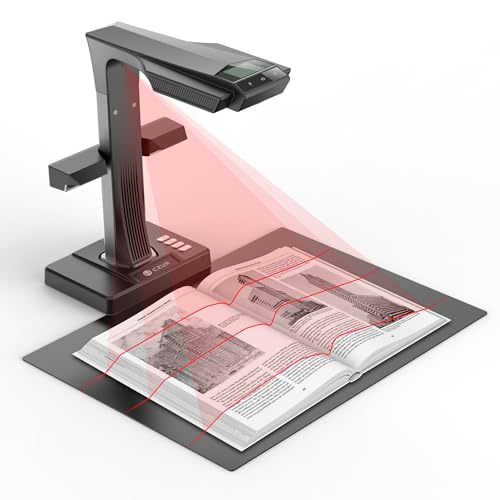
The ET24 Pro focuses on advanced flattening and a 24MP camera with 320 DPI native resolution to capture sharp, detailed pages. It supports 180+ languages via OCR and handles A3 documents, making it suitable for browsing theses, journals, and large reports. The camera upgrades improve image clarity and reduce glare, although very glossy pages may still challenge some setups. Linux users can benefit from broader system support, in addition to Windows and macOS. ET24 Pro emphasizes a balance between speed and quality for mid-to-large format book scanning needs.
Flattening technology is core to its design, with post-processing steps that reduce distortion after pixel transformation. The combination of fast scanning with efficient processing helps expedite long scanning sessions. For institutions or individuals where quick, large-page captures matter, ET24 Pro offers a compelling blend of features with pragmatic OS compatibility.
CZUR Aura Pro Portable Book Scanner

The Aura Pro Portable emphasizes portability alongside strong flattening capabilities. It uses three laser lines to mimic perfect page flattening, delivering faithful page replication for curved bound pages. The AI-powered software handles image processing, simplifying scans and enhancing accuracy. It supports macOS 10.13 or later and Windows XP/7/8/10/11, and it’s designed to be fast—approximately two seconds per page for both single and double-page scans. The included side lights reduce reflections on glossy surfaces, and a foot pedal adds convenience for repeated scans.
Notable is the 2-second-per-page speed, making Aura Pro a practical choice for researchers, students, and hobbyists who need a compact unit for occasional, rapid batch scans. While it’s optimized for A3 and smaller tasks, it remains a compelling option when artifact preservation and portability are priorities in a limited workspace.
ScanSnap SV600 Overhead Book Scanner

The ScanSnap SV600 is a long-standing option for overhead book scanning. It’s designed to scan newspapers, magazines, documents, and books without unbinding. A key feature is multi-document detection, which automatically crops and rotates scanned images for efficient batch processing. Auto Book Correction helps flatten and correct curvature, improving overall scan consistency. This model emphasizes hands-free operation and reliable performance for multi-page documents, making it attractive to libraries and archival settings seeking a non-destructive approach.
While ScanSnap SV600 excels at handling a range of document types, its workflow may be less aggressive in flattening very thick bindings compared to dedicated CZUR models. It remains a strong choice where high-volume, steady throughput is essential, and where the overhead scanning approach aligns with existing workflow software and archival standards.
Buying Guide: Key Purchase Considerations
Flattening technology: Look for devices with genuine curved-page flattening to reduce distortion without unbinding. The best models use a combination of hardware (camera, lighting) and software (AI, post-processing) to deliver true-to-page scans.
Resolution and OCR: A higher megapixel sensor yields crisper text and detailed images, which improves OCR accuracy. Consider supported languages and whether the OCR engine integrates with common formats like Word, Excel, and searchable PDFs. Note any language limitations that may affect non-Latin scripts.
Supported formats and software: Ensure output formats include JPG, PDF, and searchable PDF, plus options like Word or Excel if needed. Cross-platform compatibility with Windows, macOS, and Linux expands potential workflows. Some devices pair with dedicated apps for easier control and batch processing.
Page size and book thickness: A3-capable scanners are ideal for larger volumes, while foldable and portable models suit small spaces. Check how the device handles very thick bindings, brittle pages, or glossy coatings, and verify any recommendations regarding paper textures.
Speed and workflow: Rapid scanning accelerates large projects, but speed should not come at the cost of accuracy. Consider whether the device supports auto-detection of page turns, foot-pedal triggering, and batch processing to streamline sessions.
Hardware robustness and portability: If you plan to move the scanner between rooms or buildings, folding designs, light weight, and durable construction matter. Power options, cabling, and noise levels may affect daily use in quiet libraries or classrooms.
Price-to-performance balance: Expensive models deliver higher resolution and more sophisticated flattening, but assess whether the benefits align with your volume, publication types, and archival goals. For casual use, mid-range models often suffice and provide reliable results.
Final considerations: If your library or archive includes many languages or mixed scripts, ensure the OCR supports the target languages. For very glossy or dark pages, verify lighting and anti-glare features to minimize reflections. Finally, confirm OS compatibility and whether Linux, macOS, or Windows is preferred for your setup.