Answering your room lighting needs with motion sensors helps save energy while guiding you through dark hallways or bathrooms. The top picks below are suited for different buyers: homeowners seeking plug-in convenience, renters avoiding wiring, and tech lovers who want adjustable color and brightness. Below is a quick summary to compare options.
| Product | Best For | Key Benefit | Limitations |
|---|---|---|---|
| AUVON Plug-in LED Backlit Night Light | Common hallways and bedrooms | Diffuse backlight; dusk-to-dawn + motion modes | Requires plug-in outlet |
| L LOHAS LED Motion Sensor Night Light | Simple, reliable ambient light | Two brightness levels; three modes | Basic feature set |
| EZVALO Motion Sensor Wall Light | Modern, flexible installs | Rechargeable, no wiring; RGB and CCT | Wireless with magnetic mount |
| DAZZY DOT Motion Sensor Night Light (3 Pack) | Budget-friendly multi-pack | Ultra-thin, long runtime, magnetic | Smaller beam, needs charging |
| Lyridz LED Plug-in Night Light with 360° Motion Sensor | Wide coverage and dimming control | 360° sensing; wide brightness range | Plug-in only |
AUVON Plug-in Night Light With Motion Sensing
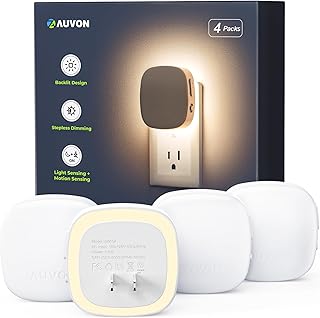
Best for: bedrooms, bathrooms, and hallways where a soft, diffuse glow is preferred. This model uses 16 LEDs to create a uniform backlit effect that reduces direct glare. The auto on/off functions save energy by activating only when motion is detected in low light, while a separate dusk-to-dawn mode handles nighttime illumination automatically. It’s well-suited for light-sensitive users who want consistent, gentle illumination without harsh lighting.
Why selected: The diffuse backlight design helps prevent eye strain and insomnia for sensitive sleepers. The dual sensor modes (motion and dusk-to-dawn) provide flexible operation that adapts to different times of day and room usage.
Caution: The auto-on timing is 60 seconds of inactivity in motion mode, which may feel slow in very busy spaces. Also, placement matters; install where the sensor can clearly detect movement within 3–5 meters and a 120° arc.
L LOHAS Motion Sensor Night Light

Best for: households wanting straightforward brightness control and reliable motion sensing. It offers two brightness levels and three modes, including an always-on option for continuous low light. The 3000K warm white glow provides comfortable, glare-free illumination for bedrooms and bathrooms.
Why selected: The combination of two brightness levels and a simple 3-mode system makes it easy to tailor lighting to a room’s needs without a complicated setup. It’s a good balance of function and simplicity for most families.
Caution: Brightness is fixed to 30 or 60 lumens; if you need very high illumination, this model may feel dim for larger spaces. Sensor range and angle are typical but can vary by outlet placement and wall material.
EZVALO Motion Sensor Wall Light

Best for: renters or quick installs where wiring isn’t feasible. This rechargeable, wireless LED sconce uses a peel-and-stick magnetic mount for fast setup and removal. It supports multiple color temperatures and RGB for ambient lighting. Ideal for living rooms, hallways, and bedrooms seeking flexible mood lighting.
Why selected: No drilling or wiring reduces installation time and damage. The 5–6 feet mounting suggestion helps optimize sensor coverage and light direction.
Caution: Detection distance and color options may influence how bright the space feels. The magnetic mount relies on a clean surface for best adhesion, and battery life will vary with usage and color settings.
DAZZY DOT Motion Sensor Night Light

Best for: small spaces where ultra-thin design matters, such as bathrooms, closets, and nightstands. The 0.57-inch thickness makes it highly space-efficient. It features USB-C rechargeability and auto-off after 30 seconds, which helps conserve energy and reduces maintenance.
Why selected: The ultra-thin profile and rechargeable design make it ideal for renters and travelers who need a compact, portable option. The magnet and thin form factor simplify placement on metal surfaces or thin walls.
Caution: The light’s narrow beam pattern may be less suitable for large rooms or corridors requiring broader illumination. Battery life depends on brightness level and usage patterns.
Lyridz LED Plug-in Night Light With 360° Motion Sensor

Best for: wide-path navigation where coverage in all directions matters, such as hallways, stairs, and entryways. The 360° motion sensing and wide dimming range (1–150 lm) provide flexible control. It retains last brightness setting for convenience.
Why selected: The 360° sensing plus dual up-and-down light emission helps illuminate paths thoroughly and evenly. Dimmable control supports customizing brightness to comfort levels and energy savings.
Caution: Being a plug-in device, it requires an outlet near the area you want lit. Sensor performance can vary with walking direction and room layout, so test placement for reliable activation.
Buying Guide: Motion Sensor Lights For Rooms
- Energy efficiency vs. brightness: Decide between auto-on energy-saving modes and higher brightness for larger spaces. Look for adjustable brightness and auto-off timers to suit your routine.
- Power source and installation: Choose plug-in models for quick setup, or rechargeable/wireless options for spaces without outlets or renters. Consider mounting options (peel-and-stick, magnetic, or traditional screws).
- Sensor range and light sensor features: A wide detection angle (110°–120°) and reach (3–5 meters or more) reduces dead zones. Dusk-to-dawn sensors automatically adapt to ambient light levels for day/night use.
- Light color and glare: Warmer temps (2700–3000K) create cozy spaces; brighter whites (4000K–5700K) are better for task areas. Look for diffuse backlighting to minimize glare in bedrooms and nurseries.
- Durability and usage: For high-humidity rooms (bathrooms, kitchens), choose lights with suitable IP ratings and robust construction. For kids’ spaces, select glare-free lighting with soft diffusion.
FAQ
- Q: Do motion sensor night lights need to be plugged in? A: Most models shown are plug-in, with some rechargeable wireless options for flexible placement.
- Q: How do dusk-to-dawn and motion sensors work together? A: Dusk-to-dawn sensors turn the light on in dark conditions, while motion sensors trigger lighting when movement is detected; many units combine both to automate operation.
- Q: What is the typical motion sensing range? A: Most units detect motion within 3–5 meters and at angles around 120°; results vary by room layout and sensor placement.
- Q: Can these lights be dimmed? A: Some models offer multi-level brightness (5–150 lumens) and stepless dimming via touch or remote controls, while others provide fixed levels.
- Q: Are these lights suitable for renters? A: Yes, wireless or magnetic-mount options and peel-and-stick installations minimize wall modification.
- Q: Do they work in all rooms? A: They’re broadly suitable for bedrooms, bathrooms, hallways, kitchens, and stairs, but consider space size and desired brightness to choose the right model.