RF HD modulator devices let you connect HDMI, AV, and other digital sources to legacy TVs or CATV systems. This guide reviews five top options, highlighting how they handle NTSC/PAL formats, channel selection, and ease of use. Use this overview to compare compatibility, setup, and performance for game consoles, DVD players, streaming boxes, and CCTV systems.
Summary of selected products:
| Product | Brand | Key Use | Format & Output |
|---|---|---|---|
| HDMI to RF Modulator (HDM61) | VQP | HDMI source to RF TV | NTSC; CH3/CH4; 1080P/1080i/720P/480p |
| M65A‑NTSC RF Modulator | ASHATA | AV output to RF coax | NTSC; VHF; plug & play |
| RF Modulator (CIMPLE CO) | THE CIMPLE CO | RCA to RF coax for legacy TVs | NTSC; CH3/CH4 |
| HDM66 HD Modulator | Flylin | HDMI to RF, PAL/NTSC | NTSC/PAL; VHF/UHF |
| HDMI RF Modulator (HDMI to RF) | AoeSpy | HDMI or AV to RF output | NTSC/PAL; VHF/UHF; adjustable channel |
HDMI to RF Modulator, VQP HDM61

VQP’s HDMI to RF Modulator converts HDMI signals into RF for legacy TV sets and CATV systems. It provides NTSC format output with CH3 at 61.25MHz and CH4 at 67.25MHz, supporting multiple resolutions including 1080P, 1080i, and 720P. The device uses 1080P PLL control to align RF output frequency, ensuring stable transmission of HD content over coax. It accepts HDMI input and RF input/output for flexible connections, and lists broad compatibility with PCs, game consoles, cameras, DVD players, CCTV, DVRs, and more. This makes it suitable for retro gaming setups or home entertainment hubs that rely on older television infrastructure.
Key considerations: Ensure your display supports NTSC channels 3 or 4, verify that your source device can output at your target resolution, and confirm that your cabling supports RF transmission without significant signal loss over distance.
Digital RF Modulator M65A‑NTSC

ASHATA’s M65A‑NTSC RF Modulator is designed for CATV systems, offering a practical, plug-and-play option with stable PLL-controlled VHF frequency operation. It supports A/V input with RF output and allows selectable NTSC channels. The device emphasizes ease of use—no driver installation required—making it a convenient choice for users who want to convert AV sources to RF with minimal setup. This model suits home theater enthusiasts who want to run legacy equipment (VCRs, DVD players, cameras) through a single RF modulator into a traditional TV or coax-based system.
Key considerations: Confirm the RF channel availability used by your existing setup, check compatibility with your AV sources, and assess whether you need multiple channel options or a fixed channel for simple operation.
RCA Modulator, THE CIMPLE CO RF Modulator

THE CIMPLE CO RF Modulator focuses on converting RCA composite outputs to RF coax for channels 3 or 4 in NTSC. It includes a complete package with the converter box, power supply, and RCA A/V cable, making setup straightforward for turning legacy devices into a single RF channel feed. Note that it does not convert RF back to RCA, so it is best used as a one-way bridge from AV devices to a TV with RF input. This can be ideal for DVD players, VCRs, and older game consoles connected to an RF-capable TV or a distribution system.
Key considerations: Be mindful of one-way conversion, ensure your device’s output matches RCA A/V format, and verify compatibility with your television’s RF tuner settings.
HDM66 HD Modulator, Flylin

Flylin’s HDM66 HD Modulator offers NTSC and PAL output with RF modulation for home CATV systems. It supports HDMI input and includes PLL-based control of the VHF operating frequency, enhancing signal stability for HD content transmitted via RF. The device emphasizes portability and ease of use with plug-and-play operation, and lists compatibility with HDMI 1.3 and HDCP 1.3. This makes it a versatile option for households that mix modern streaming devices with older TVs and CATV setups, particularly in regions using both NTSC and PAL formats.
Key considerations: If you need PAL compatibility, ensure the unit’s output settings match your region. Consider channel planning if you have multiple RF devices sharing a coax network.
HDMI RF Modulator, AoeSpy
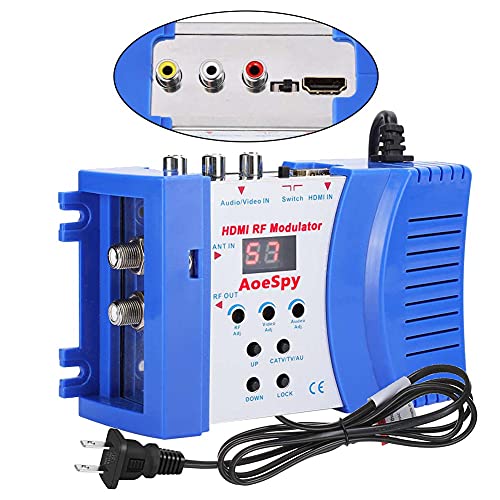
AoeSpy’s HDMI RF Modulator provides a robust bridge from HDMI sources to RF coax outputs, suitable for TVs, set-top boxes, and older display equipment. It supports HDMI input alongside RCA CVBS inputs, with RF output that covers NTSC and PAL formats, offering VHF and UHF channel ranges. The unit features a channel switch for compatibility with existing AV configurations and does not require drivers. It is designed to work with streaming devices like Apple TV, Fire TV, Roku, and gaming consoles, delivering an easy upgrade path to legacy TV systems without sacrificing modern HDMI content.
Key considerations: Ensure the HDMI source supports your desired resolution, check whether you will use VHF or UHF channels, and verify that your older TV or tuner can receive the selected channel through RF input.
Buying Guide: Key Purchase Considerations
- Input and Output Formats: Match your source device (HDMI, RCA/composite) with the modulator’s inputs, and ensure the RF output is compatible with your TV or CATV system (NTSC or PAL as applicable).
- Channel Selection and Stability: Check whether the device offers fixed channels (3 or 4) or selectable channels, and consider PLL control for stable frequency output.
- Regional Compatibility: NTSC is common in the US, but PAL support is essential for some regions. Confirm the device supports both formats if you operate across areas.
- Ease of Use: Look for plug-and-play designs with minimal configuration, especially if you are integrating with older equipment.
- Device Longevity and Build: Durable plastics and clear labeling on channel switches help with long-term reliability in home or workshop environments.
- Signal Quality and Distance: Modulators can introduce signal loss over long coax runs. Plan for short, direct runs or use quality coax to minimize degradation.
- One-Way vs. Two-Way: Some modulators only convert AV to RF (not reverse). Verify bidirectional needs if you require feedback or two-way communication.
- Compatibility with Modern Devices: If you plan to connect game consoles or streaming devices, ensure the modulator supports HDMI input and handles HD resolutions without downscaling issues.
- Power and Accessories: Ensure the included power adapter and cables align with your setup, especially if you have constrained power outlets or require a compact footprint.
- Price-to-Value Balance: Compare feature sets like channel flexibility, PAL/NTSC support, and ease of use against price. A higher upfront cost may offer greater reliability and longer-term compatibility.