For professionals and enthusiasts alike, choosing the right studio monitors is essential for accurate mixing, mastering, and enjoyable listening. This guide highlights five highly-rated options across popular brands, focusing on near-field performance, color-free sound, and value for home studios. Each selection includes a quick reference to its standout features to help you compare at a glance.
| Product | Brand | Notable Strength |
|---|---|---|
| PreSonus Eris 3.5 | PreSonus | Compact, accurate bass for near-field use |
| Edifier MR4 | Edifier | Flexible inputs with true studio reference sound |
| JBL 305P MkII | JBL | Wide sweet spot with Image Control Waveguide |
| Mackie CR3.5 | Mackie | Tone control for on-the-fly EQ shaping |
| Yamaha HS3 | Yamaha | Classic reference sound with clean low end |
Note: The selections above cover a range of budgets and room sizes, from compact desktop setups to more capable near-field configurations. Each model is designed to translate well across genres, ensuring reliable translation from your DAW to real-world listening environments.
PreSonus Eris 3.5 Studio Monitors

PreSonus Eris 3.5 near-field studio monitors deliver studio-quality, accurate sound suitable for music production, hi-fi listening, or multimedia reference. The 3.5-inch woven-composite woofer provides a tight bass presence, with a clean overall sound. Each speaker is powered by 50 watts of Class AB dual amplification (25W per side), ensuring ample volume without sacrificing tonal balance or clarity. This compact pair is ideal for desktop studios and space-limited rooms where accurate monitoring is essential.
Edifier MR4 Powered Studio Monitors
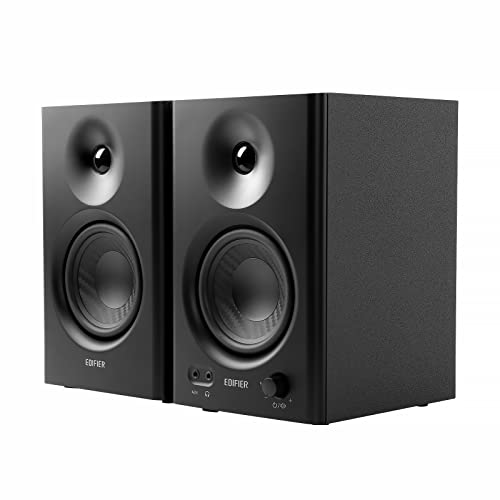
Edifier MR4 provides a true studio monitor experience with a 1″ silk dome tweeter and 4″ woofer for clear, smooth sound. The MDF cabinet helps minimize resonance, revealing true audio characteristics. Flexible connectivity includes 1/4″ balanced TRS input, RCA, and an AUX input, plus a front headphone output. This makes MR4 suitable for connecting to mixers, computers, or tablets, offering versatile use in home studios and multimedia setups.
Ortizan C7 Dual-Mode Studio Monitors

Ortizan C7 dual-mode near-field monitors combine wired and wireless versatility. They include RCA inputs for traditional connections and Bluetooth 5.3 for wireless playback, making them a flexible option for mixed setups. A 3.5″ carbon fiber woofer and a 0.75″ silk dome tweeter deliver clear midrange and smooth highs, paired with a 24-bit DAC for accurate digital conversion. Ideal for creators who want both wired accuracy and wireless convenience.
JBL 305P MkII 5″ Monitors

JBL 305P MkII monitors use a patented Image Control Waveguide to deliver a precise, immersive sound with a broad sweet spot. Each monitor houses dual 41-watt Class-D amplifiers driving a 5″ woofer, delivering dynamic range and deep bass with controlled, honest translation. The combination is well-suited for music production, podcasting, and multimedia projects where critical listening is necessary across a wide listening environment.
Mackie CR3.5 Creative Reference Monitors

Mackie CR3.5 combines studio-grade sound with a built-in tone knob and a location switch, enabling on-the-fly shaping of the bass and presence. It includes TRS and RCA inputs for versatile connections to audio interfaces, playback devices, and gaming systems. A front-mounted headphone output enhances private listening and editing sessions. The tone control helps tailor the response for gaming, casual listening, or detailed music work.
PreSonus Eris 3.5BT Studio Monitors

PreSonus Eris 3.5BT extends the Eris 3.5 lineup with Bluetooth 5.0 connectivity, maintaining the same compact form and Class AB dual amplification. This model emphasizes accurate, tight low end with a clean overall sound and adds wireless flexibility for modern desks. It remains a strong option for desktop studios, multimedia work, and quick setups where wired connections are still needed for professional sources.
Yamaha HS3 Powered Studio Monitor

Yamaha HS3 is a classic reference monitor sized for tight spaces, featuring a 3.5″ woofer and a 0.75″ dome tweeter. The pair delivers a clean frequency response from 70 Hz to 22 kHz, ensuring reliable translation for critical listening and mixing in small rooms. While compact, HS3 remains a widely used option for home studios and educational environments seeking consistent, uncolored sound.
Buying Guide: Key Purchase Considerations
- Room size and listening distance: Near-field monitors are designed for 1–2 meters of listening distance; larger rooms may benefit from monitors with extended low-frequency output.
- Drivers and enclosure: 3–5 inch woofers are common for desktop setups; woven or carbon fiber woofers can affect bass tightness and transient response. Wooden or MDF enclosures help reduce resonance.
- Amplification and headroom: Class AB vs Class D affects heat, efficiency, and depth of control. Higher wattage usually provides cleaner headroom at higher volumes.
- Input options: Balanced TRS, XLR, RCA, and AUX inputs improve compatibility with audio interfaces, mixers, computers, and consumer devices.
- Sound signature and translation: Look for monitors with a neutral or honest midrange, accurate high-end detail, and controlled bass that doesn’t overwhelm the mix.
- Subwoofer considerations: If sub-bass is critical, pair monitors with a suitable subwoofer or choose a model with extended bass capability out of the box.
- Calibration and room treatment: Aural well-being improves with room treatments (acoustic panels, bass traps) and, if needed, room EQ adjustments on some monitors.
- Budget and upgrade path: Starter monitors are valuable for learning the craft; upgrade paths often include brighter or more linear monitors with improved imaging and broader sweet spots.
- Portability and desk setup: Compact designs minimize desk clutter and allow greater flexibility for creative layouts and mobile workspaces.
When selecting rated studio monitors, consider how you’ll use them most frequently—critical mixing, casual listening, or multimedia production—and how they fit your room acoustics. The five options above provide a spectrum of approaches to achieve accurate translation, enabling informed decisions for home studios and small professional setups alike.