Radiation detectors are essential gear for preppers who want to monitor environmental safety, assess potential electromagnetic and nuclear hazards, and respond quickly to changing conditions. This guide highlights five reliable options that balance ease of use with practical data readouts. Each choice targets a different prepper need—daily household EMF awareness, portable nuclear radiation tracking, or fast on-the-move detection—so you can pick the right tool for your scenario. The buyers shown here are best suited for emergency readiness, outdoor exploration, home safety checks, or paranormal investigation contexts where EMF detection is common.
Summary table of selected products:
| Product | |||
|---|---|---|---|
| ERICKHILL 3 in 1 EMF Detector | EMF Meter (EF/MF/RF) | Home, office, paranormal investigations | EF, MF, RF levels with three-color backlight |
| GQ GMC-800 Geiger Counter | Nuclear radiation detector | Ionizing radiation monitoring outdoors or in labs | Beta, Gamma, X-ray with dosimeter and data save |
| POROMETISTO Geiger Counter ND01 | Geiger Counter | Pocket-ready early warning and health protection | Beta, Gamma, X-ray readings with three-color alarms |
| RDINSCOS EMF Detector | 3-in-1 EMF meter | Home and office EMF checks near smart meters | AC magnetic, AC electric, microwave with tri-color LCD |
| APOWER Geiger Counter RD-3 | Geiger Counter | Emergency use and field surveys | Gamma, Beta, X-ray with alarms and color display |
ERICKHILL 3 in 1 EMF Detector

The ERICKHILL RT-100S 3-in-1 EMF Detector provides measurements of Electric Field (EF), Magnetic Field (MF), and Radio Frequency (RF) in one compact device. This model emphasizes quick, easy readings suitable for home safety checks, office monitoring, or outdoor EMF scouting. The device displays all three field strengths on a single screen and uses a color-coded backlight to indicate low, moderate, and high radiation levels. It is particularly well suited for preppers who want fast visibility without complex setup, making it a practical choice for a basic EMF awareness kit.
Best for: Home users, office workers, and paranormal investigators who want straightforward, at-a-glance EMF readings. The absence of complicated configuration makes it suitable for beginners and non-technical users. A potential limitation is that it does not quantify ionizing radiation or provide detailed history data beyond live readings.
GQ GMC-800 Geiger Counter USA Design

The GMC-800 from GQ Electronics is a compact nuclear radiation detector designed for portable, real-time monitoring of ionizing radiation. It covers beta, gamma, and x-ray detection and offers a dosimeter function for real-time and accumulated exposure data. The device emphasizes quick startup, sun-readable display, and multiple function screens that can be navigated with a single button. It is well suited for preppers who want a dedicated nuclear radiation tool with data-saving and transfer capabilities, giving a practical balance of field usability and data visibility.
Best for: Preppers needing a standalone nuclear radiation monitor for outdoor expeditions or home safety checks. Better for those who want a simple, real-time readout with a dosimeter history. Limitation: data transfer relies on a USB-C interface and basic on-device storage; advanced analysis may require external software.
POROMETISTO Geiger Counter ND01

The ND01 Geiger Counter from POROMETISTO is designed for portable radiation detection with a Geiger-Muller tube, capable of sensing beta particles, gamma rays, and X-rays. It provides real-time readings with a three-color alarm system (green for safe, yellow for remind, red for danger). A compact size and a clear LCD screen ensure readability in daylight or low light. This model is suitable for preppers who want a small, on-the-go detector that gives quick hazard indications and simple alarm logic, though its response time is longer than some fast-moving detectors.
Caution: the ND01’s response time can be slower (1–2 minutes) in some scenarios, so it’s best used for spot checks and trend monitoring rather than rapid relocation decisions during an acute radiation event.
RDINSCOS EMF Detector – 3-in-1 EMF Meter

The RDINSCOS EMF Detector offers a 3-in-1 readout for AC magnetic fields, AC electric fields, and microwave sources. It uses a tri-color LCD and audible alerts to help families identify high-EMF areas quickly. The device is lightweight and designed for one-handed operation, making it convenient for quick scans around the home, office, or near smart meters and cell towers. It’s especially suitable for preppers prioritizing immediate EMF awareness over extensive data logging. A limitation is that it does not measure environmental ionizing radiation and thus should be paired with a dedicated nuclear detector for those needs.
Best for: Quick EMF checks in daily spaces and near smart devices. Choose this if you want a simple, portable EMF meter with audible alerts and an easy user experience. Avoid this if you need comprehensive nuclear radiation measurements.
APOWER Geiger Counter RD-3
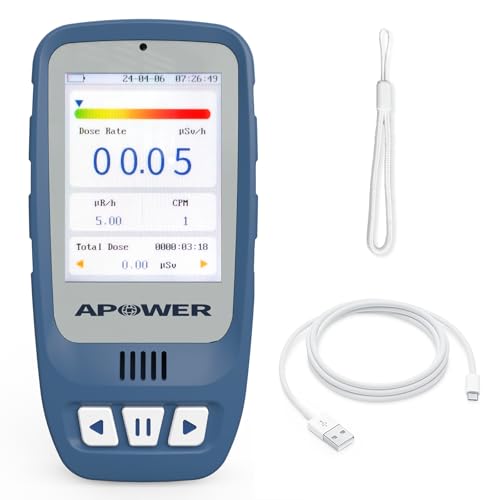
The APPOWER RD-3 Geiger counter is designed for portable, emergency-ready radiation monitoring. It detects gamma, beta, and X-ray radiation and offers a clear LCD display with multiple settings, alarms, and a color-coded readout. This detector emphasizes immediate awareness via audible and visual alarms when radiation levels exceed safe thresholds. It’s well suited for preppers who need a dependable, field-ready device for rapid scans and on-site hazard assessment, with the caveat that the device’s readings can be less precise in highly variable environments compared to higher-end dosimeters.
Best for: Field surveys, emergency preparedness kits, and rapid hazard recognition. Choose this if you want a compact, affordable detector with strong alerting features. Avoid this if you require advanced data logging or isotope identification capabilities.
Buying Guide for Radiation Detectors
What should you consider when choosing a radiation detector for prepping?
- Radiation type: Do you need a detector for EMF (non-ionizing), nuclear radiation (ionizing), or both? Some devices cover EMF only, while others focus on beta/gamma/x-ray detection.
- Portability: Will you carry the device in a backpack or use it around the home? Pocket-sized models are ideal for field use, while larger meters may offer richer displays or more data storage.
- Readout clarity: Color-coded backlights and audible alerts help quick decision-making. Look for models with at-a-glance displays and simple alarms for high-risk readings.
- Data logging and sharing: Do you need real-time data storage, timestamped logs, or easy transfer to a computer or app for trend analysis?
- Power and durability: Consider battery life, recharge options (USB-C is common), and ruggedness for outdoor environments.
- Accuracy and range: Ionizing radiation detectors often specify ranges like μSv/h or mSv; non-ionizing meters may report field strength in V/m or μT. Ensure the device covers the environments you expect to encounter.
- Ease of use: For preppers, a device that requires minimal setup and provides immediate readings is typically more reliable in stressful situations.
- Calibration and standards: Some models reference U.S. or international standards and offer calibration options. If you need precise data, verify calibration capabilities and support.
Frequently Asked Questions
- What is the difference between EMF meters and Geiger counters?
EMF meters measure non-ionizing electromagnetic fields (electric, magnetic, and RF). Geiger counters detect ionizing radiation such as beta, gamma, and X-ray radiation. - Which detector is best for a home safety kit?
A basic EMF meter (for household EMF awareness) plus a portable Geiger counter for ionizing radiation provides broad coverage for most prepper needs. - Can these detectors be used for paranormal investigations?
Some EMF meters are popular in paranormal work due to visual and audible alerts of EMF fluctuations, but results should be interpreted within proper scientific context. - Do these tools require calibration?
Many consumer devices offer simple calibration features or factory calibration. For critical field use, verify calibration options with the manufacturer or supplier. - Are there detectors that track radiation over time?
Some models include dosimeter functions or data logging to track exposure over time, which is helpful for understanding cumulative risk. - Is one device enough for prepping?
For comprehensive readiness, use a combination: an EMF detector for everyday coverage and a Geiger counter for ionizing radiation monitoring.