Looking for a quick photo scanner to digitize memories with minimal setup? This guide highlights five compact options ideal for different needs—from instant, no-computer scanning to high-volume batch work. Each pick is suited for a specific buyer: casual hobbyists, scrapbook enthusiasts, office users, and archivists. The selections emphasize speed, ease of use, and reliable results so you can choose the best fit without sacrificing image quality or workflow efficiency.
| Product | Best For | Key Benefit |
|---|---|---|
| Plustek Photo Scanner ePhoto Z300 | Casual photo collectors | Fast 4×6 scans with auto crop and deskew |
| AMBIR Photo Scanner | Multiple photo sizes | Flexible size handling and high DPI options |
| ClearClick QuickConvert 2.0 | One-off scans without a computer | No computer required and portable |
| Epson FastFoto FF-680W | Large batches | Ultra-fast batch scanning for many photos |
| ScanSnap iX1300 | Desk with space limits | Compact, wireless, and easy to use |
Plustek ePhoto Z300 Photo Scanner

The Plustek ePhoto Z300 is designed for quick photo scanning with a 4×6 to 8×10 range and auto crop/deskew features. It supports common photo sizes such as 3×5, 4×6, 5×7, and 8×10, plus letter and A4 documents. Optical resolution reaches up to 600 dpi with two settings (300 dpi and 600 dpi). This model emphasizes speed, reportedly scanning a 4×6 photo in about 2 seconds at 300 dpi and an 8×10 at 300 dpi in about 5 seconds. It’s best for casual users who want a daytime-friendly workflow and straightforward conversion of printed photos to digital files.
- Quick photo digitization for families and hobbyists who scan batches of traditional prints.
- Efficient photo-by-photo scanning reduces the manual handling typical of flatbed scanners.
- Data points emphasize speed over high-volume professional archival features.
AMBIR Photo Scanner Bundle

The AMBIR kit focuses on flexibility, handling multiple photo sizes (from 3×5 to 8×10, plus panoramics up to 12″). It offers 300 or 600 dpi scan resolutions for archival quality. The bundle aspect is helpful for users who want additional restoration and organization software to accompany the scanner. This option is well-suited for scrapbookers or families who digitize a wide variety of prints and occasional panoramic shots, balancing speed with higher-resolution options.
- Users who digitize diverse print sizes and want options for restoration and organization.
- Broad size compatibility reduces re-scanning or cropping needs.
- Software components can require setup; some users prefer plug-and-play devices.
ClearClick QuickConvert 2.0 Photo Scanner
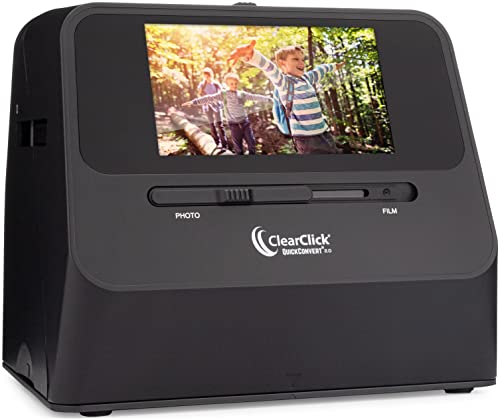
The ClearClick QuickConvert 2.0 offers stand-alone scanning without a computer, making it highly portable and convenient for on-the-go digitization. It scans 4×6 photos and smaller (with adjustable scan size) and saves JPEGs directly to an SD card. Scanning speed is about 2–3 seconds per image, and it supports 14 MP (22 MP interpolated) image quality. A built-in 5″ LCD screen and rechargeable battery enhance its practicality for quick transfers in places without a dedicated workstation.
- Quick, independent scanning without a computer, ideal for travel or classrooms.
- The no-PC workflow minimizes setup time and cables.
- No automatic document feeder and limited batch handling compared to larger scanners.
ScanSnap iX1300 Compact Scanner

The ScanSnap iX1300 is a compact, double-sided color scanner that handles documents, photos, and cards. It features an automatic feeder option and a user-friendly Quick Menu, enabling quick scanning to preferred apps. The device emphasizes reliability in small offices or home workspaces and supports fast duplex scanning while minimizing driver setup. This model is better for users who need a balanced scanner for both photos and documents in a tight space.
- Small workspaces needing a tidy, reliable, all-around scanner.
- Combines space efficiency with solid performance for mixed media scanning.
- May not match the ultra-high-volume capacity of larger, dedicated photo scanners.
Buying Guide
What should I consider when choosing a quick photo scanner?
Think about speed, photo size support, and whether you want a stand-alone device or one that relies on a computer. If you scan large batches, prioritize models with fast batch modes and higher DPI options. For travel or occasional use, a PC-free option can be a major time-saver.
Do I need color accuracy or archival-grade resolution?
Yes, if you plan to preserve precious images for long-term storage. Look for scanners offering 300 or 600 dpi at minimum, and consider 600 dpi for crisper detail in old photos. Some models offer interpolation; use it only if you need higher pixel counts for viewing on large screens.
What about practicality and ease of use?
Users should consider automatic cropping, deskew, and edge-to-edge scanning features. These help reduce manual edits after scanning. Devices with built-in memory or SD card storage can simplify workflows by removing the computer as a middleman.
What is the best setup for a mixed media workflow?
Choose a scanner that covers both photos and documents. A model with an automatic document feeder plus a photo mode offers flexibility, especially in home or office settings where you scan receipts and photos together.
Is portability important?
If you need to scan away from a desk, consider battery-powered or compact devices. Stand-alone scanners with built-in screens and rechargeable batteries are ideal for classrooms, travel, or quick family projects.
How should I assess reliability and future-proofing?
Read product specs for supported resolutions, memory options, and software compatibility. Cloud or desktop workflow compatibility matters if you want to save to PCs, Macs, or mobile devices. Look for ongoing software updates and easy driver management).
FAQ
- What DPI should I aim for when scanning photos? Choose at least 300 DPI for casual viewing and 600 DPI for archival-quality images.
- Can I scan a mix of photos and documents? Yes, many models support both types, but verify maximum photo size and document feeder availability.
- Do PC-free scanners require software? No, some models save directly to SD cards or internal memory without a computer.
- Is batch scanning important for large collections? Yes, models with automatic feeders and high page-per-minute rates save time on big projects.
- Are there any compatibility concerns? Ensure the scanner works with your computer’s operating system and preferred software.
- Which option is best for travel? A compact, stand-alone or battery-powered unit is typically ideal for portability.