When building or upgrading a drone, a dependable power distribution board (PDB) is critical for clean, efficient power delivery to the motors and electronic speed controllers (ESCs). This guide highlights five PDBs designed for FPV quadcopters and other multirotors. Each option suits different frame sizes, current demands, and environmental conditions. Use this overview to pick a PDB that best fits your build, whether you need high burst current, water resistance, or compact form factors for racing or cinematic drones. The buyer intent is to match clear needs with clear strengths of each product.
| Product | Best For | Key Strength |
|---|---|---|
| 200A Power Distribution Board for Drone PDB | High-power builds, octocopters | 200A burst, IP54 water/dust resistance |
| Matek PDB HEX 12S | Long-range, X-class or hexacopters | 6-60V input, 264A current sense |
| daier 2Pcs PDB | Value-focused quadcopter/multirotor | Fiberglass body, compact |
| Matek PDB-HEX 12S (another variant) | X-class or quad setups | 5V/9V/12V outputs, 264A sense |
| Matek Power Hub Double BEC | Dual BEC needs | 5V & 12V outputs, efficient design |
200A PDB With IP54 Sealing and 8 Outputs

This 200A PDB is designed for high-performance builds that demand strong current handling and protection against dust and water. It features an ultra-low resistance (0.0002Ω) path, supports up to 8 ESCs, and includes a compact 50mm circular layout with M3 mounting holes. Best for racing quads or cinematic drones operating in varied environments. A limitation is the 50mm footprint, which may require careful placement in very small frames.
Matek PDB HEX 12S 5A/5V-9V-12V Converter

Designed for X-class hexacopters and large quads, this Matek PDB HEX 12S supports 6–60V input and provides regulated 5V/9V/12V outputs. It features a high-precision current sense with a 264A rating and cont/ burst limits for ESC power pads. This makes it ideal for long-range or heavy-lift builds. Best for pilots needing robust voltage regulation across multiple rails. A caveat is compatibility with only some frame layouts due to its 30.5×30.5mm footprint in a compact package.
Daier 2-Piece PDB for Quadcopter Multirotor

The Daier PDB set focuses on a value-oriented option with a fiberglass body and a compact 5 cm x 5 cm x 0.2 cm size. It is suitable for smaller to mid-sized quadcopters and hobbyist builds. Best for builders prioritizing cost-effective assemblies. A limitation is limited data on current ratings beyond physical size, so verify ESC compatibility for high-power setups.
Matek PDB-HEX 12S for X-Class FPV Quadcopter
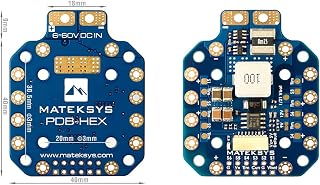
This Matek PDB-HEX variant is tailored for X-class hexacopters, offering a 6–60V input range with 5A regulation and 5V/9V/12V outputs. It provides a 264A current sense capability and supports up to 12S LiPo. Best for large, power-dense builds needing precise sensing and reliable rails. Limitations include potential complexity for smaller frames and higher component counts in setup.
Matek Power Hub with Double BEC

This dual-BEC PDB offers 5V and 12V outputs in a compact package, improving wire routing efficiency for quads needing two steady rails. Best for builds that require independent voltage rails for flight controllers and auxiliary devices. A potential limitation is the need to ensure compatible BEC current ratings with all ESCs and devices in your system.
Buying Guide: Key Considerations for Choosing a PDB
What current do you need? Choose a PDB with a burst rating at or above your maximum ESC peak. For multi-rotors with many ESCs, prioritize higher current capacity and robust current sensing for accurate power management.
How many voltage rails are required? Some boards provide multiple BEC outputs (5V/9V/12V). Decide if you need single or dual rails to power flight controllers, video transmitters, and other accessories.
Environmental resilience matters. If you fly in challenging conditions, look for IP ratings or rubber-sealed inputs to resist dust and moisture.
Frame compatibility and size. Ensure the PCB footprint and mounting hole pattern fit your frame and stacked configuration. Compact designs save space but may limit cooling options.
Ease of installation. Clear labeling of power pads and protection features, such as reverse polarity and short-circuit protection, help prevent wiring errors during build.
Frequently Asked Questions
- What is a PDB and why do I need one? A PDB distributes battery power to ESCs and other components, enabling clean, organized wiring and consistent voltage rails for reliable flight control.
- How do I choose the right current rating? Match the PDB’s continuous and burst current ratings to your ESCs’ requirements and motor power demands, with a safety margin for bursts.
- Do all PDBs include BECs? Some do, some offer only power distribution; check if you need 5V/12V outputs to power flight controllers or accessories.
- Can a PDB be used with different battery configurations? Many PDBs support 2S–12S LiPo inputs; verify the voltage range before pairing with your battery pack.
- What is the advantage of a sealed input? Sealed or IP-rated inputs protect against dust and water, improving endurance in outdoor or dirty environments.
- Are current sense resistors important? Yes; current sensing helps monitor power flow and can improve ESC performance and fault detection.
Summary of featured products, optimized for buyers seeking high performance, reliability, or cost-effective options. This guide helps you compare current capabilities, form factors, and environmental suitability to select the best PDB for your drone project.