Answering the question “ pv panel manufacturer ” requires tools that reliably test, troubleshoot, and optimize solar arrays. This guide highlights five top MPPT testers and multimeters suited for manufacturers, installers, and technicians working with photovoltaic panels. Each option is evaluated for ease of use, protection features, measurement range, and practical limitations. The buyer can quickly identify which tool best fits professional workloads, field testing, or workshop diagnostics.
| Product | Best For | Key Benefit |
|---|---|---|
| Segrehy Upgraded LCD Solar Panel Multimeter | On-site testing and professional installations | Automatic/manual MPPT detection with backlight |
| Fienzio EY-1800W Solar Panel Tester | High-widelity power and voltage range testing | Wide 5–1800W and 20–120V ranges for diverse systems |
| Blaihild Multimeter | Durable field work and general PV testing | 12–60V range with 20A current measurement |
| Pilipane Upgraded LCD Multimeter | Compact, backlit testing in varied light | Backlit display with protected MPPT testing |
| TEKCOPLUS 1800W Solar Panel Tester | Complex PV systems with multiple MPPT paths | Dual MPPT modes; no batteries needed |
Segrehy Upgraded LCD Solar Panel Multimeter

The Segrehy device is designed for effortless operation with automatic and manual MPPT detection. It does not require an external power supply, making it suitable for both field work and shop testing. Its clear interface supports quick, accurate readings, catering to professionals and enthusiasts who routinely test PV panels in the field. The device also features comprehensive protection against over voltage, over temperature, over current, and over rated power, reducing risk during testing on varied panels. A backlight enhances visibility in dim conditions, improving usability on cloudy days or shaded sites.
Who it’s best for: On-site technicians and installers who need a compact tester with reliable MPPT switching and strong protection features. This model is well-suited for quick diagnostics on a busy roof or a solar farm. Limitations: The tool relies on its internal electronics for MPPT detection, so users should verify MPPT behavior against a known reference panel when calibrating in new configurations.
Key considerations:
- Compact form factor supports portable testing in installations and workshops.
- Automatic MPPT detection speeds up initial assessments.
- Backlit display helps in low-light environments.
EY-1800W Solar Panel Tester MPPT

The EY-1800W covers an extended power and voltage range (5–1800W, 20–120V) with current up to 60A, making it suitable for residential to commercial PV systems. Its expanded voltage range supports more complex panel configurations, including series connections that require higher voltages. The large, Ultra Clear LCD display remains readable in bright sunlight, reducing the need for shade or reflectivity adjustments during field testing. This model emphasizes breadth of measurement, enabling quick diagnostics and optimization across large installations.
Who it’s best for: Installers and technicians working with mixed-system sizes, including larger commercial projects. Limitations: The broad range may be more feature-rich than necessary for small, hobbyist setups, potentially adding unnecessary cost for simple tasks.
Key considerations:
- Wide measurement range supports varied PV configurations.
- Clear LCD helps when outdoors under sunlight.
Blaihild Multimeter
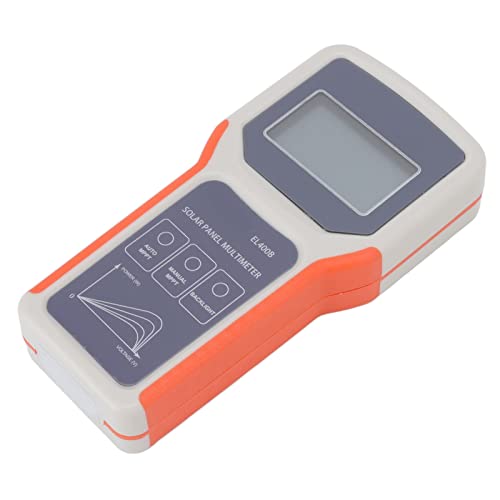
The Blaihild Multimeter focuses on a balanced approach for PV testing, offering voltage measurement from 12–60V and current up to 20A. The large LCD display supports easy interpretation of real-time data, making it suitable for field technicians and workshop bench work alike. Its ABS construction adds durability for rugged environments, providing reliability during frequent transportation or harsh site conditions.
Who it’s best for: Professionals needing a straightforward, robust meter for regular PV testing and tuning. Limitations: The current range tops at 20A, which may require a higher-capacity tool for larger commercial modules or string checks in very high-power systems.
Key considerations:
- Compact and durable for field use.
- Clear display supports quick readings on-site.
- Moderate current limit; suitable for most residential/commercial panels but not for high-power strings.
Pilipane Upgraded LCD Multimeter
The Pilipane model stands out with a backlit LCD display and second-generation MPPT testing features. Its backlight improves readability in variable lighting, which is beneficial during early morning or late evening field checks. The device includes protections against common electrical risks (over voltage, over temperature, over current, and over rated power), facilitating safer operation around diverse PV modules. The device is described as easy to operate, with options for automatic and manual MPPT detection to accommodate different user preferences and panel configurations.
Who it’s best for: Field technicians who prioritize visibility and safety features in variable lighting. Limitations: While the backlit display is helpful, the overall feature set may align more with mid-range needs than ultra-high-power string testing.
Key considerations:
- Backlit display supports testing in shadowed areas or dawn/dusk conditions.
- Auto and manual MPPT testing accommodates different workflow styles.
Ariarly Solar Panel Tester
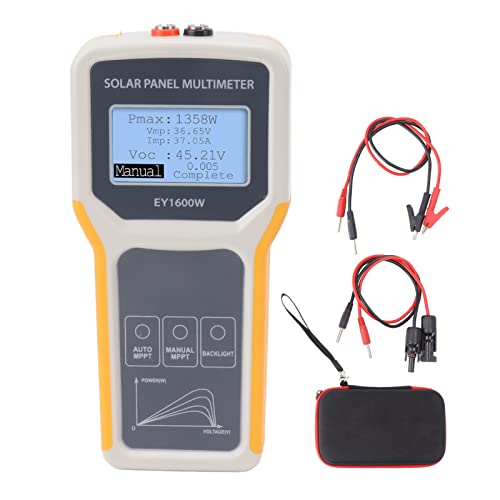
The Ariarly tester emphasizes straightforward MPPT testing with a big LCD backlight for easy data interpretation. It covers essential MPPT measurements and provides a portable testing option suitable for RVs, boats, and small roof systems. The no-battery-needed design makes it quick to deploy in field conditions, reducing setup time. This unit is best used for quick checks, performance validation, and troubleshooting where an immediate Pmax, Vmp, Imp, and Voc readout matters most.
Who it’s best for: Mobile installers and small-scale PV operators who need a lightweight tool for rapid diagnostics. Limitations: It may not offer the higher current or power ranges required for large-scale commercial strings.
Key considerations:
- Portable and battery-free for fast deployments.
- Backlit display aids readability in bright or dim light.
1800W Solar Panel Tester — TEKCOPLUS

The TEKCOPLUS 1800W tester is designed for multi-parameter solar testing, featuring Open Circuit Voltage (Voc), Short-Circuit Current (Isc), and Maximum Power Point (Pmax) alongside dual MPPT modes. Its “no batteries needed” approach simplifies field testing and reduces maintenance. The device’s robust feature set makes it a strong option for installers managing multiple panels in series or complex configurations. A caution is that higher-power testing requires careful cable management to avoid voltage drop and data inaccuracies caused by wiring resistance.
Who it’s best for: Installers and technicians working with larger arrays and series-connected panels who benefit from dual MPPT modes and battery-free operation. Limitations: Proper cable management is essential to ensure accurate measurements in longer runs or high-current configurations.
Key considerations:
- Dual MPPT modes support complex PV systems.
- No batteries required simplifies setup.
Buying Guide: Key Purchase Considerations
What range of power and voltage do you need?
Choose a tester whose power (W) and voltage (V) ranges cover your typical PV configurations. Residential systems may require 5–1800W and up to 120V, while commercial projects may demand higher current and broader voltage capabilities. Matching ranges helps avoid guessing and protects equipment during testing.
Should you prioritize MPPT auto-detection or manual control?
Auto MPPT is faster for routine checks and quick diagnostics. Manual MPPT offers precision in specialized testing or when validating a panel string under a known condition. For diverse projects, a model with both options provides flexibility.
What protection features matter most?
Over voltage, over current, over temperature, and reverse polarity protection help safeguard the tester and panels. In field environments, protective features reduce risk from irregular lighting, high ambient temperatures, or wiring mistakes.
Is a backlit display important?
Backlighting improves readability in early morning, late evening, or shaded sites. A bright LCD reduces misreads caused by glare or poor lighting, enabling faster, more accurate data capture on site.
Does portability or durability take precedence?
Field testing often requires rugged, compact devices with durable enclosures. If you travel between sites or install on roofs, portability and drop resistance are practical advantages. ABS plastic builds balance light weight with toughness for many field tasks.
What about no-battery operation?
Tools that don’t require external batteries can shorten setup and reduce maintenance. They’re particularly convenient for quick checks or when power sources are limited on the job site. However, confirm that battery-free operation doesn’t constrain measurement accuracy or duration in extended tests.
Frequently Asked Questions
- What is an MPPT tester and why do I need one?
MPPT testers measure the maximum power point of PV panels, helping optimize output and identify issues affecting efficiency. They are essential for manufacturers and installers working with strings and arrays of different configurations.
- Can these testers test open-circuit voltage and short-circuit current?
Yes. Most models provide Voc and Isc measurements, along with Pmax, Vmp, and Imp, enabling full characterization of panel performance.
- Do I need a tester with dual MPPT modes?
Dual MPPT modes are beneficial for complex systems with multi-string configurations, where separate MPPT paths can maximize energy harvest.
- Are battery-free testers reliable for long testing sessions?
Battery-free operation is convenient for short to moderate testing. For extended sessions, ensure the device has sufficient power handling and a reliable internal power source, if applicable.
- How do I decide between a compact tester and a high-range model?
If your work primarily involves small to mid-size residential panels, a compact tester with essential MPPT features is sufficient. For larger commercial systems or frequent high-current testing, choose a model with higher power and broader voltage ranges.