Answering the needs of shore anglers, this guide highlights portable, castable fish finders that excel when fishing from piers, beaches, docks, or bank fishing. The highlighted models are suited for anglers who want quick setup, wireless operation, and clear sonar data without mounting hardware. Each product section explains who it’s best for and why it stands out, plus practical cautions to consider before buying. A concise buying guide follows to help compare features such as beam width, depth range, battery life, and app integration.
Summary Table — Selected Portable Shore-Fishing Fish Finders
- Product: Venterior Portable Rechargeable Fish Finder — Best for budget-conscious shore anglers needing wireless castability and a bright color display.
- Product: Reelsonar Portable Fish Finder — Best for app-connected users who want depth tagging and fish alerts with long battery life.
- Product: Yoocylii Handheld Fish Finder — Best for kayak and dock anglers who need a compact, battery-powered unit with broad depth readouts.
- Product: Deeper Start Fish Finder — Best for quick-start users who want Wi-Fi data and a self-contained, castable solution.
- Product: LUCKY Kayak Portable Fish Finder (two options) — Best for long-range castability and a clear display for moving boats or shore setups.
Venterior Portable Rechargeable Fish Finder

Best for beginners and casual shore anglers who want a simple, cordless setup. The wireless sonar probe travels up to 262 feet (80 meters) from the handheld unit, eliminating hull drilling or permanent fixtures. It displays water depth, temperature, fish size, depth, and bottom contour, with an easy 2-color display for bright sun or night use. The device also offers a simulation mode to practice reading sonar without live water data. Caution: performance can vary with water clarity and depth beyond the stated range.
Features in context:
– Wireless sensor with 105-degree sonar beam
– Depth range: 2.6 to 164 feet
– Fish size indicators: small, medium, large
– Color display with black/white background options
Who it’s best for: Casual shore anglers who want quick setup, portability, and a display that’s easy to read in sunlight or at night.
Reelsonar Portable Fish Finder

Best for tech-savvy anglers who want depth-tagged visuals and an iOS/Android app. The device features a Bluetooth connection, a depth range up to 135 feet, and a rechargeable battery lasting 10+ hours. Visual sonar images help distinguish static vs. moving objects, and fish icons are color-coded by size. The “fish alarm” and strike alerts support dock or pier fishing scenarios. Caution: Bluetooth range and app compatibility can vary by device and operating system.
Highlights:
– Bluetooth fishfinder with app support
– Depth tagging and color-coded fish icons
– Battery life over 10 hours
– Alert features for fish activity
Who it’s best for: Anglers who want integrated smartphone data, long-running use, and intuitive visual feedback during shore or pier outings.
Yoocylii Handheld Fish Finder

Best for kayak or dock fishermen seeking a compact, battery-powered option with clear depth data. It displays water depth, fish location, and fish size, plus variables like weeds, sand, and rocks on the bottom. It uses a 200 kHz sonar with a 45-degree beam, providing a broad yet detailed view of the water beneath. It’s powered by 4 AAA batteries, offering 4-5 hours of continuous use. Caution: battery life depends on battery quality and usage, and it is best used in relatively calm water.
Key points:
– Portable and neck-strap friendly
– Freshwater and saltwater capable
– 3.0–128-foot depth range in typical use (via transducer) with 4 AAA batteries
Who it’s best for: Shore and kayak anglers who need a light, one-handed device and can manage disposables for extended trips.
Deeper Start Fish Finder

Best for quick setup and app-based data without bulky gear. The Deeper START uses self-contained Wi-Fi to pair with the Fish Deeper app on iOS or Android, saving scans with time and location for later review. It is ideal for shore anglers who want immediate depth, fish location, and bottom contour data without cables. Caution: Wi-Fi performance may be affected by interference or distance to the casting range.
Notable factors:
– Self-contained Wi-Fi, no external data usage
– Simple app pairing and data logging
– Suitable for shore, pier, bank, or kayak use
Who it’s best for: Anglers who want a fast, mobile-friendly setup and cloud-free storage of scans for post-trip analysis.
LUCKY Kayak Portable Fish Finder (Two Models)
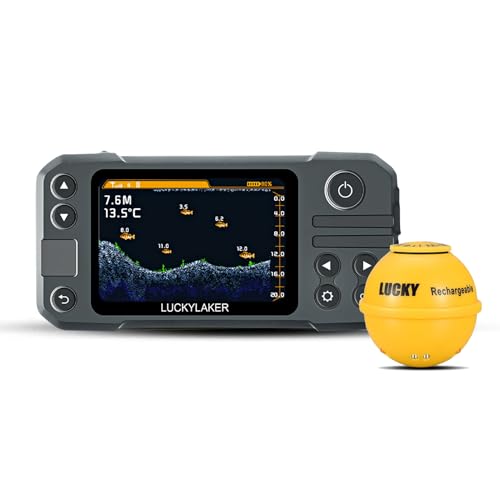
Best for long-range, castable sonar with a simple handheld display. The LUCKY system highlights a long operation distance and a clear, legible 3.5-inch LCD display. It provides depth readings and fish location, enabling users to gauge depth and structure as they move along banks, shores, or from a kayak. Caution: longer ranges may require a stable casting technique to avoid signal loss in rough water.
Key aspects:
– Wireless control with up to 853 feet range
– 3.5″ LCD display with intuitive icons
– Castable sonar suitable for shore, kayak, and boat use
Who it’s best for: Anglers who want maximum castable range and a straightforward display for on-the-move shore fishing.
LUCKY Kayak Portable Fish Depth Finder (FFC1108)

Best for flexible use across kayak and shore setups with a handheld display that shows fish location and water depth. The device supports depth readouts from 3 feet to 328 feet and includes features to identify bottom structure like weeds, sand, and rocks. It is designed for single-hand operation and includes a neck strap for mobility. Caution: performance depends on environmental conditions and the stability of the transducer in moving water.
Who it’s best for: Anglers who want a compact, one-handed device for moving shores, docks, or small boats with straightforward depth data.
Buying Guide: Key Purchase Considerations
- Castability vs. fixed transducers: If you fish from shore, castable sonar (no hull installation) generally offers more flexibility and easier transport. Fixed transducers may be better for stable platforms like boats or docks.
- Depth range and beam width: Wider beams (e.g., 105-degree, 90-degree) cover more area but may offer less precise readings at depth. Consider where you fish and how quickly you need to scan water columns.
- Display readability: Bright displays with color or backlight are important for sunny conditions on shore. Two-color or grayscale options can be easier to read in bright light or at night.
- Battery life and power source: Look for rechargeable units with 8–10+ hours of continuous use or lightweight disposable batteries for short trips. Consider how you will recharge between outings.
- App integration and data logging: Models with iOS/Android apps offer GPS tagging, saved scans, and shareable screenshots. Assess whether you need live data, offline storage, or both.
- Best use case: For shore fishing, prioritize long range, easy casting, quick setup, and weather-resistant design. For kayaks or pier fishing, weight and portability become critical factors.
FAQ
- What is the best portable fish finder for shore fishing? The best option depends on your need for castability, app features, and budget. A model like the Venterior or Deeper Start offers quick setup and good display readability for shore use.
- Do these devices require mounting or drilling? Most shore-friendly options shown are castable or handheld and do not require hull drilling.
- Can I use these fish finders in saltwater? Yes, many listed models are designed for both freshwater and saltwater use, but verify the transducer’s corrosion resistance and battery safety for saltwater environments.
- Will a longer range always improve findings? Not necessarily. Range matters, but signal quality, water clarity, and the presence of structure influence results more than max range alone.
- Are app-connected fish finders harder to use? App-based models can add features like GPS logs and drumbeat of data, but often require pairing and a compatible device. Simpler models may be easier for quick use.
- What maintenance is needed? Rinse with fresh water after saltwater use, check cables and seals, and replace batteries as needed to maintain performance.
This guide presents a balanced set of portable, shore-friendly fish finders to help buyers compare options quickly. Each option is selected to support a variety of shore fishing scenarios, from quick casts on a beach to longer pier sessions, with attention to readability, battery life, and practical use in real-world fishing. Consider your typical shore fishing conditions and preferred data presentation when choosing the right model.