Finding the right LED bulbs for your project starts with clarity about your needs. This guide highlights five practical options suited for hobbyists, students, DIY enthusiasts, and vehicle or home lighting upgrades. Each product section explains who it’s best for, why it’s a solid choice, and a potential limitation to watch. For quick comparisons, see the concise product table below.
| Product | Best For | Key Benefit | Limitation |
|---|---|---|---|
| Novelty Place 100pcs 5mm White LED Diode Lights | DIY electronics, science projects | Very bright, low power | Basic 3V operation may require current limiting |
| EBOOT 100 Pcs Clear LED Diodes | Creative color projects, classroom kits | Color variety for experiments | Forward voltages vary by color |
| 30 PCS Car 194 LED Bulbs | Vehicle interior/outside lighting | CANBUS-friendly, wide replacement | Some vehicles require decoding checks |
| ASOMST 4-Pack Vintage Edison LEDs | Decorative lighting, warm ambient spaces | Filament look with modern LED efficiency | Dimmability not specified |
| GutReise LED Screw-Mount E10 Holders | Experimenters building small circuits | Simple fixture for E10 LEDs | Holder only; needs LEDs separately |
Novelty Place 5mm White LED Diodes Kit

Product overview: The Novelty Place kit includes 100 pieces of 5mm white LEDs designed for DIY PCB circuits, science projects, and simple electronic lighting experiments. Forward voltage ranges around 3.0V–3.2V with a current of 20 mA, producing bright 6000–9000K white light at a viewing angle of about 30 degrees. Luminous intensity sits around 10000–14000 mcd, making these LEDs clearly visible in compact circuits.
Who it’s best for: Ideal for students, hobbyists, and makers who want a reliable, uniform LED source for breadboarding, LED matrix projects, or small indicators. The compact 5mm form factor fits many classic prototyping setups and basic display projects.
Why selected: High brightness with relatively low power makes them a practical, entry-level option for experimenting with LED behavior and basic electronics. The white color is versatile for a wide range of projects.
Caution: Ensure proper current-limiting resistor placement to prevent overcurrent damage, as this data set focuses on LEDs themselves rather than complete circuit protection.
EBOOT 100 Colors LED Diodes Kit
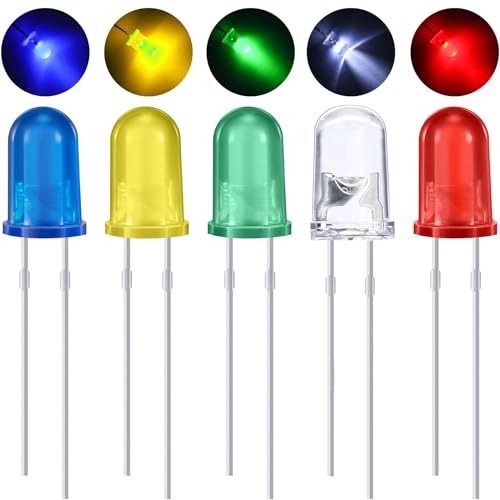
Product overview: This kit includes 100 5mm LEDs in five colors (yellow, green, blue, white, red), with roughly 20 pieces per color. Forward voltages vary by color (1.8–2.0 V for some and 3.0–3.4 V for others). Current is up to 20 mA. The bulbs have a water-drop shape and clear heads, suitable for demonstrations, science labs, and small color-coded indicators.
Who it’s best for: Great for classroom science projects, color-coded displays, and creative LED experiments where multiple colors help teach concepts like current and color mixing.
Why selected: The color variety enables more engaging experiments and easy differentiation between circuits. It’s a practical teaching kit for visual demonstrations.
Caution: Pay attention to color-specific forward voltages to ensure each LED is driven correctly within its tank of circuitry, especially when combining colors in one project.
30 PCS Car 194 LED Bulbs Kit

Product overview: These 194 LEDs use high-brightness SMD 3030 chips to provide 360-degree illumination with a bright output and low glare. The bulbs come with a long-lasting circuit board and are rated around 20,000 hours. They claim CANBUS compatibility with a plug-and-play design and include a built-in constant IC driver to minimize CANBUS errors.
Who it’s best for: Vehicle owners seeking bright, easy-to-install interior or exterior lighting that matches standard halogen replacements and reduces glare at night.
Why selected: The 360-degree illumination and CANBUS compatibility make them a solid upgrade for dashboards, dome lights, license plates, or trunk lighting in many cars.
Caution: Some vehicle models may require checking CANBUS compatibility or decoding to avoid bulb-out warnings in specific trims or dashboards.
ASOMST Vintage Edison LED Bulbs 4-Pack

Product overview: A set of four ST58-style vintage Edison LED bulbs with a 6W rating and an 850-lumen output at 5000K daylight white. They feature a 360-degree emission with high CRI. These bulbs emulate the classic filament look while delivering modern LED efficiency.
Who it’s best for: Ideal for decorative lighting in living rooms, dining spaces, cafes, or entryways where a retro aesthetic is desired without sacrificing energy efficiency.
Why selected: The combination of a vintage filament appearance, high brightness, and color temperature makes these bulbs a practical decorative option for ambient lighting.
Caution: They are described as non-dimmable in some listings; check dimmer compatibility if you plan to pair them with dimmers.
GutReise E10 LED Bulb Holder Kit

Product overview: A 10-pack of LED screw-mount E10 holders with a wire lead, designed for small circuit experiments and educational use. These holders provide a straightforward way to assemble LED-based projects in compact formats.
Who it’s best for: Ideal for students, hobbyists, or makers working on small-scale experiments or compact LED displays that need a simple mounting solution.
Why selected: The include-able wire leads make it easy to wire up LEDs in quick-prototyping scenarios without specialized hardware.
Caution: This is a holder kit; you’ll need to source compatible LEDs and resistors to complete safe circuits.
Buying Guide: LED Bulb Purchasing Essentials
What to consider when choosing LED bulbs for different uses:
- Voltage and current: Verify forward voltage and current requirements to match with your circuit or vehicle system. Mismatches can overdrive or under-drive LEDs.
- Color temperature and brightness: Cold daylight (5000K–6500K) is common for task lighting, while warm white (2700K–3000K) suits living spaces. Look at lumens and mcd ratings for brightness benchmarks.
- Base type and fit: Ensure the base (5mm, G9, E10, T10/194, etc.) matches your fixture or vehicle socket. Size compatibility affects installation ease.
- CANBUS compatibility: For vehicle lighting, choose bulbs described as CANBUS-ready to minimize error codes and dash warnings.
- Durability and lifespan: Consider expected hours and heat dissipation features, especially for high-output or enclosed fixtures.
- Color rendering (CRI): Higher CRI yields more natural colors in indoor spaces—beneficial for home and work environments.
- Installation effort: Plug-and-play designs simplify upgrades; some setups require additional resistors or decoders.
- Limitations: Some LEDs may not be dimmable or may have voltage ranges that require regulators or resistors in your circuit.
FAQ: Quick Answers For LED Bulb Purchases
- What is the difference between 3V and 5V LEDs?
– Voltage rating indicates the operating voltage; ensure your power source matches or use current-limiting components. - Are CANBUS LEDs safe for all vehicles?
– CANBUS compatibility helps avoid error warnings, but compatibility varies by vehicle model and year. - Can I mix colors in a single circuit?
– Yes, but each LED color may require its own current-limiting resistor and appropriate forward voltage. - What does CRI tell me?
– CRI measures color accuracy; higher CRI (close to 80–90+) generally yields more natural colors under lighting. - Do all LEDs require heat sinking?
– High-output LEDs benefit from heat management; compact 5mm types typically don’t need extensive cooling for small projects. - What’s the main limitation of hobby LEDs?
– Some kits don’t include resistors or decoders, so careful circuit design is needed to prevent damage.