Answering the buyer’s search intent, this guide compares top pH and TDS meters for home, hobbyist, and professional use. Each pick highlights who it’s best for, why it stands out, and any notable limitations. Ideal buyers include hydroponic gardeners, aquarium hobbyists, pool owners, and DIY water testers seeking reliable, compact meters. Below is a quick table of the featured products to help you compare at a glance.
| Product | Main Use | |
|---|---|---|
| VIVOSUN Digital pH and TDS Meter Kits | Hydroponics / Pools / Aquariums | 3-in-1 measurement with mid-range accuracy |
| Ammsia pH Meter 3-in-1 | Drinking water / Aquariums / Hydroponics | Single-screen simultaneous readings for pH, TDS, and temperature |
| GuDoQi 4-in-1 pH TDS EC | Drinking water / Aquarium / RO systems | 4-in-1 tester with wide unit options and ATC |
| APERA AI316 Premium 5-in-1 | Professional lab-like testing | Replaceable probe for long-term use |
| Hofun 5-in-1 Pool and Spa Meter | Pool / Spa / Aquarium | Multiple display modes for salinity and general water quality |
The following sections present detailed product-by-product information to help you select the best fit for your needs, with clear pros, best-use scenarios, and practical cautions grounded in the listed features.
VIVOSUN Digital pH and TDS Meter Kits

The VIVOSUN kit combines pH, TDS, and conductivity testing in a single handheld unit. It is best for hobbyists who test hydroponic solutions, pools, and aquariums with a compact, color-coded design. The device offers a full pH range of 0–14 and a 0–9990 ppm TDS/0–9990 µS/cm measurement range, with an accuracy of ±2%. Temperature measurement ranges from 0.1 to 80.0°C (32.0–176.0°F). Note that the meter is not suitable for seawater testing. Use this when you want quick, all-in-one readings in garden tanks or home pools.
Best for: Home gardeners and hobbyists who want an affordable, all-in-one tester for freshwater hydroponics, aquariums, and residential pools.
Caution: Not designed for seawater; readings may be less reliable in very saline environments.
Ammsia pH Meter 3-in-1
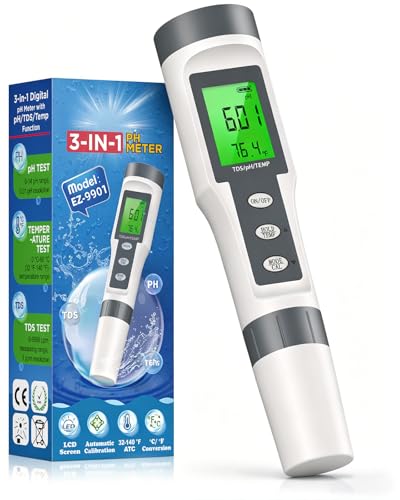
The Ammsia tester provides simultaneous readings for pH, TDS, and temperature on one screen, removing the need to switch modes. Its 0.01 pH resolution and a high-precision sensor contribute to stable measurements for drinking water, aquariums, hydroponics, and brewing. Calibration supports one-point or three-point procedures, making it friendly for both beginners and advanced users.
Best for: Quick, all-in-one water testing without mode hopping, especially useful for hobbyists who monitor water daily.
Caution: Calibration procedure may require careful handling to ensure accuracy over time.
GuDoQi 4-in-1 pH TDS EC Kit
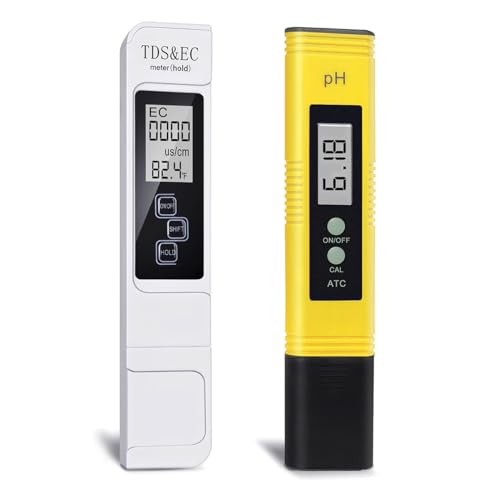
GuDoQi’s kit emphasizes broad testing across pH, TDS, EC, and a temperature reading, with a 0.01 pH resolution and ±0.01 pH accuracy. It also includes ATC (automatic temperature compensation), helping shorten setup time and maintain consistent readings across temperatures. It’s well-suited for drinking-water testing, aquariums, hydroponics, RO systems, and pools.
Best for: Users who want a robust, 4-in-1 tester with automatic temperature compensation for diverse home water scenarios.
Caution: Some users note that the device requires careful calibration and may require more frequent recalibration in variable water sources.
APERA AI316 Premium 5-in-1

The APERA AI316 Premium Series offers five measurements: pH, EC (conductivity), TDS, salinity, and temperature. The replaceable multi-parameter probe supports ongoing use, which is a notable advantage for frequent testers. This option is appropriate for professional-style testing where long-term probe upkeep matters, as readings are typically precise and consistent via a specialized probe.
Best for: Serious hobbyists or small labs needing a long-lasting, multi-parameter tester with a replaceable probe.
Caution: Higher upfront cost and more complex calibration than simpler 3-in-1 devices.
Hofun Pool Salt Tester & pH Meter
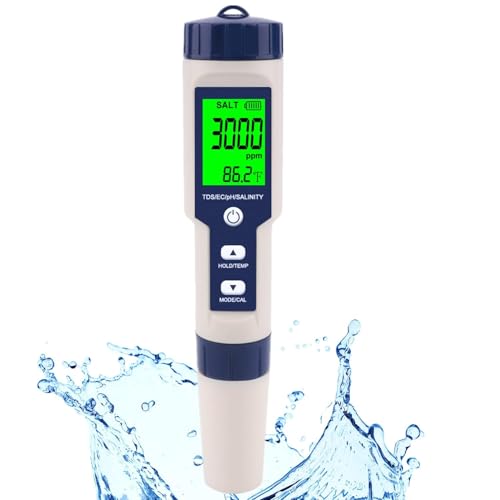
The Hofun meter focuses on five parameters relevant to pools and spas: salinity, pH, temperature, EC, and TDS. It features multiple display designs for salinity, enabling quick interpretation in pool contexts or aquariums. It is best for pool owners who need a versatile tester that neatly covers water quality across saltwater pools and freshwater systems alike.
Best for: Pool and spa owners seeking a single device that handles salinity and common water-quality metrics in one interface.
Caution: The 5-in-1 design may be more complex to navigate for casual, one-off checks.»
YINMIK 4-in-1 Hydroponic Meter

The YINMIK tester emphasizes hydroponic use, offering simultaneous pH, TDS, EC, and temperature readings with a real-time display. It’s designed for reservoir testing and ongoing monitoring in DWC, aeroponic, and garden setups. The device includes calibration solutions, enabling a ready-to-use experience straight from the box.
Best for: Hydroponic growers who want robust, integrated monitoring with out-of-the-box calibration materials.
Caution: The supplier notes that the unit is designed for hydroponics and reservoir testing; performance may vary with other water types.
EZTOCH 6-in-1 Continuous Monitor
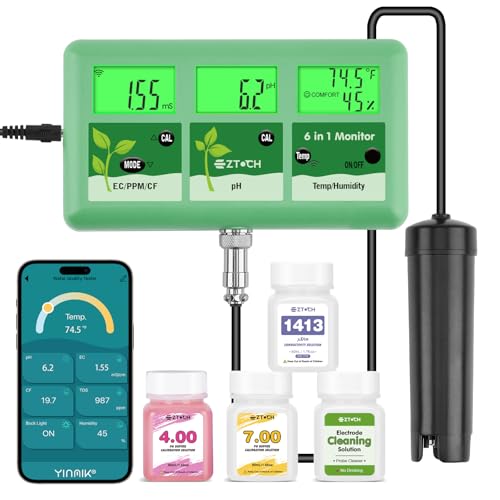
The EZTOCH 6-in-1 monitor combines pH, EC, TDS, salinity, and temperature with real-time WiFi data via Tuya-compatible app. It offers alerting, historical data, and downloadable reports. This is well-suited for growers who want remote monitoring and data analysis to maintain nutrient balance in hydroponic systems.
Best for: Advanced hydroponic setups that require remote monitoring, trend analysis, and automated alerts.
Caution: Requires network setup and app usage; dependency on WiFi for full features.
EZTOCH Hydroponic pH EC Tester

The EZTOCH 4-in-1 monitor focuses on simultaneous display of pH, EC, TDS, and temperature. It is designed for hydroponic reservoirs and allows easy lock of readings for recordkeeping. The unit targets beginners and enthusiasts who want a compact, straightforward monitor for hydroponic use, with a practical 0.01 mS/cm EC range and 0.01 pH resolution.
Best for: Beginners or hobbyists who want a simple, reliable hydroponic tester with a clear display and lock function.
Caution: The device emphasizes hydroponics; users testing other water categories should verify suitability.
Buying Guide: How to Choose the Right pH TDS Meter
- Measurement scope: Decide which parameters you need (pH alone versus pH, TDS, EC, salinity, and temperature). If you test multiple water sources, a 4-in-1 or 5-in-1 model can save time.
- 2 Calibration and accuracy: Look for devices with 0.01 pH resolution and ±0.01 pH accuracy for precise readings. ATC (automatic temperature compensation) helps maintain accuracy across temperature changes.
- 3 Probe longevity and replacement: If you anticipate heavy use, a tester with a replaceable probe (like APERA AI316) reduces long-term costs and downtime.
- 4 Display and data handling: Real-time LCD readouts, easy-to-interpret units (ppm, mg/L, ppt, us/cm), and optional app connectivity for logging are valuable for ongoing monitoring.
- 5 Use-case alignment: For hydroponics, prioritize pH and EC/TDS with quick calibration options. For pools and aquariums, salinity and temperature features can be crucial.
- 6 Budget and complexity: Simpler 3-in-1 models are cost-effective and straightforward; multi-parameter devices offer broader capabilities but may require more setup and maintenance.
Frequently Asked Questions
- What is the difference between pH, TDS, and EC? pH measures acidity or basicity of water. TDS estimates the total dissolved solids in parts per million, while EC (electrical conductivity) measures water’s ability to conduct electricity, closely related to ion concentration. These metrics together describe water quality for plants, aquariums, and pools.
- Do I need temperature compensation? Yes. Temperature affects readings, especially pH and EC. ATC or automatic temperature compensation improves accuracy across different temperatures.
- Can these meters test seawater? Some models are not designed for seawater. Check the product notes; many are intended for freshwater use or specific salt ranges.
- How often should I calibrate? Calibrate according to the manufacturer’s guidance, typically when the readings drift or after extended storage. Calibration solutions are often included with the device.
- Is a replaceable probe worth it? For frequent testers, a replaceable probe reduces long-term costs and downtime, ensuring continued accuracy without buying a whole new meter.
- Which device is best for hydroponics? For hydroponics, models offering pH, EC/TDS, and temperature with stable readings and ATC are preferred; devices such as APERA AI316 and EZTOCH multi-parameter meters are common choices for growers.