For cord-cutters and rural viewers, the right outdoor dtv antenna delivers free local channels with 4K and 1080p picture quality. This guide compares durable, weather-ready antennas that suit attic or outdoor mounting, so you can choose the best option for your home, campground, or cabin. The top picks are best for different needs: long-range reception, motorized rotation, multi-TV setup, and easy installation.
Summary of selected products:
| Product | Brand | Best For | Key Feature |
|---|---|---|---|
| GE Outdoor HD Digital TV Antenna | GE | General home use, attic or outdoor mounting | Long range, weather resistant |
| PBD Amplified Outdoor TV Antenna | pbd | Best long-range, 360° rotation, remote control | Up to 150 miles, dual TV outputs |
| 1byone Outdoor TV Antenna | 1byone | Hands-off reception, weatherproof | 360° omni-directional, 100+ miles |
| UltraPro Outdoor HD Digital Antenna | UltraPro | Universal compatibility, rugged install | 70 miles, 4K/8K ready |
| Five Star Yagi Satellite HD Antenna | Five Star | Attic or roof mounting, multi-TV | Up to 200 miles, 4K/HD |
GE Outdoor HD Digital TV Antenna

Best for: General home use with attic or outdoor mounting. This GE antenna supports 4K and 1080p HD signals and includes a J Mount for flexible installation. It is designed to work with both VHF and UHF channels, making it suitable for viewers in suburban neighborhoods or small towns who want a reliable free-to-air lineup.
Selected for: Simplicity and reliable all-season performance. The long-range capability and weather-resistant build make it a practical default choice for many households.
Caution: Ensure the coaxial connection is securely weather-sealed to prevent moisture ingress in rainy climates.
PBD Amplified Outdoor TV Antenna
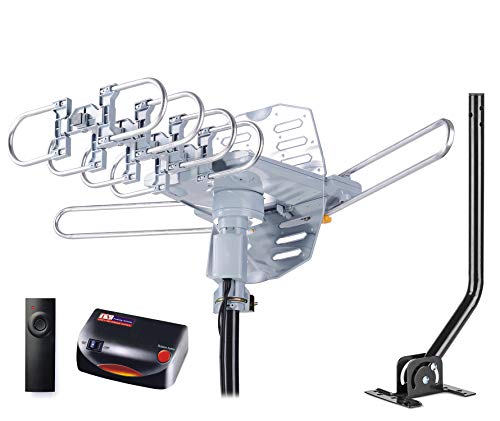
Best for: Homes within up to 150 miles of broadcast towers who want stronger reception and flexible mounting. This antenna features a built-in high-gain amplifier and a 360° motorized rotation to align toward signals, plus dual TV outputs for more viewing options.
Selected for: The motorized rotation and long range help maintain stable reception in challenging terrain or urban canyons. It’s especially useful if you want to maximize signal without manually adjusting the antenna often.
Caution: Remote control operation relies on line-of-sight; in tight spaces, reflections can affect alignment accuracy.
1byone Outdoor TV Antenna

Best for: Viewers who want hands-off, broad-direction reception without rotating the antenna. The 360° omni-directional reception covers multiple directions, making it ideal for locations with many nearby towers.
Selected for: Its moisture-proof and flame-retardant materials offer durable outdoor or attic use with minimal maintenance. It’s a strong pick when you want a set-and-forget solution.
Caution: It is designed for a single TV output; for multiple TVs, you’ll need a splitter, which can reduce signal strength for each TV.
UltraPro Outdoor HD Digital Antenna

Best for: Viewers needing broad compatibility with different TVs and converter boxes, aiming for reliable 4K/1080p reception within a 70-mile range.
Selected for: Rugged outdoor installation, weather resistance, and a mount with J-mount and mast clamp for secure placement on walls, roofs, or attics.
Caution: Performance tends to be strongest closer to towers; in very distant areas, consider accessories that boost signal or additional alignment options.
Five Star Yagi Satellite HD Antenna
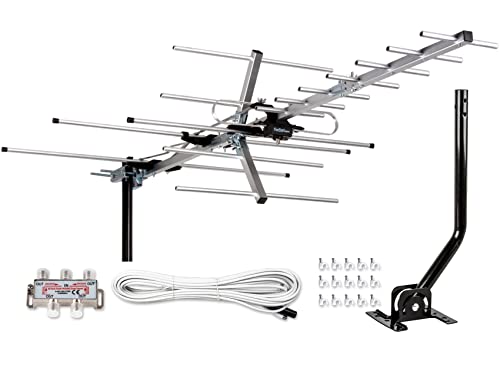
Best for: Roof or attic mounting where you want to pull in a wide range of local HD channels with a longer reach, potentially up to 200 miles depending on terrain. Designed for homes that want multiple TV capability with a single antenna setup.
Selected for: The extended antenna length and Yagi design offer stable, high-quality reception for UHF and VHF channels, reducing the need for frequent realignments.
Caution: Installation can be more complex due to the longer elements; ensure proper mast mounting and safe handling during assembly.
Buying Guide: Outdoor Dtv Antenna Essentials
What determines the best outdoor dtv antenna for you?
- Range vs. local towers: If you’re close to broadcast towers, a compact antenna may suffice. For rural areas, prioritize long-range models with amplification and weather resistance.
- Directionality: Omni-directional (360°) antennas are easy and low-maintenance but may underperform in some fringe areas. Directional (Yagi) antennas can offer stronger signals if towers are in a specific direction.
- Multi-TV support: If you need two or more TVs, choose an antenna with multiple outputs or plan for a splitter, understanding potential signal loss per TV.
- Installation location: Attic mounting reduces weather exposure but may reduce certain signals; outdoor mounting yields the strongest signals but requires weatherproofing and safety considerations.
- Weather resistance and durability: Look for UV resistance, moisture-proof materials, and sturdy mounting options for year-round use.
- Ease of setup: Some models include remote control rotation, built-in amplifiers, or step-by-step mounting hardware, which can save time and effort.
Frequently Asked Questions
- Do outdoor dtv antennas require a power source?
- Can I use one antenna for multiple TVs?
- What is the difference between omnidirectional and directional antennas?
- How do I know which channels I’ll get?
- Will these antennas work for 4K channels?
- How should I protect my antenna from weather?
Many amplified models use a built-in or external power source via coaxial or dedicated power inserter. Non-amplified antennas typically do not require power.
Yes, via a coaxial splitter. Some antennas offer dual outputs. Note that splitting may reduce signal strength for each TV.
Omnidirectional antennas receive signals from all directions and are easier to install. Directional antennas focus on signals from a specific direction, often providing stronger reception from distant towers.
Channel availability depends on your location relative to broadcast towers. Use online tools to locate towers and estimate which channels are available, then pick an antenna with suitable range and gain.
Most modern outdoor antennas are 4K-ready and support HD signals, including 1080p and 4K, depending on the local broadcaster offerings in your area.
Choose models with weather-resistant housings and mounting brackets. Proper grounding and using mast clamps help protect against wind and moisture.