Finding the right antenna amplifier can improve channel reception, reduce pixelation, and help you maximize free local broadcasts. This guide selects top performers across indoor and outdoor options, highlighting how each unit boosts signal, minimizes distortion, and fits different installation needs. All models reviewed here work with VHF/UHF and ATSC standards to support modern over-the-air viewing.
The following quick-reference table summarizes the chosen products to help you compare at a glance.
| Product | Brand | Type | Key Benefit |
|---|---|---|---|
| The CIMPLE CO Antenna Amplifier Kit | The CIMPLE CO | Distribution/Indoor | Adjustable gain up to 24 dB for multiple TVs |
| Channel Master TV Antenna Booster | Channel Master | Distribution Amplifier | 4 output ports; LTE filtering |
| GE Indoor HD Antenna Amplifier | GE | Indoor | Low-noise boost with 4G/5G LTE filter |
| Antennas Direct JUICE4 | Antennas Direct | Distribution Amplifier | 4 outputs; ATSC 3.0 and 4K/8K ready |
| GE Pro Outdoor Antenna Amplifier | GE | Outdoor | Weather-resistant with LTE filter |
The CIMPLE CO Antenna Amplifier Kit
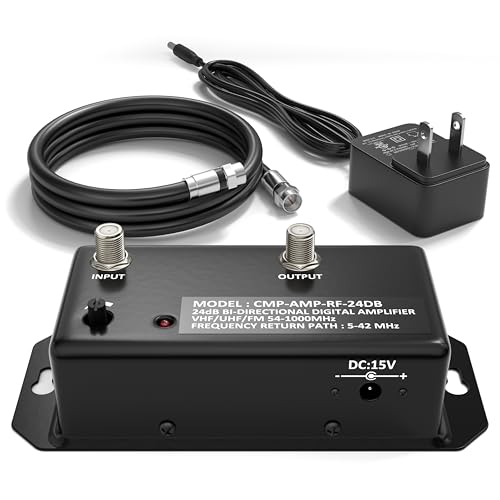
The CIMPLE CO kit offers an adjustable amplifier with up to 24 dB gain to strengthen signal from an antenna to TV sets. Included is a RG6 coaxial cable for setup, supporting VHF, UHF, and FM bands, and compatibility with ATSC, NTSC, FTA, and OTA. Designed for indoor use only, it targets strengthening existing strong signals to reduce dropouts and improve output quality while keeping distortion low.
Key features include: indoor use, adjustable gain, and a built-in distribution capability for multiple TVs. It is important to verify proximity to broadcast towers and ensure your antenna size is appropriate for the area; this device amplifies existing signals rather than creating new ones. Suitable for a home with multiple rooms needing improved reception.
Channel Master TV Antenna Booster 4-4-Port
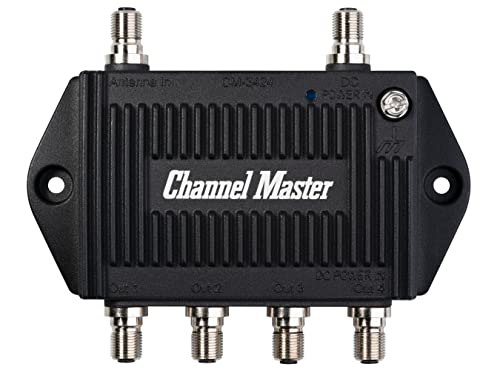
Channel Master’s booster provides four output ports to distribute a boosted signal to four rooms without sacrificing quality. Its design supports both indoor and outdoor installations, thanks to a compact form factor and a weatherproof housing. The model is positioned as an enhanced replacement for traditional four-way splitters, capable of improving signal strength in larger homes or attic/loft locations where coax runs are longer.
Features emphasize flexibility—works with non-amplified antennas, includes low-noise amplification, and is suitable for indoor, outdoor, or attic setups. It’s particularly useful when multiple TVs must receive clearer HDTV signals from a single antenna, though channel performance will still depend on distance to towers and installation quality.
GE Indoor HD Digital TV Antenna Amplifier
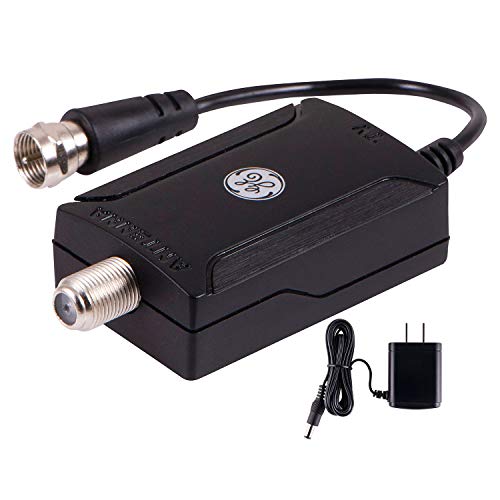
GE’s indoor amplifier is designed to enhance reception for HDTV, VHF, and UHF channels with a built-in LTE filter to reduce interference from 4G/5G networks. The device is built to be compatible with a broad range of TV brands and supports 1080p and 4K viewing when paired with an appropriate antenna. It includes PureAmp technology to suppress cellular interference while boosting signal strength, which helps maintain clear, pixel-free images on available channels.
Ideal for apartments or rooms with signal challenges, this unit emphasizes low-noise amplification to prevent over-saturation of strong signals while improving weaker ones. Performance will depend on antenna placement and distance from broadcast towers.
Antennas Direct ClearStream JUICE4

The JUICE4 distribution amplifier from Antennas Direct provides four outputs to distribute a boosted signal to up to four TVs or digital converters. It supports ATSC 3.0 NEXTGEN TV and is designed for indoor use, with options for outdoor termination and weatherproofing when needed. The device extends its compatibility to 1.2 GHz, making it suitable for CATV and certain broadband applications, while maintaining signal quality across multiple outputs.
Compact and versatile, JUICE4 fits spaces where multiple TVs share a single antenna. Its performance depends on proper antenna alignment and the presence of a reliable line from the broadcast towers to the installer’s location.
GE Pro Outdoor Antenna Amplifier

This outdoor amplifier from GE is built to withstand weather while improving HDTV reception with an integrated LTE filter. The unit is designed for exterior mounting on a mast or wall, and it includes 4G/5G filtering to block interference from wireless networks, thereby reducing noise in VHF/UHF channels. The amplifier aims to minimize dropouts caused by long coax runs or material obstructions, although actual results will vary with tower distance and installation quality.
Outdoor installation expands coverage for larger homes or challenging landscapes. Ensure proper sealing and weatherproofing for longevity, and position the amplifier to balance power and signal integrity across your antenna system.
Buying Guide
Key considerations when selecting an OTA antenna amplifier include:
- Signal environment: In areas with many strong signals, a high-gain amp helps distribute to multiple TVs, but in very strong areas a high gain can introduce distortion if not matched to the antenna. Start with moderate gain and test results.
- Indoor vs outdoor: Indoor amps are easier to install and reduce exposure to the elements, but outdoor units can compensate longer coax runs and obstructed lines better when properly weatherproofed.
- Number of outputs: For homes with multiple TVs, distribution amplifiers provide multi-output boosting. Ensure the model supports the number of televisions you intend to service.
- LTE/EMI filtering: LTE filters help block interference from cellular networks and EMI, which can significantly improve reception in some neighborhoods.
- Compatibility: Look for compatibility with ATSC/ATSC 3.0, NTSC, and OTA broadcasts, as well as both VHF and UHF bands to cover a wide range of channels.
- Installation notes: Some amplifiers require power via USB or a dedicated adapter. Verify compatibility with your existing antenna and cabling (RG6 is commonly recommended).
- Weather and durability: Outdoor models should be weather-resistant; indoor models should minimize the risk of moisture damage in humid spaces.
For best results, combine a suitable antenna with properly oriented placement near a window or unobstructed line of sight to towers. Avoid using a pre-existing amplifier unless the system specifically requires it, as duplication can cause overload and signal distortion.