Discover the best night vision trail cameras designed to capture elusive wildlife after dark. This guide highlights five reliable options, focusing on trigger speed, night vision clarity, and rugged durability. Each pick offers wireless access or easy app integration to monitor activity without intrusion, helping you document deer, predators, or nocturnal creatures with confidence.
Summary of chosen products
| Product | Brand | Key Feature | Night Vision | Trigger Speed |
|---|---|---|---|---|
| DEATTI Trail Camera 48MP 4K | DEATTI | WiFi/BT access, 48MP photos, 4K video | Color night vision in some modes | 0.1s |
| GardePro E6 Trail Camera | GardePro | Wi‑Fi with app control | No Glow night vision | 0.1s |
| Meidase P70 Trail Camera | Meidase | 64MP, 1296p, fast trigger | No-Glow LEDs | 0.1s |
| GardePro E5S Trail Camera | GardePro | 64MP, 1296p, clear night footage | 100ft no glow | 0.1s |
| KJK Trail Camera 36MP | KJK | 2.7K video, 130° wide angle | Low glow infrared | 0.1s |
DEATTI Trail Camera 48MP 4K Overview

DEATTI’s trail camera blends high resolution stills with 4K video, enabling detailed wildlife records in low light. The unit includes a robust 8 batteries and a 32GB SD card, plus built-in WiFi and Bluetooth for remote access via a mobile app. Note that the camera creates its own hotspot instead of connecting to home WiFi. A 0.1s trigger time helps catch quick animal movements, while weather sealing supports outdoor use.
GardePro E6 Trail Camera — No Glow Night Vision

The GardePro E6 emphasizes a reliable Wi‑Fi connection, a free companion app, and a wide 110° field of view. It captures 48MP stills and 1296p video with H.264 encoding for efficient playback. An antenna improves signal stability, reducing disconnections while monitoring wildlife or property. The no-glow night vision helps minimize animal disturbance during nocturnal activity.
Meidase P70 Trail Camera — 64MP Clarity

Meidase P70 delivers 64MP photos and 1296p video with a bright f/1.6 lens for sharp nighttime images. A 0.1s trigger speed and motion sensors ensure rapid capture of fast-moving wildlife. The camera uses no-glow 940nm LEDs for discreet nighttime footage up to 100 feet away, reducing the chance of animal distraction during recording.
GardePro E5S Trail Camera — 64MP Clarity

The E5S model uses a large f/1.6 aperture lens and a high-sensitivity sensor to maximize night image brightness. It records 64MP stills and 1296p video with H.264 encoding for compatibility. Night vision ranges up to 100 feet, with fast 0.1s trigger speed and quick recovery, making it suitable for monitoring wildlife or securing property after dark.
KJK Trail Camera — 36MP, 2.7K
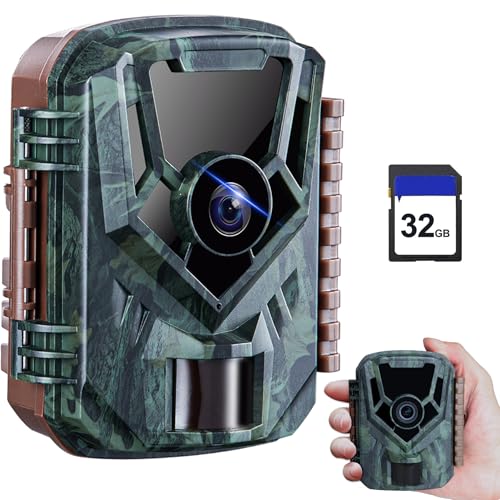
KJK’s compact trail camera captures 36MP photos and 2.7K video with 130° viewing and a 0.1s trigger. The 22Pcs 850nm low-glow LEDs deliver broad nighttime illumination while maintaining stealth. A 2.0” TFT screen helps with quick on-site review, and the device is designed for wildlife monitoring, hunting, and perimeter security.
Buying Guide
Key purchase considerations when selecting a night camera for wildlife include image and video quality, night vision brightness, trigger speed, and durability in outdoor conditions. Consider whether you need no-glow infrared LEDs to avoid disturbing animals, or if color night vision is essential for your use case. Wi‑Fi or app connectivity can simplify monitoring from a distance, but ensure the range fits your setup. Battery life, solar options, and included storage (SD cards) affect long-term reliability. Look for models with wide detection angles to maximize coverage and a robust waterproof rating for variable weather.
- Image quality: Higher megapixels enhance detail in stills; higher video resolution improves nighttime footage.
- Night vision: No-glow infrared reduces disturbance; color night vision can help in some environments.
- Trigger speed and recovery: Faster speeds capture more moments and reduce missed activity; consider burst modes for fast-moving wildlife.
- Connectivity: Wi‑Fi or cellular options allow remote checks, immediate status, and streaming video if supported.
- Durability: Look for IP ratings and rugged housings to handle rain, dust, and cold.
Comparison overview helps guide decisions based on priorities: highest detail vs. stealth night recording, remote access vs. simple standalone use, and the balance between battery life and frequent field checks. For security-focused setups, consider models with solid detection distance and anti-disruption features. For wildlife research, prioritize fast trigger speed and wide-angle coverage to document diverse nocturnal activity.