Choosing the right multimeter for small electronics involves balancing accuracy, range, safety, and ease of use. The following five models are well-suited for hobbyists, students, and professionals performing circuit testing, repair, and troubleshooting on compact projects. Each option covers essential measurements such as voltage, current, resistance, continuity, and more, with features tailored to tight workspaces and automotive or electronics work.
| Product | Brand | Key Capabilities | Notable Feature |
|---|---|---|---|
| AstroAI Digital Multimeter Tester 2000 Counts | AstroAI | AC/DC voltage, DC current, resistance, diode, continuity | Backlit display; 1999-count readout |
| KAIWEETS Digital Multimeter TRMS 6000 Counts | KAIWEETS | Voltage, current, resistance, diodes, continuity, capacitance, frequency | Auto-ranging; non-contact voltage testing |
| Klein Tools MM325 Multimeter | KLEIN TOOLS | AC/DC voltage, current, resistance, continuity, diode, battery test | Lead-Alert protection; backlit display |
| FNIRSI DMT-99 Digital Multimeter | FNIRSI | Ron width: 9999 counts, TRMS; resistance, capacitance, diode, frequency | Rechargeable with data mode |
| MS8233D Crenova Multimeter | Crenova | DC/AC voltage, current, resistance, capacitance, frequency, duty cycle | 6000-count LCD; NCV live test |
Below are the five featured models, organized to help you compare essential specifications, usability, and safety features for compact electronics work. Each section highlights notable strengths and how they translate to practical, real-world testing scenarios.
AstroAI Digital Multimeter Tester 2000 Counts

The AstroAI 2000-count meter offers essential capabilities for small electronics work, including AC/DC voltage, DC current, resistance, and diode testing. It provides a backlit LCD display with a 3 1/2-digit readout, aiding readability in confined spaces. A notable caution is the requirement to insert test leads correctly and set the rotary switch to the proper range to obtain accurate results. While it handles most household and automotive tests, it is important to review the user manual for measuring below certain AC voltage levels to avoid false readings.
Key points for use:
– Auto- or manual-range operation varies with model settings; verify the dial position before testing.
– The meter is well-suited for quick diagnostics on small electronics and automotive circuits.
– Built-in display clarity helps when working in tight spaces or dimly lit areas.
KAIWEETS Digital Multimeter TRMS 6000 Counts
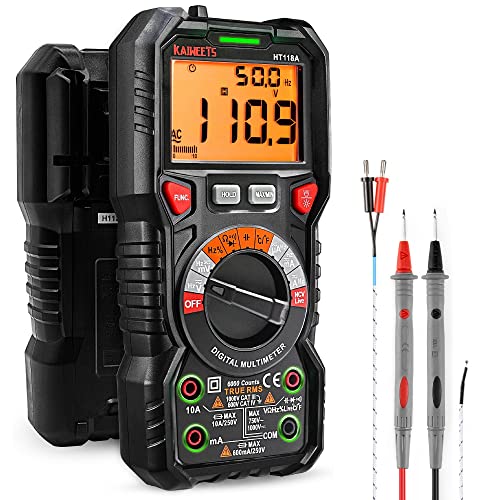
The KAIWEETS HT118A model provides wide-ranging capabilities suitable for small electronics and automotive tasks. It measures up to 1000V DC and 750V AC voltage, 10A AC/DC current, and 60 MΩ resistance, with added functions for temperature, capacitance, frequency, duty-cycle, and diode/continuity checks. Auto-ranging dramatically simplifies setup, and the large 2.9” backlit display makes readings easy to read. Non-contact voltage testing with audible/visual alert supports safer handling in tight spaces, while a kickstand and data features support field use.
Key points for use:
– Auto-ranging reduces guesswork for beginners.
– The backlight and large display aid visibility in cramped or dark workspaces.
– Multi-function testing makes it a versatile tool for electronics, automotive, and DIY projects.
Klein Tools MM325 Multimeter

Klein Tools MM325 emphasizes safety and reliable measurement for small-electronics work. It provides AC/DC voltage up to 600V, 10A DC current, and 2 MΩ resistance with additional tests for continuity, diode, and battery condition. Lead-Alert protection LEDs indicate proper test lead placement, enhancing accuracy and safety. A backlit display improves visibility in dim environments, making it a good choice for electronics labs or on-site diagnostics where lighting varies.
Key points for use:
– Safety indicators help prevent misreadings due to misconnected leads.
– Clear display supports accuracy in low-light conditions.
– Broad measurement support covers common small-electronics tasks, including battery testing.
FNIRSI DMT-99 Digital Multimeter

The FNIRSI DMT-99 stands out with a 9999-count TRMS display and a rechargeable 1500 mAh battery, enabling longer operation between charges. It supports recording and monitoring modes to observe voltage or current fluctuations over time, and it can record up to eight measurements with max/min values. This makes it valuable for analyzing transient behavior in small power supplies and embedded electronics. The built-in Type-C charging adds convenience for modern workflows and field use.
Key points for use:
– Recording and monitoring modes help track changing signals during tests.
– Rechargeable power eliminates frequent battery replacements.
– TRMS measurement improves accuracy for non-sinusoidal signals common in electronics.
Crenova MS8233D Multimeter

The Crenova MS8233D offers essential measurements for small electronics, including DC/AC voltage, DC/AC current, resistance, capacitance, frequency, duty cycle, continuity, and NCV live-wire testing. It adheres to safety standards with built-in fuses providing overload protection and an insulated holster to reduce shock risk. The 6000-count LCD, along with a bright backlight, provides clear readings in dim workspaces, making it suitable for hobbyists and professionals working on compact projects where space is at a premium.
Buying Guide: Key Purchase Considerations
When selecting a multimeter for small electronics, consider the following factors to ensure reliable testing and safe operation:
- Measurement range and resolution — For small circuits, prefer meters with at least 6000 counts and TRMS for accurate AC readings. Ensure the ranges cover the voltages and currents typical in your projects.
- Safety and standards — Look for CAT ratings suitable for your use case (CAT II/III) and built-in protections such as fuses and lead alert indicators. Insulated holsters and sturdy designs help in workshop environments.
- Display and usability — A backlit LCD or large digits improves visibility in tight spaces or dim rooms. Auto-ranging simplifies operation, especially for beginners.
- Special features — Non-contact voltage detection, data hold, minimum/maximum recording, and live-wire testing enhance usability. Recording or monitoring modes help analyze signal changes over time in electronics tests.
- Power management — Rechargeable batteries offer longer use between charges, which is useful for field work. Consider Type-C charging for compatibility with modern devices.
- Portability and form factor — Pocket-sized meters fit easily into toolboxes or carry cases, but ensure they still provide robust leads and accessible test ports for diverse tasks.
- Accessories and support — A supplied case, test leads, and clear manuals improve setup speed and safety. Manufacturer support and firmware updates can extend usability for newer electronics tests.
In practice, choose a model that balances display readability, range coverage, and safety features with the type of small electronics you most frequently service. Auto-ranging and TRMS capabilities are especially helpful for modern, compact circuits with mixed signal types. If you frequently test automotive electronics or battery systems, prioritize higher current ranges and robust lead protection. For hobbyists, models with data logging or recording modes can provide valuable insight into circuit behavior over time.