Finding the right motherboard for a mining rig starts with assessing your goals: maximum GPU count, stable power delivery, and reliable compatibility. This guide highlights five proven options that balance performance, expandability, and cooling for American buyers. Each pick is analyzed for who it’s best for, and where it excels or falls short. The focus is on motherboards that support multiple GPUs and robust power delivery, plus practical mining frames to complete a rig setup.
| Product | Best For | Key Benefit |
|---|---|---|
| VTRETU MINING 8GPU Rig (Windows 10, 8 GPUs) | Full 8-GPU setups | Integrated 2000W power supply and cooling |
| ASUS Motherboard with USB Ports | High-connectivity mining farms | 19 PCIe slots and strong protection features |
| ASRock H110 Pro BTC+ 13GPU | Mid-range 13-GPU rigs | Reliable BTC-focused mining board |
| Biostar TB360-BTC D+ | 8-GPU builds with IGFX | Intel 300 Series compatibility |
| Baseltek 6 GPU Aluminum Frame | Open-air frame for up to 6 GPUs | Durable, modular cooling design |
8GPU Mining Rig Complete Crypto Miner With Windows 10

Best for enthusiasts seeking an all-in-one 8-GPU mining solution. This kit includes an 8-GPU mining motherboard, a 2000W full-voltage power supply, Windows 10, an SSD, 4GB RAM, and a ready-to-assemble mining case. It supports HiveOS and Linux OS, with straightforward setup by mounting GPUs and drivers. Ideal for users who want a turnkey starter or a high-capacity rig for Ethereum Classic, Litecoin, Ravencoin, Monero, and related coins. The built-in cooling system includes eight controllable fans for robust airflow. A practical caveat: the Windows 10 license is not activated by default, so some users may prefer a Linux-based setup for long-term stability.
Best for: Buyers who want a complete, plug-and-play 8-GPU rig with strong cooling and a wide OS compatibility range.
Why selected: It offers a high-wan efficiency setup, a large power supply, and a complete case design, reducing component sourcing time.
Limitations to consider: Windows 10 not activated out of the box; users may want to switch to HiveOS or Linux for full automation and cost control.
ASUS Motherboard With USB Ports

This motherboard is designed for high-connectivity mining farms, featuring 19 PCIe slots divided into three power-delivery groups. It supports up to 32GB DDR4 RAM, USB 3.1 Gen1, and Intel Gigabit LAN, making it suitable for large-scale rigs that demand stable data and power distribution. The board’s 5X Protection III safeguards help reduce downtime by protecting critical components. It’s best for builders who want flexible expansion, strong networking, and resilient performance under heavy GPU workloads.
Best for: Large multi-GPU installations where abundant PCIe slots and reliable networking are priorities.
Why selected: The high slot count and robust protection features support stable operation in busy mining environments.
Limitations to consider: Availability and price can vary; not every user needs 19 PCIe slots, and space at the motherboard tray may constrain certain cases.
ASRock H110 Pro BTC+ 13GPU Mining Motherboard

The ASRock H110 Pro BTC+ is a purpose-built motherboard for cryptocurrency mining, supporting 13 GPUs. It uses ASRock Super Alloy construction for enhanced durability and is compatible with 6th and 7th-gen Intel Core processors and DDR4 RAM. This board is intended for serious miners who want a stable, multi-GPU platform with steady power delivery. It is best for mid-to-large rigs that prioritize GPU density and proven mining-specific design.
Best for: Medium-to-large mining operations seeking high GPU density in a single board.
Why selected: The 13 GPU capacity makes it a strong backbone for multi-GPU rigs with efficient power management.
Limitations to consider: Older platform may limit some newer GPUs’ PCIe configurations; ensure compatibility with your GPU lineup and case layout.
Biostar TB360-BTC D+ Mining Motherboard
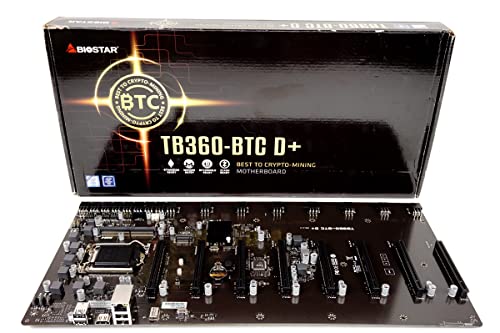
The Biostar TB360-BTC D+ is designed for Intel 8th and 9th Gen processors, aligning well with 8-GPU mining builds when paired with a capable power supply. It emphasizes compatibility with the Intel 300 Series chipset and supports DDR4 memory. It’s a practical choice for miners who want a reliable platform that balances performance with straightforward setup. Best for mid-range rigs where compatibility with older or budget CPUs helps control upfront costs.
Best for: Builders who want a straightforward, reliable board for 8-GPU mining with flexible CPU choices.
Why selected: Its compatibility with Intel 300 Series components and DDR4 memory makes it a versatile option for many mid-range rigs.
Limitations to consider: May require careful BIOS setup for optimal multi-GPU stability; ensure PSU and case clearance align with GPU count.
Baseltek 6 GPU Aluminum Mining Rig Open Air Frame

The BaselTek 6 GPU aluminum mining frame offers a sturdy open-air design for 6 GPUs, with full aluminum alloy construction and space for efficient airflow. It supports assembling multiple frames and shares a modular approach suitable for expanding a rig. This frame provides practical protection and cooling, which can translate to lower thermal throttling across sustained mining sessions. It’s best for builders who want a durable, modular frame that can scale as GPU counts rise.
Best for: Open-air rigs that require strong cooling and modular expansion up to 6 GPUs.
Why selected: Durable construction and flexible frame design help maximize cooling and ease of maintenance.
Limitations to consider: Frame only; requires separate hardware to populate GPUs and motherboard components.
Buying Guide: Key Considerations for a Mining Rig Motherboard and Frame
- Determine how many GPUs you plan to run now and in the near future. More GPUs require boards with many PCIe slots or expansion via risers, and a frame that fits the layout.
- Look for boards designed for multi-GPU use, with stable power delivery and clear guidance on PSU connections. A 1200W–2000W power supply is common for 6–8 GPU rigs, but exact needs depend on GPU type and efficiency.
- Effective cooling lowers thermal throttling and extends hardware life. Open-air frames with ample spacing between GPUs help maintain airflow; consider adding adjustable fans or a controlled chassis fan curve.
- Some miners prefer HiveOS or Linux before Windows for automation and cost control. Check if the motherboard supports these environments or if drivers are readily available for your GPUs.
- Hardware-level safeguards (like LANGuard, Safe Slot Core, and overvoltage protections) contribute to long-term reliability in demanding mining conditions.
- A turnkey kit that includes the motherboard, case, RAM, and storage can reduce setup time. Frames that allow paneling and modular expansion simplify future upgrades.
- A motherboard with robust LAN and remote management options can help monitor a rig at scale. Consider boards with Gigabit Ethernet and IP-based management features when available.
FAQ
What is the main difference between an 8-GPU rig and a 13-GPU rig?
An 8-GPU rig prioritizes lower upfront cost and simpler cooling, while a 13-GPU rig increases mining throughput but requires more complex power, airflow, and space planning.
Should I use Windows or Linux for mining?
Linux-based systems like HiveOS typically offer better long-term automation and lower overhead; Windows may be easier for beginners or when running specific mining software.
Is a dedicated mining frame necessary?
A frame supports airflow, GPU spacing, and safety. Open-air frames are common for cooling efficiency, but cases with proper airflow and cable management can also work well.
Focus on PCIe slot availability, power delivery, compatibility with your chosen CPU and RAM, and protection features that help prevent component failure under heavy GPU loads.
Can I expand a 6-GPU frame to 8 GPUs later?
Yes, if the frame design and power supply allow for additional GPUs and appropriate risers and spacing are available. Plan for airflow and cable routing with expansion in mind.