Discover top monitor stands designed to elevate a sim racing cockpit. This guide highlights five versatile options that support multiple screens, offer height and angle adjustments, and fit a range of monitor sizes. Each pick prioritizes stability, ease of installation, and compatibility with popular sim rigs.
| Product | Brand | Monitors Supported | Key Benefit |
|---|---|---|---|
| Dardoo Sim Racing Triple Monitor Stand | Dardoo | 3 screens 24–32 in; or 1 large screen 24–65 in | Adjustable height and angle for optimal viewing |
| Next Level Racing Lite Free Standing Monitor Stand | Next Level Racing | Up to 55” VESA 75×75 to 400×400 | Solid carbon steel frame with rigid construction |
| SimFab Monitor Mount Floor Stand | SimFab | Up to 100×100 VESA; 24–49” ultrawide | Clear immersion with adjustable height, tilt, and roll |
| Next Level Racing Free Standing Single Monitor Stand | Next Level Racing | 24”–85” with 75×75 to 450×660 VESA | Wider base behind wheel for optimal placement |
| Marada Racing Sim Monitor Frame | Marada | 24–60 in; 75×75 to 400×400 mm | Universal compatibility with round tube stands |
Notes: All products listed are compatible with common VESA patterns and are designed for sim racing setups. When selecting a stand, consider monitor size, mounting pattern, stability, height and angle adjustability, and compatibility with your cockpit or rig.
Dardoo Sim Racing Triple Monitor Stand

The Dardoo triple monitor mount is designed for racing simulators with flexible configuration. It supports three smaller screens (24–32 inches) or a single large screen (24–65 inches). The stand is built for a round tube racing cockpit and includes an adjustable height and angle to help achieve a comfortable, immersive viewing position. It is compatible with a wide range of monitors via VESA patterns from 75×75 mm to 400×200 mm and ships with installation accessories and a guide for straightforward setup. This option emphasizes ergonomic alignment to reduce eye strain during long sessions.
Next Level Racing Lite Free Standing Monitor Stand

The Next Level Racing Lite Free Standing Monitor Stand is designed as part of the Lite Series. It supports up to a 55-inch screen with VESA mounting patterns from 75 x 75 mm to 400 x 400 mm. The stand is built with a carbon steel tube frame and reinforced nylon components for rigidity. This option suits users seeking a sturdy, standalone monitor solution that can accommodate mid-to-large displays while maintaining a compact footprint and ease of assembly.
SimFab Monitor Mount Floor Stand

The SimFab floor stand is designed for racing and flight simulators, supporting monitors up to 100×100 mm VESA and sizes from 24 to 49 inches, including ultrawide displays. It offers adjustable height, tilt, and roll, with legs spread to wrap around a sim cockpit for maximum immersion and field of view. For larger or curved displays beyond 100×100 mm, a heavy-duty option is available. This stand emphasizes stable support and adaptability for varied cockpit layouts.
Next Level Racing Free Standing Single Monitor Stand

This free-standing single monitor stand from Next Level Racing offers robust support for large displays, with a range from 24” up to 85” and VESA configurations from 75×75 to 450×660. A wider base arrangement behind the steering wheel makes it possible to place the monitor directly in line with the driver or slightly offset, depending on space. Lockable castor wheels provide portability and quick angle adjustments for dynamic racing scenarios.
Marada Racing Sim Monitor Frame
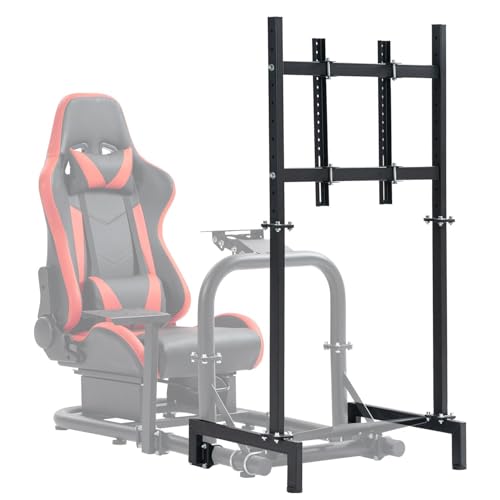
The Marada monitor frame is a universal compatibility solution designed to work with round tube stands and screens ranging from 24 to 60 inches. It supports VESA patterns from 75×75 to 400×400 mm and can handle up to 110 pounds, making it suitable for heavier displays. The stand emphasizes a blend of height adjustability and sturdy construction to ensure stable viewing angles across diverse cockpit configurations, enhancing immersion in racing sessions.
Buying Guide
Key purchase considerations help ensure you select a monitor stand that fits your sim rig and performance needs:
- Display size and weight compatibility: Verify maximum screen size and weight supported, especially for ultrawide or heavier monitors.
- VESA compatibility: Most stands support standard patterns such as 75×75, 100×100, and up to 400×400 mm. Check your monitor’s VESA holes before purchasing.
- Mount configuration: Decide between single, dual, or triple monitor setups. Triple stands are common for immersive multi-monitor rigs, while single stands may offer more flexibility in tight spaces.
- Adjustability: Prioritize height, tilt, and yaw/roll adjustments to fine-tune field of view and reduce neck strain during long sessions.
- Rig compatibility: Ensure the stand fits your cockpit or wheel base—some mounts are designed for round-tube cockpits, others are standalone frames.
- Stability and material: Look for steel frames or reinforced components for rigidity, especially if you frequently move the rig or run high-G scenarios.
- Mobility and installation: If you need to reposition frequently, consider stands with caster wheels or quick-release hardware and clear installation guides.
- Expandability: Some stands support future upgrades (e.g., upgrading from single to triple monitors) without replacing the entire system.
Compared perspectives:
- Triple-monitor setups offer wider field of view but require more space and robust support. Choose a stand with secure joints and ample weight capacity to prevent sagging.
- Free-standing designs provide easy placement away from the cockpit but may require a larger footprint. They are often simpler to move between rooms or setups.
- Floor-standing and wall-mount hybrids can save desk space but may require wall reinforcement or ceiling clearance in some rooms.
- Budget-conscious options may prioritize basic stability and easy assembly, while premium stands emphasize modularity and long-term durability.