If you’re building a home recording studio, choosing the right monitors is essential for accurate mixing and reliable playback. The following selections emphasize clarity, stereo image, and usable bass at near-field listening distances. Each option is suitable for desktop setups, multimedia production, or music creation, helping you translate ideas from your studio to your listeners.
| Product | Brand | Key Benefit |
|---|---|---|
| PreSonus Eris 3.5 (Black) | PreSonus | Accurate, compact near-field monitoring |
| Mackie CR3.5 | Mackie | Tone control for flexible sound shaping |
| JBL 305P MkII | JBL | Wide sweet spot and strong imaging |
| PreSonus Eris 3.5 (White) | PreSonus | Similar performance with stylish finish |
| Yamaha HS3 | Yamaha | Classic flat-response monitoring |
PreSonus Eris 3.5 Studio Monitors (Black)

HONEST. Eris 3.5 near field studio monitors deliver studio-quality, accurate sound perfect for music production, hi-fi audio listening, or multimedia reference. EXPRESSIVE. Clear, accurate audio with a big low end thanks to woven-composite woofers, resulting in tight bass and cleaner overall sound. POWERFUL. Compact speakers that pack a punch with 50 Watts of Class AB dual amplification (25W per side) for volume without sacrificing tonal balance.
Mackie CR3.5 Creative Reference Monitors

Mackie CR3.5 Creative Reference Powered Studio Monitors feature a built-in tone knob and flexible inputs. They connect via TRS and RCA, plus 3.5 mm for PC or gaming setups. The tone knob lets you shape sound, boosting bass and adding sparkle for immersive gaming, casual listening, or music production, all while preserving a transparent studio reference sound.
JBL 305P MkII 5″ Studio Monitors

JBL 305P MkII monitors deliver crystal-clear imaging with the patented Image Control Waveguide, yielding a wide sweet spot ideal for accurate music production and podcasting. Dual 41-Watt Class-D amplifiers drive a 5″ woofer and Slip Stream port to provide dynamic range and deep bass, supporting cinematic sound design and precise mixing.
PreSonus Eris 3.5 Studio Monitors (White)

HONEST. Eris 3.5 near field monitors deliver accurate sound ideal for music production and multimedia reference. EXPRESSIVE. Clear, deep bass with woven-composite woofers for tight low-end response and clean overall sound. POWERFUL. 50 Watts of Class AB dual amplification (25W per side) maintains tonal balance and clarity at useful listening levels.
M-AUDIO BX3 Studio Monitors

M-AUDIO BX3 monitors offer desktop-friendly studio sound with 120W powered output and a bass reflex design for deeper bass. They feature 3.5″ Kevlar low-frequency drivers and 1″ silk dome tweeters, plus a waveguide for precise imaging and front-panel controls for high and low EQ to tailor the sound to your room or genre.
Ortizan C7 Dual-Mode 2.0 Studio Monitors (White)
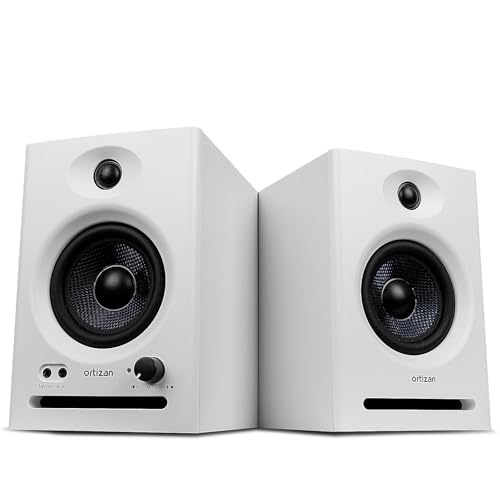
Ortizan C7 monitors provide multiple inputs, including RCA and Bluetooth 5.3 for wireless pairing. A 24-bit DAC via USB minimizes signal loss and preserves fidelity for top audio performance. The 3.5″ carbon fiber woofer and 0.75″ silk dome tweeter deliver precise mid-to-high frequencies with a layered, clear sound.
Yamaha HS3 Powered Studio Monitor

Yamaha HS3 provides a compact two-way design with a 3.5″ woofer and 0.75″ tweeter, delivering a frequency response roughly from 70 Hz to 22 kHz. Known for a flat-ish, listener-friendly sound profile, these monitors are often favored for critical listening and mixing in near-field positions.
Buying Guide: Key Considerations For Studio Monitors
- Room size and listening distance: Near-field monitors are typically preferred for small to mid-sized rooms to reduce reflections and improve clarity.
- Frequency response and accuracy: Look for monitors with a balanced, low-distortion response that reveals both lows and highs without excessive coloration.
- Woofer size and power: Larger woofers and sufficient wattage help reproduce bass accurately at typical listening levels, but space and budgeting matter.
- Connections and compatibility: Ensure there are versatile inputs (TRS, RCA, USB) to match your interface, computer, and other gear.
- Build and finish: A sturdy cabinet and placement options (on desk, near-field stands) improve imaging and reduce vibrations.
- Room treatment: Pair monitors with acoustic treatment like bass traps and panels to minimize flutter echoes and standing waves.
- Calibration features: Some models offer room EQ, high/low shelving, or tilt adjustments to tailor response to your space.
- Budget vs. value: Consider both initial cost and long-term reliability, warranty terms, and after-sales support.
- Use case variance: If you also mix video, podcast, or gaming, some monitors with tone controls or wider sweet spots may be beneficial.
These monitors provide a spectrum of budget-friendly and feature-rich options. For critical mixing, rely on models with accurate imaging and a neutral response, and complement them with careful room setup and listening fatigue checks across your typical project styles.