Mini 3D printers are compact, affordable entry points for beginners and students who want to explore hands-on design and prototyping. This guide highlights five capable models with auto-leveling, easy setup, and reliable performance. Each option brings unique strengths—from fully assembled out-of-the-box use to powerful speed and solid build quality—so you can choose the best fit for your creative projects.
| Product | Brand | Key Strength |
|---|---|---|
| Fully Assembled Mini 3D Printer Starter Kit | Asani | Auto leveling, complete starter kit |
| Tina2 Basic V11 | Entina | Ready out of the box, auto leveling |
| TINA2 Mini 3D Printer | HEPHI3D | Auto leveling, resume printing |
| Adventurer 5M | FLASHFORGE | Fully automatic bed leveling, high-speed printing |
| Mini 3D Printer, All Metal Nozzle | YUEHISY | Rapid heating, PLA/TPU compatibility |
Note: All products are presented with their features as listed by the sellers. Capabilities such as auto leveling, speed, and open-source design are emphasized to help you compare suitability for learning, classroom use, or home projects.
Asani Mini 3D Printer Starter Kit

The Asani mini printer is delivered fully assembled and packaged as a complete starter kit. It includes a mini printer, 10 meters of PLA filament, a microSD card preloaded with model designs and splicing software, and additional accessories. Its compact 8.3” x 8.3” x 11.4” footprint makes it suitable for homes, classrooms, and dorms. It emphasizes reliability out of the box with a focus on beginner-friendly operation. The device features auto leveling and a dual z-axis rail to support high-precision prints, a 2.4” LCD, and a flexible magnetic build plate for easy model removal. This model is designed to simplify the learning curve while delivering consistent results for first projects and demonstrations.
Entina Tina2 Basic V11 Mini Printer

Out of the box, the Tina2 Basic V11 is fully assembled for immediate use, aiming for quick-start printing within minutes. It offers a 2.4″ LCD and Wiibuilder slicer software to facilitate offline printing via MicroSD Card. A key feature is resume printing after power outages, helping maintain prints rather than starting over. Auto leveling is included, and the magnetic, removable build plate simplifies model removal. The setup emphasizes ease of use for beginners and children, with a focus on straightforward, accessible workflows for school or home projects.
TINA2 Mini 3D Printer by HEPHI3D
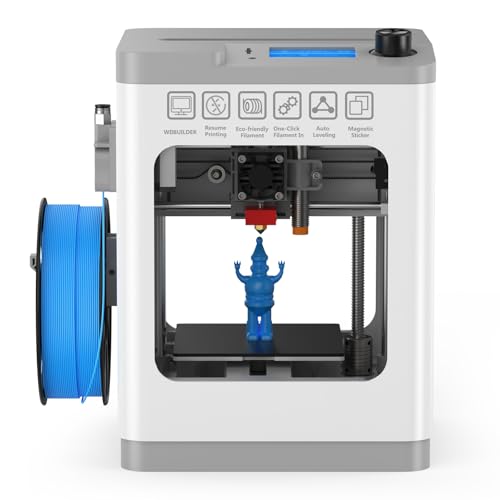
The TINA2 Mini from HEPHI3D is a compact, auto-leveling 3D printer designed for kids and beginners. It ships ready-to-use out of the box with a 2.4″ LCD display and an included sample PLA filament roll and Micro SD card loaded with models. It features auto bed leveling and a removable magnetic platform for easier model removal. While it lacks built-in WiFi in this variant, it is positioned as an accessible entry point for classroom demonstrations, home projects, and beginner experimentation, with a straightforward pause-and-resume workflow after interruptions.
FLASHFORGE Adventurer 5M 3D Printer

The Adventurer 5M from FLASHFORGE is designed for speed and reliability. It features a fully automatic leveling system, reducing manual calibration time for first-time users. The CoreXY architecture supports high-speed travel up to 600 mm/s and high acceleration, supporting rapid prototyping while maintaining print quality. A dual-sided PEI build platform and a quick nozzle-change capability provide flexibility for different materials and coatings. The printer is designed to balance ease of use with performance, making it suitable for students, makers, and professionals who need faster turnarounds on small parts and models.
YUEHISY Mini 3D Printer

The YUEHISY mini 3D printer emphasizes rapid heating and ease of use for beginners. It supports 1.75 mm PLA and TPU filaments and offers a compact 4 x 4 x 4 inch build volume. Features include a user-friendly setup, straightforward controls, and a focus on reducing printing errors with a stable, all-metal nozzle design capable of reaching typical PLA printing temperatures quickly. The device is positioned for educational use and home projects, where quick-start capability and simple operation are valued.
Buying Guide
- Out-of-the-box readiness: Fully assembled units save setup time and are ideal for classrooms and non-technical users. If you prefer a ready-to-run experience, prioritize models with auto leveling and preloaded model libraries.
- Auto leveling and bed compensation: Auto leveling helps ensure first-layer adhesion and print consistency, especially for beginners and kids learning the process. Look for printers with one-click or automatic bed leveling and a stable, removable magnetic build plate.
- Print speed and precision: Mini printers often balance speed with accuracy. Consider units that advertise a higher top speed without sacrificing layer resolution (0.05 mm to 0.2 mm range is common for entry-level devices).
- Connectivity and file transfer: WiFi-enabled printers and MicroSD card support can streamline workflow in school or home environments. If you want offline printing, ensure the included software or card supports offline operation.
- Build volume and materials: Mini printers typically offer small build areas sufficient for learning and model prototyping. Check compatibility with PLA and softer filaments like TPU to expand project options.
- Open-source ecosystems: Some printers support standard slicers (Cura, Simplify3D, Slic3r) and firmware updates, enabling customization and long-term support.
- Durability and support: Look for reputations for reliable customer support and available replacement parts, especially for school use where uptime matters.