Finding the right MIDI foot controller can streamline live rigs and studio setups by letting guitarists switch amps, pedals, and effects hands-free. This guide highlights five reliable options that balance wireless and wired reliability, durable builds, and flexible MIDI mappings. Each pick is evaluated for performance, battery life, and ease of integration with guitar pedals and DAWs.
Summary of selected products
| Product | Key Benefit | Connectivity | Approx. Buttons | Notes |
|---|---|---|---|---|
| Lefiko Wireless MIDI Foot Controller | Great balance of wireless freedom and solid build | BT MIDI + USB MIDI | 4 | Low latency, 5 modes, LCD display |
| Behringer FCB1010 | Ultra-flexible with extensive preset options | USB/5-pin MIDI compatible | 10 banks x 10 presets | Two expression pedals included |
| Btuty BT MIDI Foot Controller | Portable with long battery life | Wireless app control | 4 | CubeSuite app support |
| Cloudpower MIDI Foot Controller | Compact metal chassis on a budget | USB/BLE MIDI | 4 | 12-hour battery, quick charge |
| Nektar Pacer | Integrated DAW control for hands-free work | USB MIDI, DAW integration | 10 switches (+ up to 4 ext pedals) | Ideal for recording and live playback |
Lefiko Wireless MIDI Foot Controller (4 Buttons)

The Lefiko device offers wireless MIDI control with four customizable foot switches and an integrated expression-capable footprint. Its dual connectivity (BT MIDI and USB MIDI) supports flexible stage setups and studio configurations. The small LCD display helps track the active mode and bank, reducing on-stage guesswork. The unit ships with a stable wireless receiver to minimize dropouts in crowded venues, and it can trigger loops, presets, and effects in real time. Each switch supports multiple trigger styles for tailored use, helping guitarists map pedalboard actions without bending down to adjust settings mid-song.
Key features include long battery life, with a rechargeable battery designed for extended sessions, and a compact, durable form factor ideal for gig bags. While wireless performance is a highlight, there is also a wired USB option for computer-based control, enabling seamless integration with DAWs and guitar effects processors alike. The trade-off tends to be a smaller button count compared with larger controller rigs, so you’ll want to plan your presets and banks carefully to maximize live utility.
Behringer FCB1010 Ultra-Flexible MIDI Foot Controller

The Behringer FCB1010 is a classic option for players seeking deep customization. It combines 10 banks with 10 user-editable presets per bank and two assignable expression pedals, making it possible to control a wide array of MIDI-compatible pedals, synths, and effects units. This model excels in studio rigs and live setups where expansive MIDI routing is necessary. The dual expression pedals can be mapped to continuous controllers or program changes, allowing dynamic performance control over volume, wah, filter sweeps, and more.
Pros include robust preset management, a broad range of MIDI commands per preset, and the ability to switch quickly between complex configurations. Cons involve its size and weight, which may be less convenient for ultralight touring and its older user interface, requiring some memorization of bank/preset navigation. It remains a staple for players who require a battle-tested, versatile MIDI floor controller that can drive multiple gear blocks at once.
Btuty BT MIDI Foot Controller With App Control

The Btuty device combines portability with app-based control via CubeSuite, enabling musicians to manage MIDI programs through a smartphone or tablet. Its four foot switches support reliable on-the-fly changes to loops, patches, or effects during performances, with a rechargeable battery designed for extended sessions. The compact design makes it suitable for pedalboard integration or for players who want a lightweight, wireless option for live gigs or mobile recording sessions.
Considerations include battery life and app reliability, as well as the learning curve for configuring the app and ensuring stable Bluetooth connections in performance environments. The device is best suited for small to mid-size pedal setups where quick, wireless control is a priority and where space on the pedalboard is limited.
M-VAVE Chocolate Plus Wireless MIDI Controller
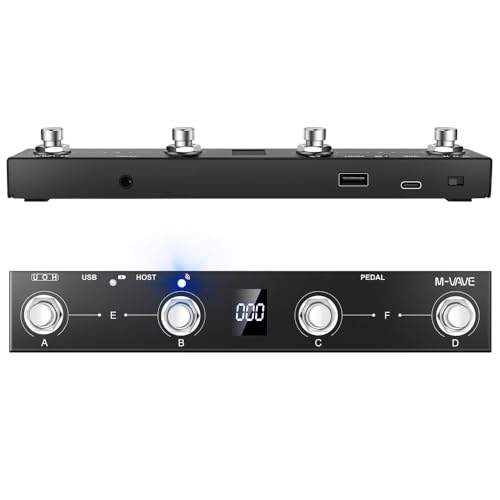
The M-VAVE Chocolate Plus provides wireless MIDI control with four foot buttons and USB charging. Its emphasis on wireless operation makes it suitable for guitarists who want to reduce cable clutter on stage. The controller claims compatibility with a broad range of music apps, enabling intuitive control over DAWs or virtual instruments through a mobile app that also facilitates firmware upgrades offline. This model is particularly appealing for mobile setups or home studios where space and wiring need minimal disruption.
Key trade-offs involve the scope of real-time mappings and the app’s depth for professional studio workflows. For performers who value portability and straightforward control over essential functions like play/pause, loop control, and patch changes, the M-VAVE option strikes a balance between simplicity and function.
PAINTAUDIO MIDI Captain Foot Controller

The PAINTAUDIO MIDI Captain Foot Controller is designed for complex key actions with a built-in time engine that records actions for later playback. It offers 10 fully customizable switches capable of sending PC, CC, and Note messages to PC/CC/Note-compatible gear. This controller is particularly attractive for players who want to assemble and recall elaborate rigs with a single foot press, such as combining bias effects, amp models, and pedal presets into a cohesive performance package. It also emphasizes ongoing firmware updates to expand function sets.
Nektar Pacer USB MIDI Footswitch

The Nektar Pacer integrates with DAWs to provide hands-free control of transport and navigation, alongside ten programmable foot switches and compatibility with up to four optional pedals. This makes it a strong choice for guitarists who also want tight DAW integration during recording sessions or live looping contexts. Its design centers on delivering reliable control without requiring heavy setup or complex routing.
Buying Guide
- Connectivity: Choose between wireless (Bluetooth) for stage mobility and wired USB/MIDI for studio reliability. If you frequently perform in crowded venues, a model with a stable wireless receiver or dual connectivity helps prevent dropouts.
- Button count and layout: For guitar pedal control, 4–10 buttons often suffice for essential presets, loops, and effects. Consider whether you need an expression pedal for real-time parameter control such as volume or filter sweep.
- Presets and bank management: Look for models offering multiple banks and easy switching between presets. Some devices support extensive per-preset MIDI messages, which is beneficial for complex rigs with multiple effect chains.
- Battery life and charging: Rechargeable batteries with several hours of continuous use are ideal for gigs. Fast charging minimizes downtime between sets.
- App and firmware support: A robust companion app and regular firmware updates ensure compatibility with the latest DAWs, pedal effects, and operating systems.
- Durability and form factor: Metal chassis and compact designs withstand road use and fit on crowded pedalboards. Weigh options against touring needs and space constraints.
- DAW and device compatibility: Ensure the controller works with your primary DAW (e.g., Logic Pro, Ableton) and with your favorite guitar pedals or effect units, especially if you rely on MIDI for parameter control.
- Ease of setup: Some devices offer out-of-the-box templates or simple mode-switching, which can save time during rehearsals and live performances.
When selecting a MIDI foot controller for guitar pedals, balance is key: wireless freedom versus reliability, minimal footprint versus extensive control, and immediate usability against deeper customization. The options reviewed here provide a spectrum of choices, from compact four-button models to expansive multi-bank controllers, enabling players to tailor their rigs for studio recordings or live performances without sacrificing pedal response or on-stage practicality.