For drum-hearted producers and beat makers, midi controllers that combine pads, knobs, and keyboard keys can streamline workflow, samples, and sequencing. Below are handpicked options that suit live performance, studio work, or portable setups. Each product is evaluated for drum pad quality, ease of mapping, and software integration to help you choose the right tool for your style.
| Product | Brand | Key Features |
|---|---|---|
| Akai MPK Mini MK3 (25 keys, 8 pads, 8 knobs) | Akai Professional | Portable USB-powered, NKS integration, arpeggiator, 4-way thumbstick |
| Akai MPD218 (16 MPC pads, 6 knobs) | Akai Professional | Dedicated pad banks, full level, note repeat, compact for travel |
| AKAI LPD8 (8 pads, 8 knobs) | Akai Professional | 8 RGB pads, 8 assignable knobs, preset mappings |
| Donner STARRYPAD (16 pads, 2 faders) | Donner | Backlit pads, 3 banks, class-compliant USB-C |
| Novation Launchkey 61 MK4 (61 keys, 8 pads) | Novation | DAW integration, chord/scale modes, arpeggiator, software bundle |
Akai MPK Mini MK3 Overview

The Akai MPK Mini MK3 is a compact USB-powered MIDI controller designed for drum and beat production on the go. It features 25 velocity-sensitive mini keys for melodic control and 8 backlit drum pads for launching samples and drums. A four-direction thumbstick provides expressive pitch bending and modulation, while the built-in arpeggiator adds rhythmic variety. Native Kontrol Standard (NKS) integration extends control with compatible software and library support, enabling seamless Kontrol from the hardware. This model suits travelers, bedroom studios, and live performers who need portability without sacrificing core drum and beat-making capabilities.
Akai MPD218 Drum Controller
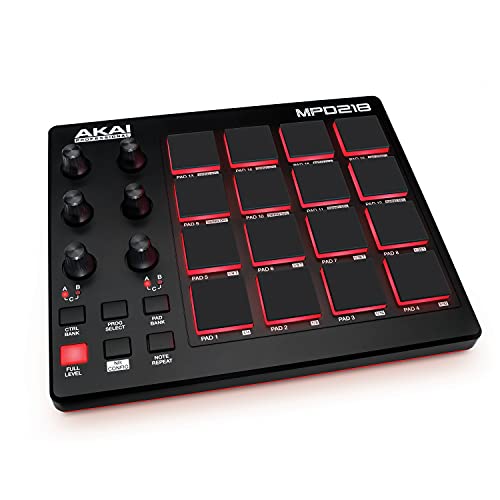
The Akai MPD218 is a compact USB MIDI pad controller featuring 16 MPC-style pads designed for drum sequencing and beat creation. It includes 6 assignable knobs for DAW control and parameter tweaking, plus note repeat and full level functions. The device is well-suited for groove-based production, enabling quick pad-based composition while offering accessible banks for expanded control. Its portability makes it a practical choice for producers who want a dedicated pad-focused workflow without a full-size controller.
AKAI LPD8 Pad Controller

The LPD8 from Akai is an 8-pad, 8-knob USB MIDI controller designed for hands-on control. Its RGB-backlit pads provide clear visual feedback while triggering samples, loops, and virtual instruments. The 8 assignable Q-Link knobs map to DAW parameters and software instruments for tactile mixing and effect adjustments. With four programmable preset slots, users can quickly switch between different mappings for multiple DAWs or projects, supporting a quick on-the-fly setup for live or studio sessions.
Donner STARRYPAD Drum Pad Controller

The Donner MIDI Pad Beat Maker STARRYPAD offers 16 soft silicone backlit pads, arranged for versatile drum and sample triggering. It supports three pad banks that expand to 48 pads, enabling complex beat setups. The controller includes two faders and three knobs plus a Shift key, which adds a secondary layer of control for more intricate mapping. It is class-compliant, USB-C powered, and designed for plug-and-play operation with various DAWs and devices, including iOS with the right accessory.
Novation Launchkey 61 MK4 Overview
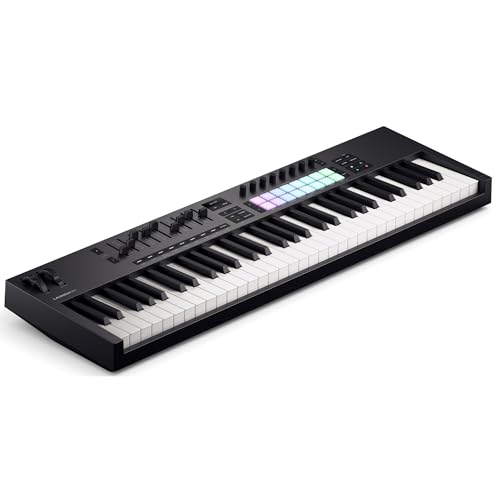
The Novation Launchkey 61 MK4 combines a 61-key semi-weighted keyboard with 16 responsive pads and deep DAW integration. It includes chord and scale modes for quick melodic ideas and performance-friendly features like an arpeggiator. The kit comes with a software bundle for music production and is compatible with major DAWs, offering a streamlined workflow for Launchkey users who want an all-in-one instrument for keyboard, drum programming, and clip launching.
Buying Guide
- Pad quality and feel: For drums, pad responsiveness, velocity sensitivity, and backlighting help with accurate triggering and visual feedback during performances.
- Keybed preference: If you also play melodies, weigh 25- or 61-key options versus full-size keys. Semi-weighted keys offer a balance between feel and portability.
- DAW compatibility: Confirm that the controller maps cleanly to your preferred DAW and whether it includes ready-to-run templates or software bundles.
- Control surface: Look for knobs, faders, and a modulation/aftertouch system that suits your workflow—especially for mixing and effect navigation during sessions.
- Portability vs. desktop setup: Compact units are great for travel and small spaces; larger controllers provide more hands-on control but require more desk space.
- Expandable capabilities: Consider models with multiple pad banks or assignable controls to scale with your evolving project needs.
- Software integration: NKS or other native integrations can streamline library access and instrument control for faster production.
- Price-to-feature balance: Higher-priced models often offer more robust pads, better key action, and richer software bundles; ensure you’re selecting features that match your use case.
- Future-proofing: If you anticipate expanding into live performance, choose an option with robust hardware controls and stable drivers for reliable gig use.
Multiple Perspectives
Whether you prioritize portability for on-the-road music making or seek a larger control surface for studio sessions, each option in this list offers distinct strengths. Pad-centric devices excel for drum sequencing and clip launching, while keyboard-based controllers provide melodic and harmonic input alongside rhythm control. For live DJs and beatmakers, models with clear visual feedback and quick bank switching reduce setup time. If you depend on specific software ecosystems, consider compatible integrations like NKS or DAW-mapped templates to minimize configuration work and maximize creative output.