Finding the right microscope for mushroom spores requires clear optics, reliable illumination, and sturdy construction. This guide highlights five versatile options that balance magnification, lighting, and ease-of-use for hobbyists, students, and researchers. The selections emphasize spore-focused viewing, cell detail, and the ability to illuminate translucent samples. Best for beginners, best for portable field work, and best for deep-dive lab analysis are noted for quick decisions.
| Product | Best For |
|---|---|
| PALOBIL Microscope for Adults Professional | Adults needing high magnification with durable build |
| Elikliv LCD Digital Coin Microscope | Users who prefer a large display and PC viewing |
| WKR Coin Microscope with LCD | Budget-friendly, easy setup for home labs |
| PalliPartners Compound Microscope for Adults & Students | Serious study in school or home lab |
| Herwicm Compound Binocular Microscope | Professional-grade imaging and recording |
PALOBIL Microscope for Adults Professional

Best for adults needing a sturdy, high-magnification instrument. This compound microscope includes WF25X eyepiece with 4x/10x/40x objectives and multiple magnification settings (100X, 250X, 1000X, 200X, 500X, 2000X). It features an adjustable dual LED light system for clear imaging of both opaque and translucent samples. A metal frame adds durability for long-term use and frequent handling. The kit supports both battery operation and AC power, offering flexibility in studio or field environments.
Who it’s best for: serious hobbyists and education-focused users who require precise multi-range magnification and robust construction. The dual illumination supports clear observation of spores in both prepared slides and live samples. Choose this if you want a higher magnification range and a solid, professional build.
Caution: Requires batteries (3 AA, not included) or an AC adapter (included in some bundles); ensure compatibility with your power source before use.
Elikliv LCD Digital Coin Microscope 1000x

Best for users who prefer a large LCD display and PC compatibility. This 4.3-inch LCD digital microscope provides 720P live imaging with 8 LED lights for bright, even illumination. It supports higher magnification and can connect to Windows/Mac for viewing on a larger screen and saving images or videos. The device emphasizes ergonomic viewing, reducing eye strain, and is suitable for documenting spore morphology and surface details.
Who it’s best for: students, researchers, or hobbyists who want an integrated display and computer workflow for easy documentation. It’s a good pick when you need to compare multiple samples side-by-side on a larger screen.
Caution: Actual magnification depends on camera distance and screen size; not all models offer long-term battery-free operation without a power source.
WKR Coin Microscope with LCD
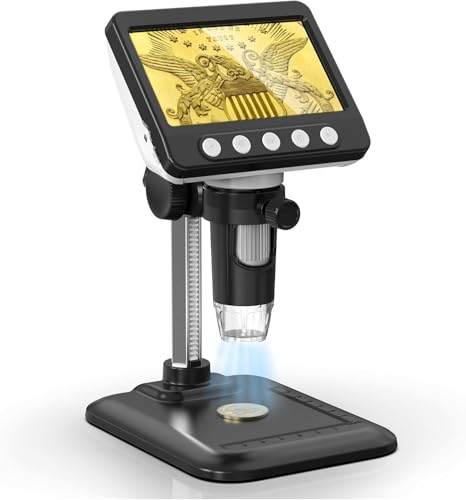
Best for easy, compact observation with a built-in display. This 4.3″ LCD digital microscope offers 50X-1000X magnification and 1080P HD imaging. It provides 8 adjustable LEDs to ensure evenly lit samples. The large screen reduces eye and neck strain and supports quick checks of spore shapes and surface textures. It’s particularly convenient for field work or quick classroom demonstrations.
Who it’s best for: beginners and home lab enthusiasts who want a simple, portable solution with an integrated screen. Choose this if you prioritize ease of use and a ready-to-view-on-screen experience.
Caution: Magnification range is tuned for coin-like samples; observe very small spores with attention to proper lighting angles to avoid glare.
USB Digital Microscope, 50x-1600x

Best for smartphone-focused observation and portability. This handheld USB digital microscope delivers 50X-1600X magnification with a +2MP camera and 1920x1440P HD captures. It uses a dedicated app and Type-C connection for Android and iOS devices. The design is compact and ideal for on-the-go spore observation, with manual focus via a center wheel.
Who it’s best for: mobile users and those who want to document spores with a smartphone. Choose this if you want a pocket-friendly option that integrates with a phone for quick notes and photos.
Caution: Not compatible with PCs or laptops via USB; intended for smartphone/tablet use only. App availability may vary by device.
PalliPartners Compound Microscope for Adults & Students

Best for comprehensive biology study at home or in small classrooms. This compound microscope features WF25X eyepiece with 4X/10X/40X objectives across six magnifications (100X-2000X). It includes dual LED lighting (top and bottom) with brightness control and a reinforced metal frame. A larger mechanical stage and precise coarse/fine focusing support meticulous slide work and stable imaging, ideal for examining plant cells and insect parts.
Who it’s best for: students, educators, and serious hobbyists who need reliable optics, solid illumination, and stable stage movement for repeated observations. Choose this if you want a versatile, entry-to-mid level lab-grade instrument.
Caution: Assembly and calibration may require time; ensure slides and covers are compatible with the stage size for best results.
Herwicm Compound Binocular Microscope

Best for advanced researchers and educators requiring high magnification and flexible viewing options. This trinocular setup supports 40X-5000X magnification with a flat-field achromatic objective system. It features coaxial coarse/fine focusing, dual-level LED illumination (upper and lower), and a hinged binocular head suitable for comfortable observation. An optional camera accessory path allows recording and sharing of images for demonstrations and documentation (camera not included).
Who it’s best for: labs or serious home users who demand high-resolution imaging and the ability to attach a camera for documentation. Choose this if you need maximum magnification and the ability to broadcast or archive observations.
Caution: Higher magnification requires carefully prepared slides and stable handling to prevent blur; ensure proper alignment of the trinocular head if camera attachment is planned.
Buying Guide: Key Considerations For Mushroom Spores
- Magnification range: Mushroom spore observation benefits from a two-tier approach—moderate magnification (100X-400X) for overall spore shape and higher magnification (1000X-2000X) for detailed cell walls and ornamentation.
- Illumination: Dual LED top/bottom illumination improves contrast on translucent spores and allows observation of internal structures. Adjustable brightness helps prevent glare and artifacts.
- Optical quality: Look for widefield eyepieces (WF10x or WF25x) and achromatic objectives to minimize color distortion and maximize field of view across magnifications.
- Build and stability: A metal frame and a sturdy mechanical stage prevent drift during focusing, which is critical for capturing clear images of small features.
- Illumination control and accessories: A padded stage, spring-loaded slides, and a capability to switch between transmitted and incident light facilitate observing a variety of spores and spores-containing tissues.
- Ease of use vs. advanced features: Beginners benefit from simplified controls and built-in lighting, while advanced users may require trinocular options with camera attachment for documentation.
- Display and data capture: LCD displays or PC connections aid in documenting spores. When choosing a model, consider whether you want on-device viewing or screen-based analysis on a computer.
- Portability and power: Battery-powered units are useful for field observations; options with AC adapters offer steady performance in a home lab or classroom.
Frequently Asked Questions
- What magnification is best for mushroom spores?
A: A practical range is 100X-1000X to view spores in detail, with higher ranges (1000X-2000X) for cell structure and wall details when needed. - Should I get a microscope with a camera?
A: If you plan to document and share images of spores, a model with a camera port or built-in display simplifies capture and analysis. - Is LED illumination enough for translucent spores?
A: Yes, dual top and bottom LEDs with adjustable brightness typically provide adequate contrast for translucent samples. - Can I use these microscopes for field work?
A: Some models offer battery power or portable designs; check power options and weight before taking them to the field. - What should I consider when choosing between a monocular, binocular, or trinocular microscope?
A: Monocular is simpler and lighter; binocular reduces eye strain for long sessions; trinocular supports camera attachment for recording observations. - Do I need prepared slides to observe spores?
A: Prepared slides are convenient for learning; for living samples, ensure you have safe handling practices and appropriate slide preparations.