Discover top microcontroller development kits designed to accelerate learning and turn ideas into tangible projects. Each kit blends a capable microcontroller with a curated assortment of modules, sensors, and tutorials to help beginners advance quickly while still offering room for advanced experimentation. The following selections emphasize ESP32-based kits and versatile boards that work well with the Arduino IDE, making them ideal for hobbyists, students, and makers in the United States.
| Product | Brand | Core Strength | Included |
|---|---|---|---|
| ELEGOO ESP-32 Super Starter Kit | ELEGOO | ESP32 with Wi-Fi/Bluetooth; Arduino IDE | 35+ modules; tutorials |
| LAFVIN Basic Starter Kit for ESP32 | LAFVIN | ESP32S; easy beginner projects | Introductory components; tutorial |
| FREENOVE ESP32-S3 CAM Kit | FREENOVE | ESP32-S3; camera; Wi-Fi/Bluetooth | Onboard display; heart-rate sensor; tutorials |
| FREENOVE ESP32 Dev CAM Ultimate Kit | FREENOVE | ESP32 CAM; Wi-Fi/Bluetooth; Python/C/C++ | 795-page tutorial; 240 items |
| FancyWhoop ESP32 Development Set | FancyWhoop | ESP32 with wide GPIO support | Multiple boards; extensive features |
Note: This article highlights five kits focused on ESP32-based development, widely used in education and hobbyist communities for hands-on learning and prototyping. Each option lists key strengths and tutorial support to help you choose the best fit for your goals and skill level.
ELEGOO ESP-32 Super Starter Kit

The ELEGOO ESP-32 Super Starter Kit centers on a robust ESP-32 board featuring dual cores, integrated Wi‑Fi and Bluetooth 4.2, and compatibility with the Arduino IDE for straightforward programming. The kit includes more than 35 modules and components—sensors, displays, motors, input devices, LEDs, and a keypad—providing a broad playground for experiments and projects. An accompanying, beginner-friendly online tutorial covers 30+ projects with complete code, circuit diagrams, and step-by-step instructions, helping newcomers build confidence while leveraging the ESP-32’s capabilities for IoT, smart devices, or cloud-connected projects.
LAFVIN Basic Starter Kit for ESP32

The LAFVIN Basic Starter Kit targets beginners seeking a gentle introduction to electronics and programming with the ESP32. It emphasizes ease of use and approachable learning curves, enabling new users to practice common tasks such as controlling LEDs, reading sensor data, and interfacing with basic modules. The kit supports programming ESP32 modules to manage other devices like LEDs, DHT11 sensors, and OLED displays, making it a practical stepping stone toward more complex IoT projects.
FREENOVE ESP32-S3 CAM Kit
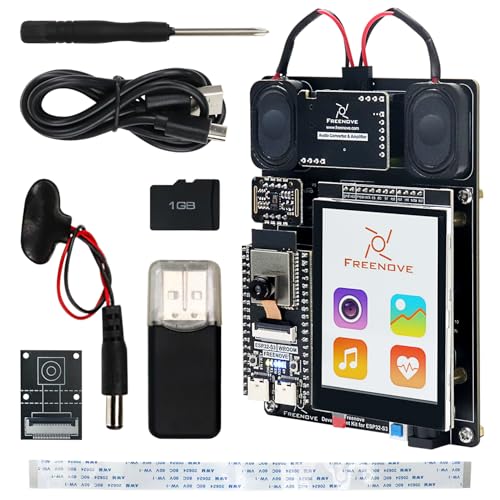
The Freenove ESP32-S3 CAM Kit centers on the ESP32-S3 microcontroller, offering dual-core processing up to 240 MHz, 8 MB flash, and 8 MB PSRAM, with built-in 2.4 GHz Wi‑Fi and Bluetooth 5 (LE). This kit includes a color touchscreen, camera, stereo speakers, and a heart‑rate sensor for demonstration purposes. It provides a complete hardware-software platform suitable for advanced projects like computer vision, multimedia interfaces, and IoT devices, backed by a robust tutorial and examples.
FREENOVE ESP32 Dev CAM Ultimate Kit

The Freenove Dev CAM Ultimate Kit blends a dual-core ESP32 with a high-capacity feature set: 4 MB flash, 8 MB PSRAM, onboard camera, and a memory card slot. It supports 2.4 GHz Wi‑Fi and Bluetooth 4.2 (LE), with USB code uploading and a 1 GB memory card. This kit ships with multiple code bases—MicroPython, C, and Processing (Java)—and a detailed, extensive 795-page English tutorial. It is designed for developers who want a deep, comprehensive platform for camera-enabled and AI-assisted IoT experiments.
FancyWhoop ESP32 Development Set
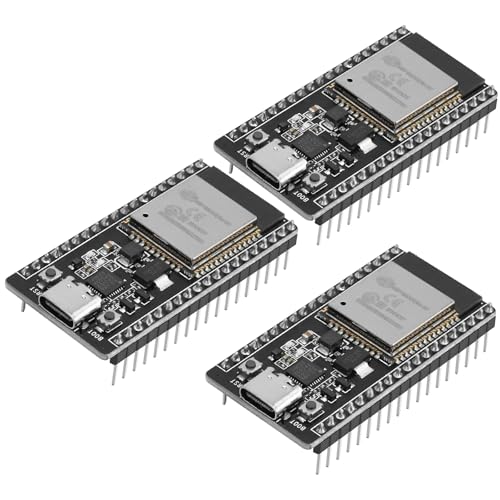
The FancyWhoop kit provides a practical collection of ESP32 development boards with wide GPIO access, suitable for diverse projects requiring robust wireless connectivity. It emphasizes compatibility with the Arduino IDE, Lua, and MicroPython, and highlights multiple peripheral interfaces such as SPI, I2S, UART, I2C, LED PWM, and camera interfaces. Its flexible design supports AP, STA, and AP+STA modes, enabling varied networking configurations for learning and prototype development.
Buying Guide
- Core processor and connectivity: ESP32 variants (dual-core, Wi-Fi, Bluetooth) provide strong versatility for IoT and multimedia projects. Consider whether you need a camera, BLE, or extended memory for your use case.
- Module compatibility: Confirm compatibility with the Arduino IDE or other preferred development environments to simplify coding and porting existing projects.
- Hardware scope: Kits with many modules and sensors offer broad exploration opportunities, but ensure you actually need those extras to avoid overwhelm.
- Documentation and tutorials: Comprehensive guides, example codes, and step-by-step diagrams shorten learning curves and improve outcomes.
- Expansion options: Look for kits with plenty of GPIOs and modular headers to facilitate future projects and hardware upgrades.
- Camera and multimedia: If you aim to build vision-enabled projects, prioritize kits with onboard camera support and adequate memory.
- Size and power: Consider board dimensions and power requirements relative to your project space and power supply constraints.
When selecting a microcontroller development kit, align the choice with your learning goals, project ambitions, and preferred programming language. ESP32-based kits are widely supported, offering strong performance for both introductory experiments and advanced IoT prototypes. The included tutorials and project examples help learners move from basics to more complex applications with confidence.