Starting a looping journey is easier than ever with beginner-friendly loop stations. This guide highlights five entry-friendly BOSS loopers and a straightforward, value-focused option to help newcomers build confidence while exploring rhythm, layering, and performance ideas. Each product offers essential features like audio quality, undo/redo, and multiple memory options to support practice and live ideas alike. Read on to compare capabilities and choose the best looping companion for your style and budget.
| Product | Brand | Key Features | Ideal For |
|---|---|---|---|
| BOSS RC-1 Loop Station Pedal | BOSS | 12 minutes, 24-segment LED, stereo looping, simple stompbox operation | Absolute beginners focusing on fundamentals |
| BOSS RC-5 Loop Station | BOSS | 32-bit AD/DA, 13 hours, MIDI/IO, USB, modern display | Users wanting advanced features in a compact form |
| BOSS RC-202 Loop Station | BOSS | Two stereo tracks, 64 phrase memories, hands-free controls, FX | Electronic musicians and beatboxers seeking hands-on control |
| BOSS RC-30 Loop Station Twin Pedal | BOSS | Two synchronized stereo tracks, dedicated faders, up to 3 hours | Live performers needing dual tracks and robust memory |
| BOSS RC-3 Loop Station Pedal | BOSS | 99 memories, up to 3 hours stereo recording, compact | Portability and basic looping capabilities |
BOSS RC-1 Loop Station Pedal

The RC-1 is a straightforward, entry-level looper designed for general guitars, keyboards, or bass. It features a stereo looping path with a single footswitch, simple level control, and clear feedback for first-time users. Its eleven- to twelve-minute total recording window suits practice sessions and small ideas. Students can focus on timing and overdubs without distraction, making it a preferred starter choice for home practice and teaching environments.
BOSS RC-5 Loop Station

The RC-5 expands looping with modern processing and extended features suitable for advancing beginners. It emphasizes 32-bit AD/DA and 32-bit floating-point processing for higher fidelity, onboard rhythms, and memory for storing loops. The device supports MIDI/IO and USB connectivity, enabling integration with other gear and evolving performance setups. This model balances ease of use with room to grow, appealing to players who want more versatile looping options as they improve.
BOSS RC-202 Loop Station

The RC-202 is a tabletop looper designed for more experimental and progressive setups, featuring two stereo tracks, dedicated controls, and multiple effects per track. It supports four input and four track FX simultaneously, which enables immersive DJ, electronic, or beatbox applications. While more complex than entry models, its hands-on layout remains approachable for beginners willing to explore deeper looping concepts and studio-style processing.
BOSS RC-30 Loop Station Twin Guitar Pedal

The RC-30 offers dual synchronized stereo tracks, true stereo I/O, and a substantial internal memory capacity. With two independent loops and dedicated volume faders, it suits performers who need to layer parts in real time during gigs or rehearsals. The RC-30’s robust features make it a practical step up for players who require more complex arrangements and longer performances without sacrificing ease of use.
BOSS RC-3 Loop Station Pedal
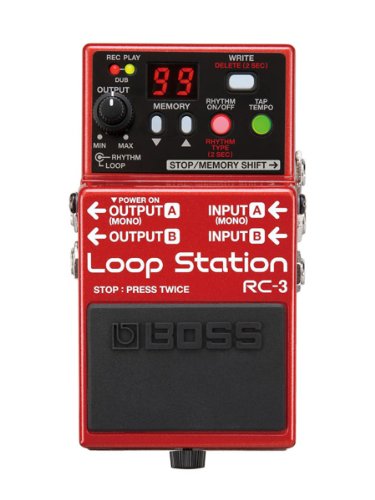
The RC-3 delivers compact, powerful looping with a large internal memory and up to three hours of stereo recording time. It features 99 onboard memories for quick access to multiple loops, making it ideal for practice routines, songwriting sessions, and small live setups. Its simplicity helps beginners focus on fundamental looping concepts while still offering enough depth to grow with.
Buying Guide
When choosing a loop station as a beginner, consider these factors:
- Ease of use: Start with a pedal that offers clear feedback, simple controls, and intuitive overdub functions to build confidence quickly.
- Recording time and memory: More minutes and memories provide longer practice sessions and greater flexibility for layering ideas.
- Tracks and stereo I/O: Decide if you want single-track looping for simplicity or dual/multi-track capabilities for more complex arrangements.
- Connectivity: MIDI/USB compatibility allows future integration with keyboards, DAWs, or other effects, expanding sonic options.
- Portability vs. desktop use: Pedals are great for practice; tabletop models suit studio setups and hands-free control of more intricate loops.
- Learnability: If you’re just starting, models with helpful displays, clear LEDs, and documented tutorials can reduce the learning curve.
Comparison snapshot for beginners:
- RC-1: Best for pure simplicity and immediate hands-on looping without distraction.
- RC-5: A balanced step up with better processing and onboard rhythms for faster progressions.
- RC-202: Hands-on control with multiple FX for more experimental approaches.
- RC-30: Dual tracks and robust memory; ideal for live players needing multiple layers.
- RC-3: Compact and affordable with ample memory for practice and quick ideas.