Choosing a robust LGA 1700 motherboard with DDR5 support is essential for building a future-proof gaming or content-creation PC. The following selections emphasize PCIe 5.0 readiness, solid VRMs, active cooling, and multiple M.2 slots to handle high-speed storage and memory. Each option here targets different priorities—from premium overclocking stability to strong Wi‑Fi connectivity—so you can find a board that aligns with your specific needs and budget.
| Product | Brand | Socket | Memory | Key Features |
|---|---|---|---|---|
| ASUS TUF GAMING B760-PLUS WIFI | ASUS | LGA 1700 | DDR5 | 12+1 DrMOS, PCIe 5.0, 3x M.2, 2.5G LAN, USB 3.2 |
| ASUS TUF Gaming Z790-Plus WiFi | ASUS | LGA 1700 | DDR5 | 16+1 DrMOS, PCIe 5.0, WiFi 6, Thunderbolt/USB4 |
| ASUS Z790-AYW WiFi II | ASUS | LGA 1700 | DDR5 | 12+1 DrMOS, PCIe 5.0, USB4, Thunderbolt, WiFi 6 |
| MSI PRO Z790-A WIFI II | MSI | LGA 1700 | DDR5 | 16+2 VRM, PCIe 5.0, 4x M.2, Wi-Fi 6E, 2.5G LAN |
| GIGABYTE Z790 AORUS Elite AX | GIGABYTE | LGA 1700 | DDR5 | PCIe 5.0, 2.5GbE, WiFi 6E, Quad M.2 |
ASUS TUF GAMING B760-PLUS WIFI Review

The ASUS TUF GAMING B760-PLUS WIFI targets mainstream builders seeking robust reliability with modern DDR5 memory support. It features an enhanced power solution with 12 plus 1 DrMOS stages, a six-layer PCB, and ProCool sockets to ensure stable rails for processors across 12th to 14th Gen Intel CPUs. Cooling innovations include enlarged VRM heatsinks and M.2 heatsinks, plus hybrid fan headers and Fan Xpert 4 for efficient thermal management. PCIe 5.0 readiness and a trio of M.2 slots provide ample storage bandwidth for demanding tasks.
ASUS TUF GAMING Z790-PLUS WiFi Review
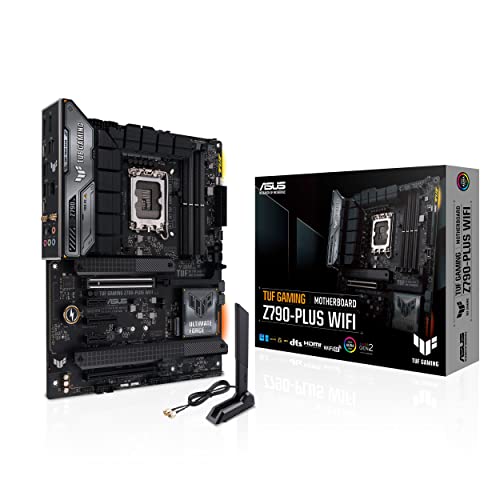
This model highlights an extended power solution with 16+1 DrMOS and ProCool connectors designed for 12th, 13th, and 14th Gen Intel CPUs. It supports PCIe 5.0 and DDR5 memory, offering robust overclocking potential and durability via military-grade TUF components. A comprehensive cooling strategy includes VRM and M.2 heatsinks, plus Fan Xpert 4 to maintain stable performance under load. It ships with Wi‑Fi 6 and a 2.5G LAN for flexible networking options.
ASUS Z790-AYW WiFi II Review

The Z790-AYW WiFi II focuses on high-end connectivity and stability for Intel 14th and 13th Gen processors. It features 12+1 DrMOS, a six-layer PCB, and ProCool power connectors, delivering reliable power delivery. DDR5 memory support and PCIe 5.0 are standard, with multiple USB and Thunderbolt/USB4 options via the rear I/O and headers. It also combines WiFi 6 and 2.5Gb LAN for flexible networking in various environments.
MSI PRO Z790-A WIFI II Review

The MSI PRO Z790-A WIFI II equips a dual-rail 80A SPS VRM designed to support Intel 14th, 13th, and 12th Gen CPUs. It features DDR5 memory, PCIe 5.0 x16, 4x M.2 Gen4 slots, and Wi‑Fi 6E plus 2.5G LAN. The board emphasizes advanced cooling with MOSFET thermal pads, a large heatsink suite, and a robust 6-layer PCB with enhanced copper for stability, making it suitable for enthusiasts who push system performance hard.
GIGABYTE Z790 AORUS Elite AX Review

The GIGABYTE Z790 AORUS Elite AX is built for robust performance with LGA 1700 compatibility and DDR5 compatibility. It features PCIe 5.0 with a heavy-duty VRM design and dual M.2 support for fast storage. The board includes Intel WiFi 6E, a 2.5GbE LAN, and GIGABYTE’s reinforcement features, delivering strong stability and comprehensive I/O for gaming and productivity workflows.
ASUS Prime B760M-A AX Review

The ASUS Prime B760M-A AX is a microATX option that focuses on value without sacrificing essential DDR5 support and PCIe 4.0. It includes Realtek 2.5 Gb LAN and Wi-Fi 6, plus dual M.2 slots and a cooling approach with VRM and M.2 heatsinks. While offering fewer PCIe lanes than larger boards, it remains a solid foundation for mid-range builds using 12th and 13th Gen Intel CPUs.
Buying Guide
- CPU compatibility: Ensure the board supports your intended Intel generations (12th–14th Gen) via the LGA 1700 socket.
- DDR5 reliability and speed: Look for boards with strong VRMs and good thermal design to maximize DDR5 performance and stability.
- Power delivery: A robust VRM and proper cooling are crucial for sustained workloads and overclocking potential on higher-end CPUs.
- PCIe 5.0 readiness: For future-proof storage and GPU bandwidth, PCIe 5.0 compatibility is a key feature to prioritize.
- Storage and expansion: Consider the number of M.2 slots, PCIe slots, and USB connectivity, including USB 3.2 Gen 2/4 and USB4 or Thunderbolt options if needed.
- Networking: Wi‑Fi 6/6E and 2.5G LAN provide fast, flexible networking; select based on your router capability and cabling.
- Form factor: ATX boards commonly offer more expansion; microATX boards (like B760M-A) save space for smaller builds.
- BIOS and software: Look for user-friendly firmware with clear overclocking controls and system monitoring utilities.
- Future upgrades: Verify memory compatibility (DDR5 speeds and XMP profiles) and ensure the board supports pending Intel platform updates.
These selections reflect a balance across price, performance, and feature sets. When choosing, align the board’s VRM quality, PCIe 5.0 readiness, and memory support with your processor, GPU, and storage plan to maximize system stability and future compatibility.