Finding age-appropriate technology that blends play with learning can support early literacy, math, and cognitive skills. The following five toddler-friendly learning computers and tablets come from reputable brands and feature interactive modes, music, lights, and realistic pretend play. This guide highlights how each option can aid letter recognition, number sense, vocabulary, memory, and social skills through engaging, age-appropriate activities.
| Product | Brand | Age Range | Key Benefit |
|---|---|---|---|
| GMAOPHY Learning Laptop (Green) | GMAOPHY | 12-36 months | 2-in-1 laptop with 120+ themes and multiple play modes |
| GMAOPHY Learning Laptop (Pink) | GMAOPHY | 12-36 months | Similar 2-in-1 design with colorful learning modes |
| Fisher-Price Laugh & Learn Smart Stages Tablet | Fisher-Price | 12+ months | Progressive content with 3 Smart Stages and 100+ songs |
| BEKILOLE Montessori Laptop | BEKILOLE | 3-7 years | Wooden, screen-free pretend laptop promoting imagination |
| Peacurh Trilingual Learning Tablet | Peacurh | 12-36 months | Trilingual with multiple modes and music |
Note: All products below are designed for early learning with safe, age-appropriate features. Links lead to the official Amazon listings for reference and deeper details.
GMAOPHY Learning Laptop – Green

The GMAOPHY 2-in-1 Learning Laptop for toddlers combines a screen-enabled mode with a detachable base, enabling both desktop-style learning and portable play. It features 120+ learning themes, including letters, words, numbers, and colors, to support early cognition, vocabulary, listening, and pronunciation. Four interactive modes — Learning, Spelling, Quiz, and Music — encourage active engagement while developing fine motor skills and memory. The 8-function-key setup mirrors real-life screens, helping children practice social cues and everyday vocabulary through imaginative pretend play. Suitable for ages 1-3, these activities foster confidence and independent exploration.
GMAOPHY Learning Laptop – Pink
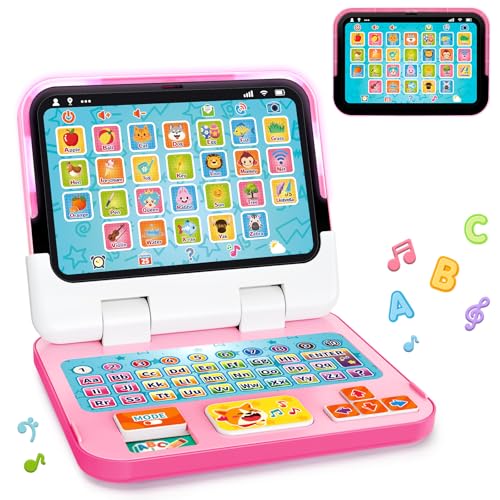
This pink variation mirrors the green model’s 2-in-1 design, offering the same educational versatility with a detachable base for adaptable play. It also features 120+ learning themes and four modes—Learning, Spelling, Quiz, and Music—to help develop number sense, letter recognition, colors, and vocabulary. The toy emphasizes practical pretend-play scenarios (such as calling or emailing) to support social language and everyday communication. Its interactive elements encourage sensory-rich exploration, aiding memory and cognitive development for toddlers aged 1-3.
Fisher-Price Laugh & Learn Smart Stages Tablet

This pretend tablet introduces letters, objects, and basic colors with 100+ songs, sounds, and phrases. The 3 Smart Stages levels grow with the child, adapting to the toddler’s development. With 28 app-like buttons and a variety of lights and melodies, it supports early literacy and auditory discrimination. The device emphasizes cause-and-effect learning and social interaction through realistic pretend-play experiences, helping toddlers explore new vocabulary and concepts in a familiar, engaging format.
BEKILOLE Montessori Laptop

Designed as a screen-free alternative, the Bekilole wooden laptop encourages imaginative play and social interaction while reducing screen exposure. Its 11.8-inch size offers a toddler-friendly form factor, with interactive features that spark curiosity and cognitive development through hands-on activities. Marketed for ages 3-7, it serves as a thoughtful gift option that supports independent exploration, fine motor skills, and early problem-solving within a Montessori-inspired framework. The wood construction also emphasizes durability and a tactile learning experience away from digital screens.
Peacurh Trilingual Learning Tablet

The Peacurh Trilingual Tablet blends English, Spanish, and French to expose toddlers to multiple languages through interactive icons, sounds, and music. It covers themes like Alphabet, Shapes, Colors, Numbers, and Animals, with four modes: Learning, Quiz, Music, and Pretend Play. This tablet supports cognitive growth, memory, and pronunciation while offering pretend-play opportunities such as camera and messaging icons. It suits toddlers aged 12-36 months and focuses on vocabulary expansion, listening skills, and multicultural awareness via a kid-friendly interface.
Buying Guide
- Age-appropriate design: Choose devices clearly labeled for the target age range. Older toddlers may benefit from more interactive modes, while younger children need simpler interfaces and sturdier builds.
- Learning goals: Look for products that emphasize early literacy (letters, phonics, spelling), numeracy (numbers, counting), colors, shapes, and vocabulary. Modes that adapt to progress (e.g., Smart Stages) can extend relevance.
- Monetization and content: Consider how many themes, songs, and activities are included and whether the toy offers ongoing value through new content or modes.
- Durability and safety: For toddlers, sturdy construction and non-toxic materials are essential. Wooden options provide a different tactile experience and can reduce screen time exposure.
- Screen exposure balance: Balance screen-based play with pretend play and non-screen activities. Wooden or Montessori-style options can complement electronic tablets to support holistic development.
- Language support: Trilingual or bilingual devices can aid early language development, especially for families with multilingual environments.
- Portability and storage: Consider size, weight, and portability for travel or small living spaces. Detachable bases or foldable designs add versatility.
Across these options, parents can align toy features with children’s interests and developmental milestones. When selecting a learning computer for a toddler, prioritize interfaces that promote curiosity, interaction, and social engagement while ensuring safety and age-appropriateness.