Answering the demand for visible, reliable green laser pointers in bright conditions, this guide highlights top options designed for daylight visibility, outdoor activities, and professional presentation use. Each pick targets a specific buyer type—outdoor enthusiasts, presenters, or technicians—so you can choose based on beam range, rechargeability, and carry options. The following product selections balance brightness, battery life, durability, and portability for daytime and twilight applications.
| Product | Best For |
|---|---|
| Damflew Green Laser Pointer High Power | Outdoor use; hiking and camping |
| HiTekk High Power Green Laser Pointer (X3) | Travel and presentations; long-range pointing |
| MIPREZT [Professional] Rechargeable Green Laser Pointer | Office and classrooms; long distance |
| JANHER Green Laser Pointer High Power | Large venues and outdoor settings; rugged use |
| QUEOPFU Green Laser Pointer | Hiking, camping; diverse patterns |
Damflew High Power Green Laser Pointer

The Damflew model emphasizes a bright, adjustable beam suitable for both close-up tasks and long-distance illumination. The bezel-adjustable focus lets the user switch from a concentrated point to a wide floodlight, making it versatile for outdoor night use and indoor demonstrations. The USB charging capability supports easy recharging via computers, wall adapters, or power banks, ensuring preparedness for extended sessions. Best for outdoor enthusiasts who want a powerful beam and quick recharge during hikes or camping trips. A potential limitation is the reliance on USB charging; carrying extra power sources may be necessary on extended trips.
HiTekk High Power Green Laser Pointer
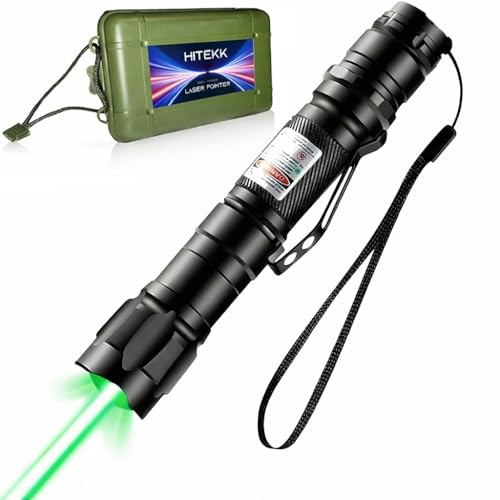
HiTekk’s model is built for long-range visibility, ideal for stargazing, outdoor adventures, and nighttime presentations. It features a rechargeable battery and a compact carrying case, aiding travel and fieldwork. This option is best for users who need a strong beam with dependable portability. Choose this if you value a dedicated case for protection and easy transport; avoid if you require the smallest possible device, as the case adds bulk.
MIPREZT [Professional] Rechargeable Green Laser Pointer
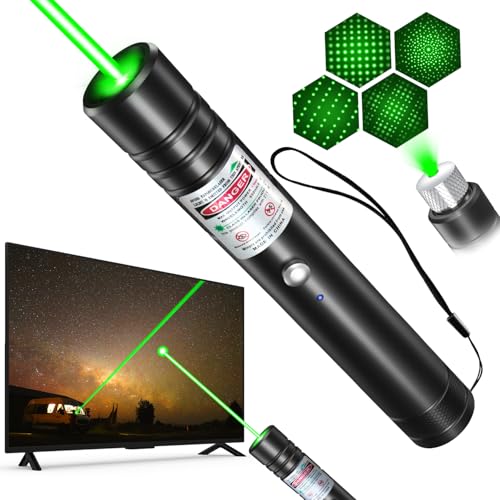
The MIPREZT unit highlights long-distance capability with an aluminum body for durability. It offers a USB-rechargeable design and a star-cap feature that reveals a star-shaped pattern in the dark, adding visual appeal for presentations and outdoor use. Best for professionals and educators who want a high-power beam plus visual patterns. A caveat is that the star-cap patterns may be more of a novelty in bright daylight and less visible in daylight conditions.
JANHER Green Laser Pointer High Power
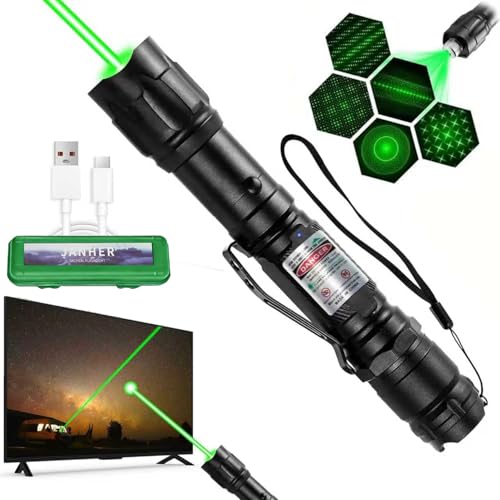
JANHER emphasizes a rugged aluminum housing and waterproof protection, making it well-suited for outdoor conditions and large venues. USB rechargeability adds convenience for repeated use during long days of demonstrations or fieldwork. Best for users who need resilience against weather and accidental bumps. A limitation to note is that the heavy-duty build may be less comfortable for users seeking a compact, ultra-lightweight option.
QUEOPFU Green Laser Pointer

QUEOPFU offers a Class 2B green laser with an adjustable focus and a USB rechargeable design. The device includes a rotating head with Gypsophila-pattern projections, adding variety for demonstrations or entertainment in campouts and events. Best for users who enjoy customizing the projection pattern and using the device for both practical pointing and playful displays. A potential limitation is that the rotating pattern may be less impactful in bright daylight, where simple focusing becomes more practical.
Buying Guide
Key considerations when choosing a daylight-visible green laser pointer include beam brightness, range, focus control, power source, and ruggedness. Here’s what to evaluate:
- Beam brightness and visibility in daylight: Look for higher mW ratings and adjustable focus to maximize brightness in outdoor daylight.
- Range vs. portability: Longer-range beams are helpful for outdoor use and large rooms, but may come with a larger form factor. Choose based on travel and storage needs.
- Power source: USB-rechargeable models are convenient for frequent use, but consider battery availability for remote locations.
- Durability: Aluminum bodies and weather protection improve reliability in outdoor conditions.
- Patterns and features: Some models include star patterns or rotating heads for visual demonstrations; assess whether these add value to your intended use.
- Carrying case: A protective case is useful for travelers and professionals who move between sites.
Practical buyer questions
- Will a green laser pointer be visible in daylight? Yes, higher-power green lasers remain visible in daylight, especially with adjustable focus and suitable beam quality.
- Is USB charging enough for outdoor trips? USB charging is convenient, but consider backup power banks for multi-day outings.
- What should I choose for teaching and presentations? Look for a bright beam, reliable focus control, and a portable case for easy transport.
- Do all models include a protective carrying case? Not all; check product specifics or bundle options if case availability matters.
- Are there safety considerations? Always avoid pointed use at people and animals; follow local regulations regarding laser exposure.
FAQ
- What is a typical safe usage distance for daylight-labeled green lasers? Answer: Distances vary by model, but always follow manufacturer guidance and avoid direct eye exposure.
- Can these pointers be used for astronomy? Answer: Yes, many models are designed for stargazing and pointing at distant celestial objects.
- Do they require specialized batteries? Answer: Most are USB-rechargeable, but some may use standard batteries; check product specs.
- Are there patterns beyond a plain beam? Answer: Some models offer rotating patterns or star caps for visual effects; daylight visibility may vary.
- What safety accessories should I consider? Answer: A protective case, lanyard, and proper storage can prevent damage and accidental exposure.
- Is higher mW always better for daylight use? Answer: Higher power improves brightness and range but may increase heat and affect portability; balance with your needs.