If you need large, highly legible indicators for a scoreboard, clock, timer, or event signage, these large seven-segment displays deliver high visibility and flexible integration. This guide highlights five suitable options, explains who each is best for, and compares key considerations such as size, voltage, and driver compatibility. Ideal buyers include hobbyists building DIY clocks, educators crafting classroom displays, and makers designing public signage.
| Product | Size / Height | Best For | Notes |
|---|---|---|---|
| Lonely Binary 4″ 7-Segment LED Display | 4″ (100 mm) | Scoreboards, large clocks, timers | Chainable, 12V driver with 3.3V/5V logic |
| 5 PCS 1.8″ Digital Blue LED Displays | 1.8″ per digit | Compact multi-digit projects | Economical pack, blue digits |
| 2X Red 2.3″ Red 7-Segment Displays | 2.3″ digits | Clear single-digit indicators | Low voltage, common cathode |
| PATIKIL 4″ Red 7-Segment Display | 4″ digit height | Durable, plug-and-play modules | Common cathode, 9.5V |
| uxcell Common Anode 1.8″ 7-Segment | 1.8″ digit height | General-purpose displays | Common anode, compact |
Lonely Binary 4″ 7-Segment LED Display
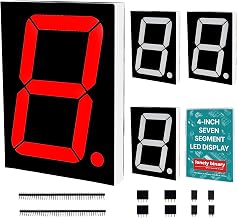
Best for high-visibility projects that require large, legible digits from a distance. The 4″ jumbo size provides easy readability for scoreboards, clocks, timers, or event signage. The integrated driver PCB supports 12V drive while accepting 3.3V or 5V MCU logic, simplifying control from common microcontrollers. The chainable design lets users daisy-chain multiple modules using only three GPIO pins, reducing wiring complexity for multi-digit displays.
Who it’s for: hobbyists building public-facing displays, schools using large classroom clocks, and makers who value simple wiring and scalable digit arrays. Limitation: requires 12V power, which may necessitate additional power regulation in some setups.
5 Pieces 1.8 Inch Blue LED Digital Tube

Best for budget-friendly, compact installations needing multiple digits. The set provides five 1.8″ blue digits, suitable for small panels, DIY clocks, or instrument displays where space is limited. Light weight and easy to mount, these units are ideal for projects where multiple single-digit indicators must run in tandem.
Who it’s for: students, hobbyists, and small makers seeking a low-cost spread of digits. Limitation: overall brightness may be less impactful outdoors compared to larger displays.
2X Red 2.3″ Single-Digit Displays

Best for clear, high-contrast single-digit readouts in compact form. The 2.3″ red digits provide strong visibility from a distance and use a 7.2–8.0 VDC power supply. They feature a common cathode design with a 10-pin PCB, making them straightforward to integrate with standard driver ICs for simple projects.
Who it’s for: developers needing reliable single-digit indicators in space-constrained applications. Limitation: requires compatible driver hardware for full functionality.
PATIKIL 4″ Red 7-Segment Display Module

Best for robust, plug-and-play visual indicators in larger panels. This 4″ red digit module uses a 9.5V supply and offers a common cathode configuration. It is designed for easy integration with driver boards and electronic projects requiring reliable, readable digits. The package emphasizes durability and simplicity in setup.
Who it’s for: educational labs and DIY setups that favor quick installation. Limitation: higher voltage requirement may necessitate a dedicated power supply or regulator.
uxcell Common Anode 1.8″ 7-Segment Display

Best for general-purpose use with a common anode design in a compact footprint. The 1.8″ red digits are suitable for basic indicators, dashboards, and DIY instruments. It runs on low forward current and voltage, supporting straightforward operation with many common driver ICs.
Who it’s for: makers seeking small, versatile digits for familiar electronics projects. Limitation: smaller size reduces readability at greater distances compared with 4″ displays.
Buying Guide: Key Purchase Considerations
- Size and legibility: Choose digit height based on reading distance and viewing angle. Larger digits are better for public signage; smaller digits fit tighter projects.
- Voltage and driver compatibility: Confirm supply voltage and whether the module uses common cathode or common anode. Ensure your microcontroller or driver IC supports the board’s logic level (3.3V/5V).
- Ease of wiring: Chainable or plug-and-play designs reduce wiring complexity for multi-digit displays; consider modules with integrated drivers if wiring is a concern.
- Durability and enclosure needs: For outdoor or event signage, select modules with robust construction and suitable housing considerations.
- Cost and quantity: A mix of single displays versus packs can affect total project cost; plan per-digit and per-project needs.
- Power considerations: Some 4″ modules require 12V, others work at low voltages; ensure compatible power supplies and wiring safety.
Frequently Asked Questions
- What is the best large seven-segment display for a public scoreboard? Look for 4″ or larger digits with clear contrast and a simple driver interface, such as chainable 12V modules with 3-pin control.
- Do I need special drivers for seven-segment displays? Many modules include driver boards; otherwise, common driver ICs (e.g., TC74HC, MAX7219) can be used depending on voltage and pin compatibility.
- Can I use these displays outdoors? Choose modules with appropriate brightness, weather resistance, and enclosure when deploying outdoors.
- Are common anode and common cathode displays interchangeable? They are not interchangeable; verify the module type and match it with a compatible driver or wiring scheme.
- What voltage should I supply for 4″ displays? Some require 12V for the segments with logic at 3.3V/5V; others operate at lower voltages—always check the product documentation.
- Is a kit with multiple digits better than singles? Yes, for multi-digit readouts a daisy-chained or integrated-driver solution reduces wiring and simplifies syncing across digits.