This article highlights top 3D printers with expansive build areas, designed for engineers, studios, and education teams. The selections emphasize reliable large-bed performance, fast print speeds, and multi-printer management capabilities for scaling up production. Each model below is evaluated for operate-at-scale practicality, consistency, and overall value in a professional or serious hobby setting.
| Product | Build Volume | Key Strength | Best For |
|---|---|---|---|
| Creality Ender 5 Max | 400 × 400 × 400 mm | Ultra-fast CoreXY with WLAN multi-printer control | Print farms and large prototypes |
| Creality K2 Plus Combo | 350 × 350 × 350 mm | Multicolor capability with 16-color blending | Complex multi-color parts |
| Longer LK5 Pro 3 | 300 × 300 × 400 mm | Stable triangular structure and auto calibration | Home labs and classrooms |
| Longer LK5 Pro 3 (Second Listing) | 300 × 300 × 400 mm | Open-source motherboard, high-speed 180 mm/s | Educators and beginners upgrading |
| Bambu Lab P1S | All-in-compact large print size with multi-color | Auto bed leveling and enclosed design | Precision multi-color projects |
The following sections inspect five selected models in detail. Each product section includes a concise overview, notable features, and how it fits into workflows that require larger build volumes, faster throughput, or multi-material capabilities. All information reflects listed features and typical use cases for professional or advanced hobbyist environments.
Creality Ender 5 Max — Large Build Area And Fast Output

The Ender 5 Max provides a substantial 400 × 400 × 400 mm build volume, supporting larger prototypes and batch parts without model splitting. It is designed for studios or spaces with higher throughput needs, enabling oversized prints that would otherwise require multiple runs. The printer’s performance is supported by a CoreXY-like architecture and high-torque motors, delivering rapid print cycles while maintaining precision. WLAN multi-printer control helps teams organize workflows and monitor status indicators for efficient queue management.
Key considerations include the balance between speed and accuracy at scale. Users should evaluate heat management and bed adhesion for long sessions, and plan for print-farm layouts that integrate with the WLAN control features. The Ender 5 Max is well-suited for makers and small-to-mid scale operations seeking a capable, expandable platform with centralized monitoring and batch production potential.
Creality K2 Plus Combo — Multicolor Capability At Speed

The K2 Plus Combo emphasizes multicolor printing with a Color Filament System (CFS) unit that enables up to 16-color blending in a single print. With a 350 × 350 × 350 mm build area, it accommodates sizable models while preserving high-detail fidelity at 0.05 mm resolution. The system operates at high speed, reaching up to 600 mm/s with aggressive accelerations, while maintaining quiet operation around 45 dB. This makes it a strong option for graphic design studios or education labs exploring color-rich prototypes.
As a larger-volume, multi-color printer, the K2 Plus Combo invites considerations around filament management, color calibration for blending, and post-processing workflows for multi-material pieces. Its combination of speed, color versatility, and a stable aerospace-grade frame makes it suitable for makers who want professional-color prototyping without sacrificing throughput.
Longer LK5 Pro 3 — Large Size And Open-Source Durability
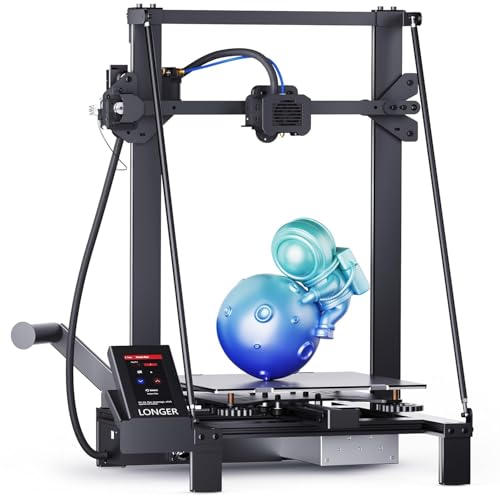
The Longer LK5 Pro 3 offers an expansive 300 × 300 × 400 mm build volume with a robust triangular frame that reduces vibrations and enhances dimensional stability. Auto-calibration on the X and Y axes minimizes layer-to-layer variability, delivering precision around 0.1 mm. This printer suits beginners and hobbyists who want a sizable printing envelope without sacrificing user-friendliness. It supports a broader set of materials and emphasizes reliable bed adhesion and material flow through a silicone carbide lattice glass platform, ensuring uniform heating and consistent results across larger prints.
Practical considerations include the balance of speed versus precision for large parts and the need for reliable cooling during extended prints. The LK5 Pro 3 is a strong option for classrooms and small studios where a sturdy, open-source-friendly platform is valued, allowing users to customize firmware and hardware to fit specific workflows.
Longer LK5 Pro 3 (Second Listing) — High-Speed, Big Canvas

This variant repeats many strengths of the LK5 Pro 3, including a 300 × 300 × 400 mm build size and stability-enhancing triangular frame. It emphasizes rapid printing speeds up to 180 mm/s with a 0.1 mm precision level, enabled by automatic X and Y-axis calibration and firmware optimization. The open-source motherboard supports ongoing customization for education or hobbyist labs seeking modular upgrades and community-driven improvements.
Key considerations for this listing include evaluating the availability of spare parts, the ease of swapping components, and compatibility with a variety of filaments. It stands out for users who want an upgrade path from smaller printers while preserving a familiar workflow and open hardware ecosystem for experimentation and learning.
Bambu Lab P1S — Enclosed, High-Color Flexibility

The Bambu Lab P1S emphasizes a fully enclosed design with automatic bed leveling and support for up to 16 colors or multi-material printing when paired with its accessory ecosystem. A 500 mm/s nominal print speed and aggressive acceleration enable rapid prototyping while maintaining precision. The compact, enclosed footprint makes it attractive for environments where draft control and safety are priorities, such as classrooms and shared workshops. It also supports multi-color printing through its AMS-ready setup and material compatibility options.
When evaluating the P1S, users should consider the total cost of ownership, including accessories for multi-color workflows, maintenance of enclosure integrity for high-temperature materials, and integration with any required post-processing or consumables. It is a compelling option for teams prioritizing color-rich, high-precision prints in a controlled environment.
Buying Guide
Key purchase considerations for large-build-volume 3D printers include build volume requirements, print speed, and print quality alignment. Balance the need for oversized parts with stability, heat management, and bed adhesion. Consider whether you need multi-material or multi-color capabilities, as these features dramatically influence cost and workflow complexity.
- Build Volume vs. Footprint: Larger beds increase capabilities but demand more desk or enclosure space. Measure your workspace and plan for ventilation and cable management.
- Speed and Precision: Look for printers with proven high-speed performance that still deliver reliable layer adhesion and dimensional accuracy. Check acceleration, jerk control, and nozzle sizing options for diverse materials.
- Bed Leveling and Calibration: Auto or assisted bed leveling reduces setup time and improves repeatability, especially for large surfaces. Auto-calibration is particularly useful for farms with multiple units.
- Materials and Filament Handling: If you plan multi-color or multi-material prints, assess the filament system, color mixing capabilities, and compatibility with your preferred materials (PLA, PETG, ABS, composites).
- Expansion and Upgrades: Open-source platforms or easily interfaceable hardware enable firmware and hardware upgrades—beneficial for long-term investment and experimentation.
- Software Ecosystem: A robust software pipeline for slicing, color management, and printer farm control can save time and reduce bottlenecks in production environments.
For teams evaluating these five models, consider how each printer’s strengths align with your project mix: oversized prototypes, color-intensive parts, or education-focused labs. A balanced approach often favors printers with reliable auto-leveling, stable frame design, and an ecosystem that scales from single-unit use to a small print farm. Safety features, enclosure options, and noise levels are also important in shared spaces. Finally, verify compatibility with your preferred materials and check for ongoing support or community resources when planning long-term deployments.