Finding the right large-format flatbed scanner can transform photo archives, art portfolios, and archival documents into crisp, easily shareable digital files. This guide highlights five top picks that balance speed, resolution, and versatility for libraries, schools, studios, and offices. Each product section includes a quick overview, key features, and practical use cases to help you compare at a glance.
| Product | Brand | Key Strength | Ideal For |
|---|---|---|---|
| VIISAN 3120 A3 Flatbed Scanner | VIISAN | Fast 8-second scans at A3 size, 1200×1200 dpi | Artworks, large documents, school projects |
| VIISAN Large Format Book & Document Scanner | VIISAN | High-res 26MP capture with A2/A3 formats | Books, journals, large documents, remote collaboration |
| Epson Perfection V19 II | Epson | Compact, 4800 dpi, USB-powered | Photos, documents, compact workspace |
| Epson Perfection V600 | Epson | 6400×9600 dpi, 35mm slides and film | Film, prints, large enlargements |
| ScanSnap iX2500 | ScanSnap | High-speed, 5″ touchscreen, cloud-enabled | Receipts, documents, photos, cloud workflows |
VIISAN 3120 A3 Flatbed Scanner
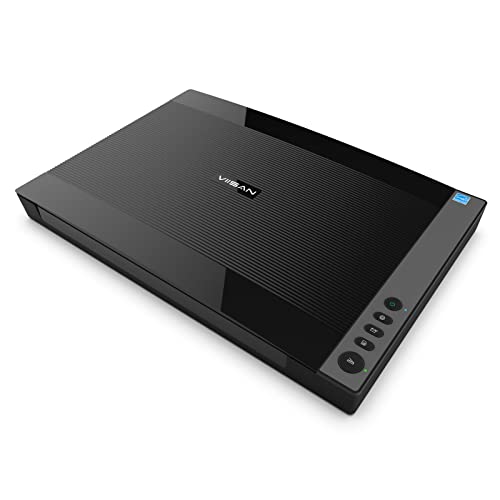
VIISAN’s 3120 A3 flatbed model targets users who need fast, reliable scanning of large layouts and bound materials. It accommodates artworks, photos, books, magazines, CAD drawings, and other tall documents up to nearly A3 in size. A notable feature is its 8-second scan speed at 200 dpi for A3-sized color documents, with a maximum optical resolution of 1200 x 1200 dpi and 48-bit color depth for richer, more accurate reproductions. The frameless lid design is intended to simplify scanning of bound materials, while Auto-Scan enables continuous workflow when the lid is closed. LED lighting helps conserve energy and minimizes warm-up time, making it a practical option for busy libraries or classrooms.
Key specs and use cases:
- Supports large-format items up to 11.98″ x 16.8″
- Auto-Scan for unattended, efficient operation
- LED light source for stable illumination and energy savings
- Designed for schools, libraries, studios, and small offices
What to consider
Choose this model if you frequently scan A3-size originals, want a fast throughput, and value a frameless design that eases scanning of bound materials. It is well-suited for art projects and large document archiving, but users should confirm software compatibility with their preferred workflow on Windows or macOS.
VIISAN Large Format Book & Document Scanner

This VIISAN model targets high-resolution capture for large-format documents and books, offering up to 26MP image quality when paired with compatible software. It supports A2/A3 formats and features Auto-Flatten technology to reduce book curvature during scanning, enabling clearer reproductions of pages, maps, and manuscripts. The device is designed with multi-language OCR and can integrate with Windows or macOS. Practical uses include archiving library collections, digitizing archives, and supporting graphic design workflows that require precise texture and detail.
Key specs and use cases:
- Capture up to 26MP resolution (5888 × 4522) with software support
- Auto-Flatten and multi-language OCR features
- Supports A2/A3 formats for broad documents and books
- Windows and macOS compatibility
What to consider
Ideal for institutions or studios needing very high detail on larger originals. Consider software compatibility with your operating system and whether you require advanced OCR features for searchable archives.
Epson Perfection V19 II

The Epson Perfection V19 II sits as a compact, budget-friendly option for users needing reliable color scans of photos and documents. It offers 4800 dpi optical resolution and USB power, reducing desk clutter and eliminating the need for an external power supply. The included Epson ScanSmart software aims to streamline the scanning workflow, making it straightforward to scan photos, artwork, books, and documents. While not a large-format specialist, its balance of performance and portability makes it a solid choice for smaller studios, classrooms, or home offices with limited space.
Key specs and use cases:
- 4800 dpi optical resolution for detailed scans
- USB-powered operation for a tidy setup
- Designed for photos, art, and documents
What to consider
Consider this model if you need a compact, plug-and-scan solution and primarily work with standard-size originals. It may not handle very large pages or bound volumes as efficiently as larger-format scanners.
Epson Perfection V600

The Epson Perfection V600 is designed for enthusiasts who want to digitize film, slides, and prints with high fidelity. It supports 35mm slides, negatives, and medium-format film via a built-in Transparency Unit, making it suitable for photographers preserving archives or creating large enlargements (up to 17″ x 22″). Its 6400 x 9600 dpi resolution and 3.8 Dmax deliver exceptional detail, while ReadyScan LED technology provides quick warm-up and low power use. This is a strong choice for professional photo digitization and archival projects that demand image richness and fidelity.
Key specs and use cases:
- 6400 x 9600 dpi resolution
- Built-in Transparency Unit for film
- ReadyScan LED with no warm-up
What to consider
Suitable for photographers and archivists needing high-resolution scans of film and large prints. It is bulkier than entry-level models, so ensure you have the workspace to accommodate it and that your workflow includes film handling.
ScanSnap iX2500

The ScanSnap iX2500 is a feature-rich document scanner designed for speed and connectivity. It includes a 5-inch touchscreen for on-device scanning, a 100-page Auto Document Feeder, and cloud-enabled workflows for Mac and PC. It supports high-speed scanning, with smart optimizations and multiple profiles to simplify recurring tasks. This model is well-suited for offices and home workspaces that process a large volume of documents, receipts, and photos, with easy sharing to cloud services and mobile devices.
Key specs and use cases:
- Large touchscreen and 100-page ADF
- Wi-Fi and USB connectivity
- Cloud services integration and personalized profiles
What to consider
Choose this scanner if you prioritize speed, automatic document handling, and seamless cloud integration. It is ideal for busy offices or home setups that require straightforward digital workflows for various document types.
Buying Guide: Large-Format Flatbed Scanning Essentials
When selecting a large-format flatbed scanner, consider these factors to ensure the device fits your workflow and budget:
- Document size compatibility: Confirm the maximum scanned width and length (A2, A3, or larger) and whether bound materials are supported with features like auto-flattening.
- Optical resolution and color depth: Higher dpi yields crisper images; 1200–6400 dpi is typical for photos and artwork. Consider 48-bit color for richer color reproduction.
- Scanning speed: For busy environments, faster scans (especially at common sizes like A3) improve throughput. Look for auto-scan and batch features.
- Paper handling: ADF capability, lid design, and auto-cropping or deskewing functions affect daily use. Book scanners offer flattening and page curvature reduction.
- Software and compatibility: Ensure compatibility with Windows, macOS, and your preferred editing or publishing tools. OCR capabilities can be essential for searchable archives.
- Connectivity and workflow: USB, Wi-Fi, and cloud integration affect how you share scans. Consider whether you need mobile device support or cloud storage.
- Size and footprint: Large-format scanners can be bulky. Measure workspace to ensure a comfortable fit plus room for handling artists’ materials.
- Energy use and reliability: LED lighting reduces warm-up time and power consumption. Build quality and warranty are important for long-term use.
Bottom line: If your priority is very large originals, high resolution, and robust document handling, a dedicated large-format model with A2/A3 support and auto-flattening features is typically the best fit. For lighter duties, compact high-resolution scanners or document-focused models may be more economical and space-efficient. Always align the device’s strengths with your primary tasks—art restoration, library archiving, or professional photography digitization—and verify software compatibility before purchase.