Answering your search for a keyboard with drum pads, this guide highlights five reliable options ideal for producers, beat makers, and musicians who want hands-on control, compact size, and integrated drum pads. Each option is explained with who it’s best for, why it stands out, and a practical caveat to consider before you buy. The top picks cover beginners seeking an approachable setup to advanced users needing more hands-on control and seamless software integration.
| Product | Best For | Key Benefit |
|---|---|---|
| Akai MPK Mini MK3 Series | Beginners to intermediate producers | NKS integration and versatile pads |
| Akai MPK Mini IV | Beat makers who want a full display | 360° knobs and real-time DAW access |
| Akai MPK Mini MK3 (Black) | Compact production on the go | Thumbstick control and arpeggiator |
| M-VAVE 25 Key Controller | Portable studios and mobile creators | Bluetooth wireless and RGB pads |
| Donner DMK 25 Pro | Budget-conscious learners and students | Smart scale modes and multiple DAW compatibility |
Note: Each option above is USB-powered or USB-C powered, includes drum pads, and is designed to integrate with common DAWs. When choosing, consider portability, software bundles, pad feel, and how you’ll use pitch/modulation controls during production.
Akai MPK Mini MK3: 25 Keys, 8 Pads, 8 Knobs

The MPK Mini MK3 offers 25 velocity-sensitive keys, 8 backlit drum pads, and 8 assignable knobs. It features a 4-way thumbstick for dynamic pitch and modulation control, plus a built-in arpeggiator with adjustable resolution, range, and modes. Native Kontrol Standard (NKS) integration lets you Kontrol compatible Native Instruments sounds directly from the device. Best for space-saving studio setups and mobile producers who rely on excellent software control. Choose this if you want robust DAW integration and compact performance.
Best for: Small home studios, traveling producers, and users who benefit from NKS compatibility. Limitation: The compact keyboard may feel cramped for players who rely on full-size keys for long sessions.
Akai MPK Mini IV: 25 Keys, 8 Knobs, MPC Pads

Designed for beginners and producers, this model adds a vibrant full-color display, 8 assignable 360° knobs, and a push/turn encoder for direct access to presets and DAW functions without a computer. It retains 25 velocity-sensitive keys and iconic 8 RGB-backlit MPC pads with dynamic feedback. Best for learners who want immediate, tactile control and clearer on-device navigation. Caution: The display may require some setup with certain DAWs for optimal use.
Akai MPK Mini MK3 25 Key Pro: 8 Pads, 8 Knobs
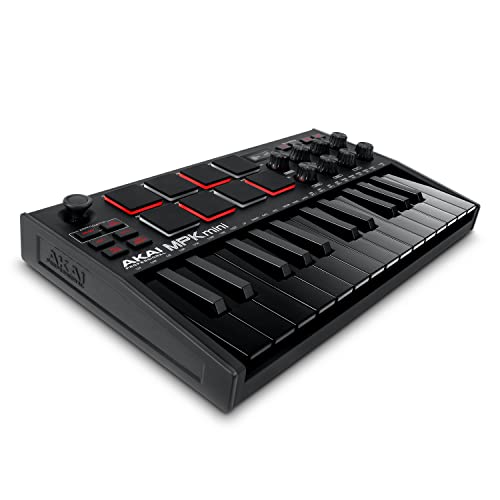
This MPK Mini MK3 variant emphasizes the same core features: 25 velocity-sensitive keys, 8 backlit pads, 8 assignable knobs, a 4-way thumbstick, and NKS integration for direct control of NI sounds. It’s best for producers who want the same compact footprint with a consistent control surface across MK3 models. Limitation: Some users may prioritize larger keys for expressive playing, which this compact design does not fully provide.
M-VAVE 25 Key USB MIDI Controller

The M-VAVE controller features 25 velocity-sensitive keys, 8 backlit RGB pads, 8 assignable rotary encoders, and two capacitive touch stripes for pitch bend and modulation. It also supports Bluetooth for wireless use and includes a rechargeable battery for on-the-go creativity. Best for mobile setups and creators who want wireless flexibility. Caution: Wireless operation may introduce latency in some setups; prefer USB in critical recording situations.
Donner DMK 25 Pro: 25 Keys, 8 Pads, 16 Scales

The Donner DMK 25 Pro is a compact MIDI keyboard with 25 keys, 8 drum pads, and 16 smart scales that simplify playing in different keys and genres. It includes arpeggio, note repeat, and chord features, plus four DAW software bundles. Best for learners and DJs who want guided scale and chord options. Limitation: It notes that the DMK 25 Pro is not a standalone instrument and requires a DAW or mobile device to produce sound.
Buying Guide: Key Purchase Considerations
- Pad and key feel: Decide whether you prefer velocity-sensitive mini keys or larger, full-size keys. Pads should be responsive with both velocity and aftertouch if possible for expressive drum programming.
- DAW compatibility and software: Look for models with ready-to-use software bundles or strong DAW integration (like NKS compatibility) to streamline your workflow.
- Connectivity: USB versus USB-C, Bluetooth options, and whether the device is powered via USB. Bluetooth adds portability but may introduce latency in some environments.
- Control surface: Consider the usefulness of knobs, faders, and an on-device display. A color display or RGB pads can improve navigation in complex sessions.
- Portability vs. performance: For travel or small spaces, compact MIDI controllers excel. If you primarily work at a desk, a larger layout may offer more comfort.
- Arpeggiation and scales: An arpeggiator and smart scale modes help produce musical ideas quickly, especially for beginners.
- Best-for guidance: Choose based on your primary use—on-the-go production, studio work, live performance, or a mix of these.
Frequently Asked Questions
- What is a drum pad controller used for? – Drum pads trigger samples, drums, or percussive elements in a DAW or software instrument, enabling quick rhythm programming and finger drumming.
- Are built-in sounds available on these devices? – Most of these controllers do not produce sound by themselves; they control software sounds in a DAW or bundled software.
- Do these devices work with iPad or Android tablets? – Many support iOS via compatible USB adapters or Bluetooth MIDI, but check each model’s compatibility with your exact device and OS version.
- Is NKS integration important? – NKS provides a streamlined way to access Native Instruments sounds directly from the controller, which can speed up production for NI instrument users.
- Can I use Bluetooth to connect to my computer? – Bluetooth offers wireless convenience, but USB connections tend to be more reliable for low latency during recording and live play.
- Which model is best for beginners? – For absolute beginners, the MPK Mini IV and Donner DMK 25 Pro provide clear navigation, scale features, and bundled software that facilitate learning.