The industrial marking landscape benefits from handheld and online inkjet printers that deliver fast, durable, and precise prints on a variety of substrates. This guide highlights five leading options, focusing on print height, ink capabilities, and surface compatibility. Each product section includes a concise overview, key features, and practical considerations to help buyers compare performance, cost, and suitability for their operations.
| Product | Brand | Print Height | Main Use |
|---|---|---|---|
| ZHONGMIN ZM-C800 | ZHONGMAN | 0.5 in | Text/Date/QR/Barcode |
| BENTSAI B85 | BENTSAI | 4 in | Large-format marking |
| A1 Handheld Inkjet Printer | Eudaemelli | 2-12.7 mm | Text/Dates/QR/Barcode |
| PEKOKO LBX1000 | PEKOKO | Varies up to large heights | Batch/Code/Logo |
| BENTSAI B45 | BENTSAI | ~2 in | Batch/Date/Code |
ZHONGMIN Handheld Printer With 42ml Ink

The ZHONGMIN ZM-C800 is a handheld inkjet printer designed for flexible industrial marking. It supports printing small character text, dates, times, batch numbers, QR codes, barcodes, logos, and more on a wide range of surfaces. The unit accommodates curved surfaces and irregular shapes, such as pipes or textiles, making it versatile for factory labeling and DIY projects. It uses a 42 ml quick-drying ink cartridge, with ink that dries in 2–5 seconds and offers water resistance. Its adjustable print height ranges from 0.08 to 0.5 inches (2–12.7 mm), enabling both fine and broader markings as needed on different materials.
Key considerations include surface compatibility (cardboard, textiles, plastic, metal, glass, ceramic), print quality at various heights, and the practicality of ink maintenance. The quick-drying ink helps minimize smudging in fast-paced production lines, and the device’s compact form promotes handheld operation for on-site coding and labeling.
BENTSAI B85 Wide Format Handheld Printer

The BENTSIA B85 is engineered for large-format coding with four print heads, enabling tall characters up to 4 inches (92 mm) and up to 40 lines of text. It supports printing on porous and non-porous surfaces, which makes it suitable for cartons, packaging, manufacturing lines, construction sites, and logistics. The system includes 4 × 42 ml quick-dry EB22B-L ink cartridges and a positioning tool for precise layout. It delivers up to 300 DPI at speeds up to 10 m/min, with an option to use refillable water-based ink (EB21B) for porous surfaces to reduce costs.
Considerations center on print height capability, ink types for different substrates, and the need for accuracy across varying materials. For operations requiring bold, high-visibility markings, the B85 offers a compelling balance of height, speed, and versatility at scale.
A1 Handheld Inkjet Printer Gun

The A1 handheld inkjet printer offers a 4.3-inch HD touch screen for easy data input and template creation. It prints on cardboard, fabric, wood, plastic, metal, ceramic, and even foil bags, with waterproof ink suitable for absorbent materials. The printing height spans 2–12.7 mm, and it can handle a variety of content, including text, numbers, serials, batch numbers, QR codes, barcodes, expiration dates, logos, and more. A 42 ml quick-drying ink cartridge is included, and additional color options are available via separate cartridges. A practical tip is to replace the protective cap when not in use to prevent nozzle clogging.
PEKOKO LBX1000 Industrial Inkjet Printer

The PEKOKO LBX1000 is designed for online batch coding and is capable of printing text, dates, batch codes, times, MRPs, QR codes, barcodes, logos, and graphics. It supports multiple ink colors, including black, white, yellow, blue, green, red, and even invisible inks. The printer is suitable for porous, semi-porous, and non-porous substrates such as glass, plastics, metal, and concrete. It includes built-in counters and supports variable databases from USB flash drives, enabling flexible data management for production lines. It can print on a broad range of materials including HDPE, LDPE, PET, PP, and more.
BENTSAI B45 Handheld Printer
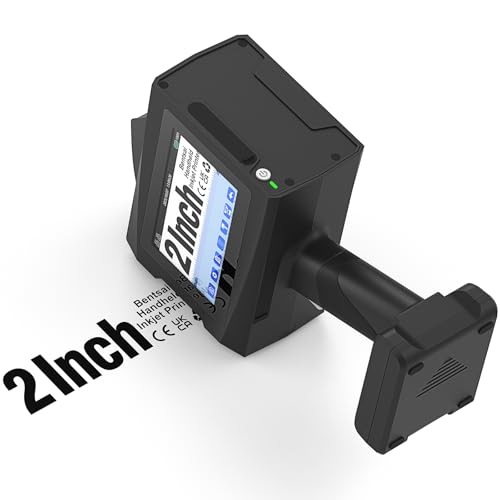
The BENTSAl B45 features patented dual-head stitching technology, enabling content stitching across two 25.4 mm print heads for larger print heights. It supports large-format marking with nearly 2 inches of print height and handles bold text, barcodes, QR codes, logos, and batch numbers. The dual-head design enhances stability and reduces misalignment risks on uneven surfaces. It ships with two 42 ml fast-dry inks that dry in 2–5 seconds and print on porous and non-porous materials such as wood, plastic, metal, glass, fabric, and more. This makes it well-suited for manufacturing, logistics, and retail labeling workflows.
Buying Guide
Key purchase considerations include print height and versatility, surface compatibility, ink type and drying speed, and total cost of ownership.
- Print height and maximum character size: Larger heights enable bold, high-visibility marks on packaging and pallets, but may limit fine text on small items. Choose a height that matches typical labeling needs.
- Surface compatibility: Porous versus non-porous substrates determine ink choice and printing approach. Ensure the device supports your primary materials (cardboard, plastic, metal, glass, fabric, etc.).
- Ink properties: Quick-drying inks reduce smudging; waterproof inks improve durability in moist or outdoor environments. Consider inks tailored to your substrates and potential color needs (including invisible inks if relevant).
- Durability and maintenance: Look for reliable components (print heads, nozzles) and easy-access ink replacement. Some models include positioning tools or wireless/data transfer features to enhance accuracy and efficiency on the line.
- Data handling: For production lines, consider printers with onboard memory, USB data input, or database support to manage batch numbers, dates, and codes consistently across shifts.
- Cost of ownership: Compare ink cartridge capacity, refill options for porous surfaces, and potential downtime due to clogging or cleaning. A model with longer run time and simpler maintenance minimizes operational disruptions.
- Operational fit: Evaluate whether a handheld model suffices or an inline/mini-conveyor embedding capability is needed for automated environments. Consider integration with your existing labeling workflow.