Finding the right incident light meter helps you nail exposure in photography, film, and lighting design. The top picks below cover both digital and analog options, suited for ambient and flash reads, portable field use, and studio work. If you’re a still photographer, filmmaker, or a lighting tech, these meters offer reliable readings across different scenarios. The summary table highlights who each product is best for.
| Product | Best For | Key Strength |
|---|---|---|
| Sekonic L-308X-U Flashmate | Hybrid stills and motion work | Ambient + flash, pocket-friendly |
| Sekonic L-398A Studio Deluxe III | Studio hard-light and on-location | Battery-free, full dial readout |
| Sekonic L-208 Twin Mate | Travel, quick field readings | Analog, instant dial readout |
| BTMETER BT-881E | Budget indoor/outdoor lighting | Wide range, fast response |
| Dr.meter LX1330B | Plant growth, studio, garden setups | FC/LUX toggle, fast response |
Sekonic L-308X-U Flashmate Light Meter

The Sekonic L-308X-U is a compact incident and reflected exposure meter with modes for Photo, Cine, and HD Cine. It provides exposures accurate to a tenth of a stop for ambient and flash readings in full-stop mode, making it suitable for on-location photographers and light designers who need rapid, reliable results. Photo Mode displays a full range of ambient and flash functions, including corded and cordless flash measurements. This unit’s small size supports pocket carry without sacrificing precision.
Best for: Still photographers and light techs who need a portable meter with both ambient and flash readouts. Choose this if you work with quick setups and require a familiar, compact workflow.
Caution: The device uses a traditional LCD interface; users new to Sekonic may need a brief setup to switch between ambient and flash modes.
Sekonic L-398A Studio Deluxe III

The L-398A Studio Deluxe III is a battery-free analog light meter offering incident and reflected readings with a swivel head and full dial readout. Its amorphous photocell and non-electronic interface make it reliable in studio environments or on location where battery dependence is undesirable. The full dial readout provides an immediate, at-a-glance view of aperture and shutter combinations, simplifying exposure decisions without navigating menus.
Best for: Professionals who prefer a battery-free, durable analog meter for studio or field use. Choose this if you want a traditional, hands-on exposure tool with no power requirements.
Caution: Analog operation may feel slower for users who rely on digital readouts and auto-capture features.
Sekonic L-208 Twin Mate

The L-208 Twin Mate is a compact analog meter designed for incident and reflected measurements with a sliding Lumisphere for quick mode selection. Its palm-sized body fits in a pocket or camera bag, making it ideal for travel, street photography, and on-location shoots where fast, accurate exposure readings are essential. The instant dial readout supports immediate exposure settings without complex menus.
Best for: Photographers and videographers who value portability and immediate, analog exposure data. Choose this if you want a rugged, pocketable meter for field work.
Caution: Analog devices rely on manual operation; there is no digital storage for readings or advanced data features.
BTMETER BT-881E Digital Illuminance Meter
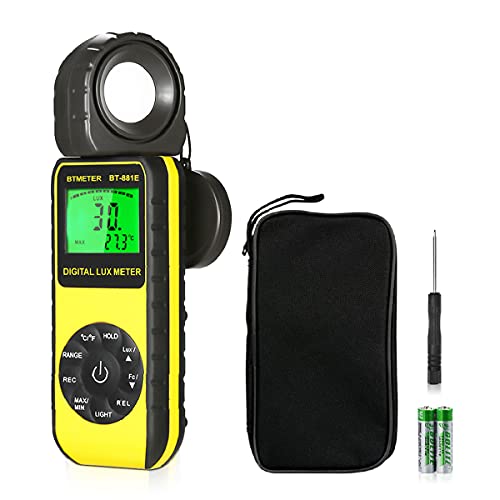
The BT-881E digital illuminance meter measures 0.01 to 300,000 Lux with a wide range suitable for indoor and outdoor lighting. It provides fast 0.4-second response times and supports high accuracy with specified tolerances. The device is suited for plant growth setups, aquariums, and general lighting projects where quick lux readings are necessary. It alternates between Lux and FC units for flexible international use.
Best for: Budget-conscious users who need broad illuminance coverage and quick readings for horticulture, studios, or classrooms. Choose this if you want a feature-rich digital meter at a lower price point.
Caution: Extremely bright environments may require careful handling of glare on the sensor window to avoid measurement skew.
Dr.meter LX1330B Digital Illuminance Meter

The Dr.meter LX1330B provides a 0-200,000 Lux measurement range with a fast two-reading-per-second update. It offers FC/LUX conversion, letting users toggle between units for gardening or photography tasks. This meter is designed for indoor and outdoor brightness measurements and supports quick lock-in of peak values, which is helpful for transient light sources. It is a practical choice for plants, filming setups, or general lighting evaluation.
Best for: Gardeners, photographers, and small studios needing a versatile, fast-responding digital lux meter. Choose this if you want straightforward FC/LUX switching and peak data capture.
Caution: As with many budget digital meters, accuracy can vary slightly with calibration; periodic checks are advisable if precise readings are critical.
Buying Guide: Key Considerations And Comparisons
What type of meter do you need? Digital meters offer fast readings and data storage, while analog meters provide direct, uninterrupted exposure calculations without batteries. Consider ambient vs. flash compatibility, portability, and whether you need Lux or FC units. If you work with both stills and motion, a meter with flash measurement modes and an ambient reading range is valuable. For studio environments, battery-free or analog options deliver steady performance in varying power conditions.
Which features matter most?
- Readout Type: Analog vs. digital. Digital meters are quick and store readings; analog meters offer simplicity and reliability without power.
- Measurement Range: Look for at least 0 to 20,000+ Lux or equivalent for indoor scenes; flash compatibility expands exposure control in dynamic lighting.
- Modes: Incident and reflected readings, plus dedicated Photo/Cine modes if you shoot video or cinema content.
- Portability: Pocket-sized meters are ideal for travel and field work; swivel heads aid measurements at awkward angles.
- Unit Conversion: Lux vs. FC support helps with international projects and cross-compatibility with lighting designs.
How to choose between analog and digital?
- Analog meters are fast to read, battery-free, and rugged in studio environments; they excel in quick decision-making and simple workflows.
- Digital meters provide precise numerical values, data logging, and easier integration with modern digital cameras and editing workflows.
Accuracy And Reliability
For critical exposure work, prioritize meters with clearly defined accuracy specs, a stable response to changes in light, and consistent performance across ambient and flash readings. Pocket meters with memory for last readings can save time on location. Always confirm whether a meter supports both ambient and flash measurements to ensure it meets your needs.
Compatibility And Use Cases
Still photography, cinematography, horticulture, and architectural lighting may require different features. If you frequently shoot with strobes, ensure the meter handles flash exposure and has a reliable flip or backlight for low-light conditions. For plant growth or horticulture, the Lux range and rapid response are valuable for maintaining consistent lighting schedules.
Maintenance And Longevity
Analog meters require minimal maintenance but may need occasional recalibration reference checks. Digital meters benefit from battery management and protective cases to guard sensors and displays in field use. Consider the environment where you’ll work most—studio, outdoors, or travel—when selecting build quality and sensor protection.
FAQ
- What is an incident light meter used for? A: It measures light falling on a subject to determine correct exposure settings for photography and film.
- Should I choose a digital or analog meter? A: Digital meters are fast and data-rich; analog meters are reliable without power and great for simple, quick readings.
- Can these meters measure flash lighting? A: Yes, several models like the Sekonic L-308X-U include flash measurement modes in addition to ambient readings.
- Is Lux the same as FC? A: No. Lux (lx) measures illuminance; FC (foot-candles) is another illuminance unit. Many meters switch between them.
- Do meters require calibration? A: Some meters, especially digital ones, may benefit from periodic calibration or sensor checks to maintain accuracy.
- Are analog meters still relevant? A: Yes, for reliability without power and for quick, intuitive exposure decisions in studio or field work.