Answering your search for reliable TV backlight testers and video pattern generators, this guide highlights practical tools that help diagnose backlight issues or calibrate displays. Each product is selected for specific buyer needs—pros who repair LED backlights, professionals calibrating monitors, or hobbyists testing home theater setups. The top picks include versatile LED backlight testers, portable video pattern generators, and multi-purpose testers. Use the quick comparison table below to decide which tool fits your workflow and budget.
| Product | Best For | Key Benefit |
|---|---|---|
| TKDMR LED Lamp Bead TV Backlight Tester | LED backlight repair Techs | Safe, precise 0–300V output for locating bad LEDs |
| Banhey LED Light and TV Backlight Tester | DIY enthusiasts | Real-time voltage/current readout with auto-adaptive voltage |
| SID LED Multipurpose Tester | Repair shops | Real-time voltage/current for CC drive boards |
| GME PG-28 Portable Video Test Pattern Generator | Field techs | 8 test patterns for TV/NTSC monitor calibration |
| GME PG-16A Portable Video Test Pattern Generator | PC/MAC/TV monitors | 8 PC, 4 MAC patterns with versatile outputs |
TKDMR LED Lamp Backlight Tester

The TKDMR LED Lamp Bead TV Backlight Tester is designed to diagnose LED backlight problems in televisions safely and accurately. It provides an output range of 0–300V at up to 30mA, enabling quick identification of failing LEDs without damaging the panel. This tool is best for technicians handling LED TV backlights in various sizes and for experienced hobbyists seeking a reliable diagnostic device. Caution: avoid prolonged testing at high voltage without proper insulation and PPE. The device supports both small and large backlight assemblies, making it versatile for different TV models.
Best for: Professional LED backlight technicians and serious DIY repairers who need precise voltage control to locate bad LEDs quickly.
Why selected: Combines safe operation, adjustable voltage, and a clear display to pinpoint failing LED elements without harming the LED beads.
Limitation: Some users may require additional amperage for high-load backlights; this model is rated up to 30mA.
Banhey LED Light and TV Backlight Tester

The Banhey tester covers a broad voltage range (0–300V) with real-time voltage and current display. Its adaptive voltage feature automatically matches the LED’s requirements, reducing the risk of over-voltage damage to strips, beads, or TV backlights. The device emphasizes safety with isolation and anti-electric shock design, suitable for both professional workshops and home repairs. Best for those who want immediate feedback while adjusting test parameters.
Best for: DIYers and technicians who value live readouts and automatic voltage matching to prevent over-voltage stress on LEDs.
Why selected: Real-time readouts and adaptive output simplify testing and minimize guesswork when diagnosing backlight issues.
Limitation: While safe for most LEDs, users should still follow standard electrical safety practices to avoid incidental exposure to live circuits.
SID LED Multipurpose Tester

The SID LED Multipurpose Tester provides real-time testing of voltage and current for constant-current LED driver boards. It supports a wide range of LED configurations, including LED strips, panels, COB sources, backlights for LED TVs, displays, and computers. This makes it a flexible tool for professional repair work and component-level testing. Best for: technicians who need to verify CC drive behavior across multiple LED formats and systems.
Why selected: Supports diverse LED formats and indicates live voltage/current for precise fault isolation on backlight circuits.
Limitation: Data indicates its utility across many LED types; verify compatibility with specific panel voltages in your workflow.
Best for: Techs who work on backlights across TVs, monitors, and displays that use constant-current drives.
THE CIMPLE CO Antenna Signal Strength Meter
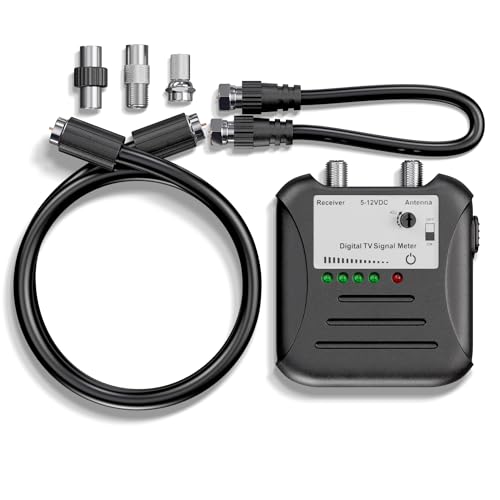
Though primarily an antenna signal strength meter, this tool helps with TV setup and alignment, which can influence perceived picture quality and brightness balance during calibration. It’s ideal for buyers focused on optimizing channel reception and antenna positioning in new or unfamiliar environments. Best for RV users and home installers who need straightforward signal feedback to aim antennas precisely.
Best for: TV setup technicians and travelers needing practical antenna positioning support.
Why selected: Provides LED feedback and a simple interface to assist with channel optimization, complementing backlight diagnostics.
GME PG-28 Portable Video Test Pattern Generator

The GME PG-28 is a handheld generator designed for TV and NTSC monitor testing, calibration, and troubleshooting. It offers a wide variety of test patterns, including color bars, cross hatch, dot, stair-step, circle, and raster patterns across multiple color options. Best for on-site field work where quick verification of display alignment and geometry is needed. Limitations include limited advanced test options compared to full-service lab equipment, but it remains a robust portable choice.
Best for: Field technicians and service engineers needing quick, portable pattern testing for TV/NTSC monitors.
Why selected: Reliable set of patterns with simple operation makes it a go-to for routine calibration and fault finding on-site.
Limitation: Not a full-spectrum analyzer; use with other equipment for comprehensive diagnostics.
GME PG-16A Portable Video Test Pattern Generator

The GME PG-16A is designed for PC, MAC, and TV monitor testing, offering eight PC and four MAC monitor formats and a broad collection of test patterns. It provides separate video outputs for PC, MAC, and TV, with a user-friendly interface and pattern control. Best for technicians who work across multiple platform displays and need precise pattern formats for each environment.
Best for: Multi-platform repair professionals who calibrate PCs, Macs, and TVs from a single device.
Why selected: Flexible format support and distinct outputs simplify cross-platform calibration tasks.
Limitation: As a portable device, it may lack some advanced patterns found in larger lab units.
Buying Guide
What should I consider when buying a backlight tester or video pattern generator?
- Ensure the tester can handle the voltages used by your backlight assemblies. Look for adjustable voltage and current controls to avoid damaging LEDs.
- Prioritize devices with short-circuit protection, isolation, and anti-electric shock design to protect both the user and the LED modules.
- For video test generators, more pattern options and color channels ease calibration and fault isolation on different display types.
- Portable testers are ideal for fieldwork, while benchtop models may offer more patterns and higher precision.
- Check compatibility with LED strips, LED panels, TV backlight systems, PC/MAC monitors, and various panel formats.
- Real-time voltage/current displays simplify diagnosing issues and reduce setup time.
FAQ
- What is a backlight tester used for? It helps locate failing LEDs in TV backlight assemblies and verifies proper voltage distribution across LED strings.
- Can I use a video pattern generator to calibrate a TV backlight? Pattern generators primarily test video timing and geometry; they are complementary tools to testers focused on backlight LEDs.
- Is safety a concern when testing backlights? Yes. Use devices with insulation, short-circuit protection, and proper PPE to minimize electric shock risk.
- Do these tools work with all LED backlights? They cover common LED backlights, strips, and panels, but verify voltage and connector compatibility for your specific model.
- What’s the difference between the PG-28 and PG-16A? PG-28 focuses on NTSC TV/monitor testing with a broad pattern library; PG-16A supports PC, MAC, and TV monitors with platform-specific outputs and patterns.
- Are these tools suitable for beginners? Some devices require familiarity with electronics and LED circuitry; beginners should follow safety guidelines and manufacturer instructions.