Choosing the right in-ear monitor (IEM) system helps performers stay on pitch, hear their mix clearly, and move freely on stage. This guide highlights five reliable options across 5.8 GHz and 2.4 GHz bands, covering durability, latency, channel scanning, and multi-user capabilities. Each pick includes practical strengths to match rehearsal spaces, live gigs, and studio work.
The following quick-reference table summarizes the featured products and core capabilities to help you compare at a glance.
| Product | |||
|---|---|---|---|
| Xvive U45 Wireless In-Ear Monitor System | 5.8 GHz | Channel Scan, 20 Hz–20 kHz, 24-bit/48 kHz | Live performance, studio |
| Phenyx Pro Quad-Channel Wireless IEM System | UHF (4×25 frequencies) | 4 receivers, IR sync, long range | Band rehearsals, multi-performer gigs |
| Xvive U4 Wireless In-Ear Monitor System | 2.4 GHz | Low latency, up to 6 channels, 24-bit/48k | Studio and stage |
| Xvive U4 Wireless In-Ear Monitor System Set | 2.4 GHz | 6 channels, <5 ms latency, portable range | Small to mid-size venues |
| 2.4 GHz | Up to 4 receivers, auto-pairing, long battery life | Church, band rehearsals |
Xvive U45 Wireless In-Ear Monitor System

The U45 system uses a 5.8 GHz true diversity setup designed to maintain a stable RF connection over distances up to about 100 feet (30.5 m). It supports on-channel scanning that helps match transmitter and receiver settings after scanning, reducing setup time during sound checks. The audio chain features a broad frequency response from 20 Hz to 20 kHz with a high-resolution 24-bit/48 kHz signal and an impressive 110 dB signal-to-noise ratio for clean, detailed sound at any stage volume. This option is suitable for performers needing a balance of reliability and ease-of-use in both rehearsal rooms and live venues.
Key specs and notes:
– Channel Scan Mode simplifies pairing between transmitter and receiver.
– Solid performance without interference from other wireless devices in typical venue environments.
– Clear, wide-frequency audio suitable for vocalists and instrumentalists seeking fidelity without latency concerns.
Phenyx Pro Quad-Channel Wireless IEM System (PTM-33-4B)

This multi-channel IEM system provides four independent monitor streams, enabling four performers to hear distinct mixes without latency. The integrated monitor station supports left/right inputs and loop outputs, enabling daisy-chaining and flexible routing with minimal rack space usage. With up to 140–164 feet of interference-free line-of-sight range, you can stage complex performances with multiple musicians moving freely. IR sync helps quickly link multiple receivers for quick setup in busy rehearsal rooms or gigs.
Considerations:
– Ideal for small to mid-sized bands needing separate mixes for each member.
– The system emphasizes reliable stereo separation and consistent level control, though it’s primarily mono monitor focus per user.
– Rack-friendly design suits studios and rehearsal spaces with limited rack space.
Xvive U4 Wireless In-Ear Monitor System (Professional) – U4

The U4 model emphasizes a robust 2.4 GHz wireless link with a clean, low-noise signal and low latency, delivering a seamless monitoring experience. It supports a mono balanced XLR or mono TS input, making it compatible with a wide range of mixers and personal listening setups. The system’s built-in limiter helps prevent distortion at higher input levels and includes a front-panel headphone jack for direct monitoring. A rechargeable battery offers about five hours of operation, making it suitable for shorter shows or rehearsal blocks where quick swaps are needed.
Highlights:
– Sub-5 ms latency across multiple channels.
– Wide dynamic range and 24-bit/48 kHz audio quality.
– Simple, practical design aimed at single-user performance with a straightforward workflow.
Xvive U4 Wireless In-Ear Monitor System Set
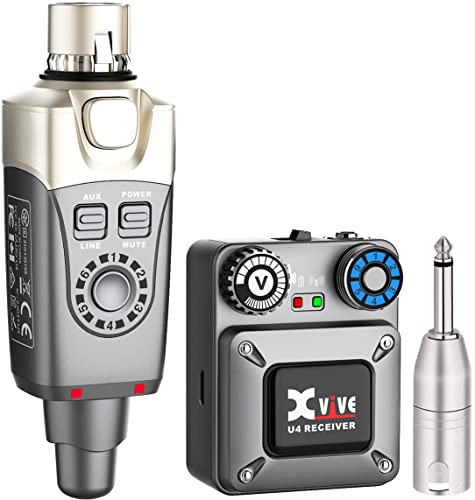
This set expands on Xvive’s 2.4 GHz line with a six-channel capability and low latency, designed for flexible stage work where multiple performers need reliable, synchronized audio. The system supports simultaneous broadcasts on up to six channels, making it suitable for bands and coaching environments where multiple performers require distinct mixes. The compact transmitter and beltpack receivers keep a light footprint on stage while maintaining consistent performance.
LEKATO MS-02 Wireless In-Ear Monitor System

LEKATO’s MS-02 is an upgraded 2.4 GHz IEM system focused on ultra-low latency and a practical one-to-many configuration. It supports up to four receivers from a single transmitter, with auto-pairing to simplify setup. The system provides a long battery life of about 6–8 hours, and a 24-bit/48 kHz high sampling rate to maintain clear sound through audience-facing monitors or studio playback. It’s well-suited to church, small bands, and rehearsal environments where ease of use and dependable ranges matter most.
Xvive U45T9 Wireless In-Ear Monitor System

The U45T9 model builds on the U45 platform with dual BA drivers (T9) for richer low-end response and a detailed mid-high range. Like the U45, it operates on the 5.8 GHz band with channel scan functionality to quickly lock to the best channel. The driver combination aims for a balanced, controlled listening experience that can satisfy audiophiles and professional players who require accurate monitoring across stages with minimal coloration. Channel scan helps ensure reliable performance alongside a broad, flat frequency response.
Buying Guide: Key Purchase Considerations
- Band and interference: 5.8 GHz systems often offer robust performance in crowded RF environments, while 2.4 GHz options can be more affordable and widely compatible. Consider venue size, other wireless gear, and potential RF congestion.
- Latency: Lower latency is critical for performers who rely on timing-accurate monitoring. Look for sub-5 ms latency in single-user systems and confirm that multi-channel configurations maintain low latency across all channels.
- Channel options: For solo performers, a two-channel system may suffice. For bands, multi-channel or “one-to-many” configurations reduce inter-parent interference and allow personalized mixes.
- Sound quality: Seek systems with wide frequency response and high signal-to-noise ratios (e.g., 110 dB or higher) to preserve vocal and instrument detail at stage levels.
- Battery life and charging: Check battery life on beltpack receivers and whether the system supports quick swaps or hot-swapping during shows. Rechargeable options are common and convenient.
- Ease of setup: Features like IR/Channel Scan, auto-pairing, and rack-mount compatibility reduce setup time and streamline rehearsals and sound checks.
- Durability and form factor: Metal-bodied packs and rugged transmitters are preferable for frequent gigging and touring. Consider a compact, lightweight profile for portable rigs.
Across these products, users can expect options tailored for solo performers, small ensembles, or larger bands. The chosen systems offer reliable wireless performance, manageable latency, and practical wireless channel management to support multiple performers on busy stages.