Choosing the right in-ear monitor (IEM) system is essential for a full-band setup. The right system delivers clear, stage-friendly audio for all musicians, minimizes latency, and reduces stage clutter. Below, we spotlight five top options that balance reliability, sound quality, and ease of use for band rehearsals and live performances. The selections cover wireless diversity, multi-channel monitoring, and easy pairing, helping every musician hear their own mix with confidence.
| Product | Brand | Key Benefit |
|---|---|---|
| Xvive U45 Wireless IEM System | Xvive | Channel Scan and crystal-clear 20 Hz–20 kHz audio |
| Xvive U4 Wireless IEM System Set | Xvive | 4-channel, low latency, up to 6 simultaneous broadcasts |
| Phenyx Pro Quad-Channel Wireless IEM System | Phenyx Pro | Four bodypacks, four 25 UHF frequencies, rack-mountable |
| LEKATO MS-1 Wireless IEM System | LEKATO | One TX to 6 RXs, auto-pairing, stereo transmission |
| Phenyx Pro UHF Stereo IEM System | Phenyx Pro | Stereo/mono options, 89 tunable frequencies, long range |
The following sections present five top picks in detail, focusing on performance, reliability, and practical features for a full band environment. Each entry provides a direct link to the product page, an image, and a concise summary of the main features.
Xvive U45 Wireless IEM System

The Xvive U45 system operates on 5.8 GHz with true diversity, providing a stable RF connection over approximately 100 feet. It supports Channel Scan mode to help quickly locate the best channel and minimize interference on busy stages. The system delivers a broad 20 Hz–20 kHz frequency response with a high-resolution 24-bit/48 kHz audio path and a 110 dB SNR for clear, detailed sound at any listening level.
Ideal for bands needing dependable in-ear monitoring without complex setup. Channel synchronization between transmitter and receiver after scanning is straightforward, enabling quick on-the-fly adjustments during sound checks or gigs.
Xvive U4 Wireless IEM System Set

The Xvive U4 set operates on a 2.4 GHz band, offering uncompressed wireless audio with low latency. It supports up to six channels simultaneously, and includes a rechargeable lithium battery providing around five hours of use per charge. A front panel 1/4-inch monitoring output and a built-in limiter help maintain consistent sound levels and protect equipment, making it suitable for small to mid-sized venues and tours.
Designed for straightforward use in band settings, the U4 emphasizes toughness and ease of pairing, with clear, balanced audio across a wide bandwidth and minimal latency for real-time performance feedback.
Phenyx Pro Quad-Channel Wireless IEM System

This 4-channel wireless monitor system provides four independent left/right inputs with loop outputs, enabling flexible daisy-chaining of audio signals from a single mixer. It offers up to 4 standalone monitor mixes with negligible delay and includes IR sync to quickly link multiple receivers. The system covers a broad 140–164 ft line-of-sight range, helping bands tour or rehearse with minimal interference, and is well-suited for larger ensembles needing multiple personal mixes.
Constructed with rack-mount compatibility and strong stage reliability, this Phenyx Pro model supports a clutter-free stage and consistent performance across the four band members.
LEKATO MS-1 Wireless IEM System
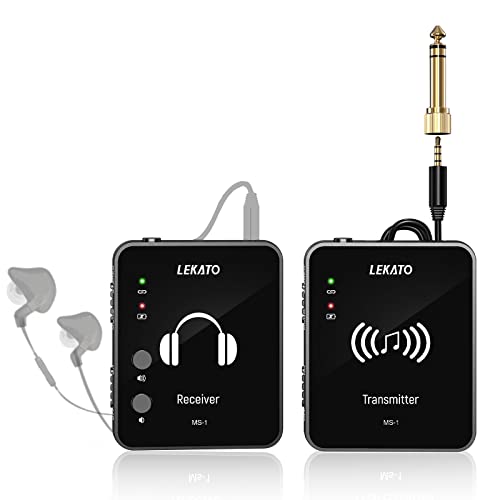
The LEKATO MS-1 supports one transmitter to multiple receivers (up to six sets) with auto-pairing, simplifying setup for bands with several performers. It transmits true stereo audio and provides a straightforward switch to mono if needed. The system is designed for small to medium gigs and rehearsal spaces where easy, reliable stereo monitoring is valuable for overall stage cohesion.
Auto-pairing and a robust, simplified workflow reduce the technical overhead during load-in and sound checks, helping performers focus on performance rather than gear setup.
Phenyx Pro UHF Stereo IEM System

This system offers true stereo monitoring with adjustable mono/stereo modes, enabling richer spatial sound. It uses 89 selectable frequencies in the UHF range to minimize interference and supports up to 160 ft of reliable transmission. The device includes built-in functions such as EQ, balance, limiter, and lock to protect settings, along with a PAD switch to prevent signal overload. It is suited for longer gigs, lectures, or exhibitions where stable, high-quality stereo monitoring is essential.
Buying Guide: What To Look For In A Band-Wide IEM System
Choosing the right IEM system for a whole band involves balancing several factors. Consider these perspectives to determine what best fits your needs:
- Frequency Band and Interference: Systems operate in 2.4 GHz, 5.8 GHz, or UHF ranges. The 5.8 GHz and UHF bands typically offer less congestion and longer range in busy venues, while 2.4 GHz provides universal compatibility but can be more prone to interference in crowded Wi-Fi-rich environments.
- Channel Count and Grouping: A system should support enough channels for all band members to have independent mixes. Look for multi-channel options (4–6 channels or more) and the ability to create separate personal mixes for each performer.
- Latency: Latency should be minimal to avoid synchronization issues with on-stage performance. Latencies under 5 ms are common in these systems and generally suitable for live use.
- Battery Life and Power: Consider battery life on beltpack receivers and the availability of charging options in venues or transport. Rechargeable packs with solid runtime are preferable for longer sets.
- Sound Quality: A wide frequency response (typically 20 Hz–20 kHz) and a high SNR (around 100 dB or higher) help deliver clear, detailed sound, especially at louder stage volumes.
- Pairing and Setup: Auto-pairing and quick-channel-scan features save setup time. IR sync or simple app-based pairing can reduce stage tech complexity.
- Durability and Comfort: Durable housings, robust antennas, and comfortable earpieces matter for long gigs and touring schedules.
- Scalability: For bands that expand, ensure the system can grow with the group—additional receivers or a higher channel-count transmitter option.
Overall, bands should evaluate the balance between reliability, ease of use, and audio fidelity. For multi-member ensembles, systems that support multiple receivers with flexible monitoring mixes typically deliver the most utility on stage. When possible, test in a rehearsal space with your actual stage setup to confirm there are no dropouts or noticeable latency.