Discover premium telescopes that blend advanced optics, robust mounts, and smart features for both beginners ready to upgrade and seasoned observers seeking deeper sky targets. This guide highlights five top picks, outlining what makes each model stand out, from large-aperture Schmidt-Cassegrains to smart, app-controlled systems. Use the buying guide to compare capabilities and find the right balance of performance and ease of use for your observing goals.
| Product | Aperture / Optics | Key Feature |
|---|---|---|
| Celestron NexStar 8SE | 8-Inch Schmidt-Cassegrain | Fully automated GoTo with SkyAlign |
| Celestron NexStar 130SLT | 130mm Newtonian Reflector | Compact computerized hand control |
| MEEZAA 150EQ | 150mm Reflector, Equatorial Mount | Stable, beginner-friendly EQ mount |
| MEEZAA 90mm Refractor | 90mm Aperture | High-quality refractor with AZ mount |
| Odyssey PRO UNISTELLAR | 85mm f/3.9, Computerized | Smart telescope with app control |
Celestron NexStar 8SE Computerized Telescope

The NexStar 8SE combines a proven optical design with modern automation. Its 8-inch Schmidt-Cassegrain optics deliver bright, detailed views of the Moon, Jupiter, and faint deep-sky objects, while the GoTo mount simplifies navigation. The NexStar+ handheld controller provides access to a database of more than 40,000 celestial targets, enabling precise slews and tracking. This setup suits observers who want an all-in-one platform that balances performance with approachable operation.
Key features include a robust computerized mount, SkyAlign alignment, and compact portability for an 8-inch scope. The combination of high light gathering and automated targeting makes it a strong choice for both beginner upgrade paths and more experienced users seeking reliable, high-contrast images across a broad range of targets.
Celestron NexStar 130SLT Computerized Telescope

The NexStar 130SLT blends portability with computerized location and tracking. Its Newtonian reflector design provides solid light gathering at a compact size, making it easy to transport for observing sessions away from light pollution. A database of thousands of stars, galaxies, and nebulae supports quick target acquisition and reliable tracking with the NexStar controller. This model is well-suited for beginners who want a capable sky-watcher that remains practical for travel and field use.
With a 130mm aperture and SkyAlign technology, users can observe planetary details such as Saturn’s rings and Jupiter’s bands, as well as brighter deep-sky objects. The combination of a portable footprint and strong optical performance makes it a versatile choice for family stargazing and entry-level astronomy enthusiasts aiming to progress quickly.
MEEZAA 150EQ Newtonian Reflector Telescope
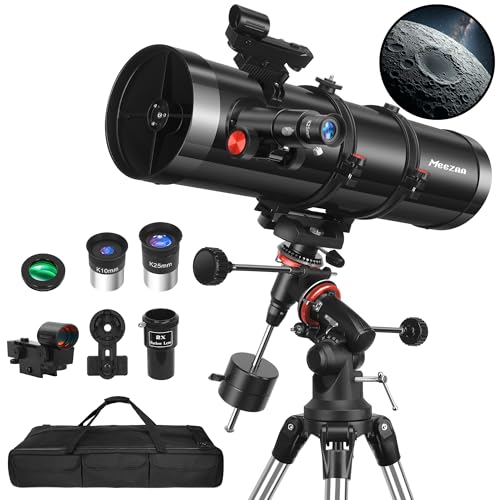
The MEEZAA 150EQ combines a fairly large aperture with a stable equatorial mount, supporting smooth manual tracking and gradual object slewing. Its 150mm objective provides ample light-gathering power for planetary detail and deep-sky viewing, while the equatorial configuration assists astrophotography beginners in learning tracking techniques. The kit typically includes a range of accessories such as eyepieces, a moon filter, and a carry bag to support field use and storage.
Optical performance inherits from quality coatings and a practical focal length that suits a broad observing range. The 650mm focal length keeps the scope manageable for beginners yet capable of delivering crisp lunar features and bright galaxies under dark skies. It is a prudent step up for those seeking improved resolution without the complexity of higher-end mounts.
MEEZAA 90mm Refractor Telescope with AZ Mount

This 90mm refractor from MEEZAA emphasizes optical clarity and ease of use. The apochromatic-like performance helps deliver sharp, bright images with good color saturation for planets and the Moon. The included AZ mount enables straightforward manual tracking and targeting, making it a practical option for beginners who want crisp linework and wide-field views without heavy setup. The kit commonly includes a tripod, phone adapter, and carry bag to support quick start-up and travel.
With a focal length around 800mm, this telescope balances light gathering with manageable magnification. It’s suitable for those who want reliable daytime celestial viewing and kid-friendly night-sky exploration, while keeping the hardware light enough for car camping and urban balconies.
Odyssey PRO UNISTELLAR Smart Telescope

The Odyssey PRO UNISTELLAR represents a modern jump in smart astronomy. It integrates 85mm optics, a complete digital system, and a motorized GoTo setup with app control, enabling quick access to celestial targets without extensive manual alignment. It also features onboard storage and a versatile tripod, making it a compact option for urban observation or travel to dark-sky locations. The system supports phone-based imaging and advanced digital functionalities for enthusiasts seeking a tech-forward observing experience.
Key advantages include rapid alignment, intuitive navigation, and the ability to observe and capture data with minimal setup. While it prioritizes smart control, it still delivers solid optical performance for the wide portion of the night sky, appealing to both casual skywatchers and those exploring beginner-to-intermediate astrophotography.
Buying Guide: Key Purchase Considerations
- Aperture and optical design: Larger apertures gather more light and reveal fainter objects, but they add weight and cost. Schmidt-Cassegrain and Newtonian reflectors offer a mix of portability and light capture, while refractors excel for sharp, color-correct views at moderate apertures.
- Mount type and tracking: GoTo computerized mounts simplify locating targets and tracking, especially for beginners. Equatorial mounts offer smoother tracking for long-exposure astrophotography, but can be heavier and require initial alignment.
- Automation vs. manual control: App-based or handheld control systems speed up target acquisition. Manual control provides a tactile experience and can be more budget-friendly, though it requires star hopping skills.
- Portability and setup: Consider your observing sites—urban balconies require lighter, easier-to-transport setups, while rural dark skies justify larger, more capable instruments.
- Accessories and expandability: Included eyepieces, filters, finders, and carrying bags add value. Look for compatibility with additional accessories like cameras, adapters, and tracking mounts if you plan to expand.
- Imaging potential: If astrophotography is a goal, prioritize mounts with accurate tracking, stability, and software compatibility. Some models integrate dedicated imaging pipelines, while others rely on separate cameras and capture tools.
- Budget and intended use: For beginners, a balanced setup with good optics and a reliable mount is ideal. For advanced observers, investing in larger apertures, precision mounts, and smart features can justify the price.
- Maintenance and support: Reputable brands offer robust customer support, parts availability, and online resources, which can ease troubleshooting and upgrades over time.