Answering the common buying question, these HDMI splitters replicate one source to two or more displays without extending content. They’re ideal for streaming events, gaming setups, or classrooms where identical video output is needed. This guide highlights top options, who they’re best for, and practical considerations like required power and distance limits.
Buyer Summary Table (selected products)
| Product | Best For | Key Note |
|---|---|---|
| NEWCARE HDMI Splitter 1×2 | Home theaters, small office setups | Power supply required |
| avedio links HDMI Splitter 1×2 | Simple mirroring needs | Not an extender or switcher |
| GANA HDMI Switch 4K@60Hz | Multiple devices to one display | Bidirectional; only one display active at a time |
| MT-ViKI HDMI Splitter 1×4 | Display across multiple rooms | Power adapter required |
| avedio links HDMI Splitter 4K@60Hz (1×2) | 4K mirroring with auto downscaling | Not extend; not audio extractor |
NEWCARE HDMI Splitter 1×2 Out

Product overview: This 1×2 HDMI splitter mirrors a single HDMI input to two displays with 4K compatibility. It supports 4K output, 3D, and up to 10.2 Gbps bandwidth, ensuring synchronized video and audio across both screens. A power adapter is required for proper operation.
- Best for: small living rooms or studios where identical content is needed on two displays.
- Why selected: Simple, reliable mirror output with clear 4K capability and a documented power requirement for stability.
- Limitations: Not a switcher; cannot extend content or connect audio devices like speakers; ARC/eARC are not supported.
avedio links HDMI Splitter 1×2 Out

Product overview: This 1×2 HDMI splitter duplicates one HDMI input to two displays, suitable for mirroring content to two screens simultaneously. It’s not designed to extend or switch between inputs, and it does not support audio extraction or ARC/eARC.
- Best for: simple dual-display mirroring in home theaters or presentations.
- Why selected: Clear emphasis on mirror output with 4K compatibility and straightforward operation.
- Limitations: Not a switcher or extender; no audio extraction; avoid using with audio-centric setups without separate solutions.
GANA HDMI Switch 4K@60Hz 2 In 1 Out
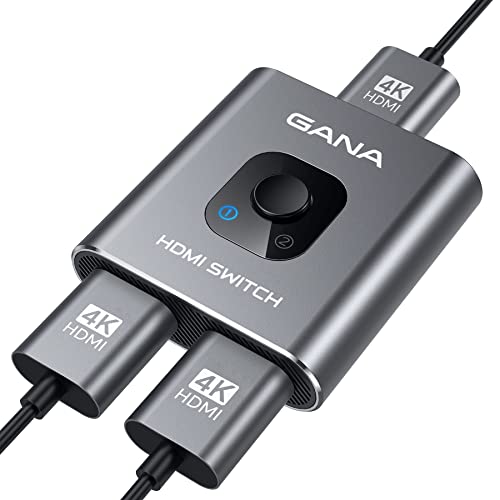
Product overview: This bidirectional HDMI switcher provides 3 HDMI ports to connect multiple sources to a single display, or toggle between two displays from one source. It supports 4K@60Hz and includes LED indicators to show the active input. Power is often recommended for stable performance.
- Best for: gaming consoles, Blu-ray players, or streaming devices when you need to switch between sources on one display.
- Why selected: Flexible port options with clear active-port indication and robust 4K support.
- Limitations: Only one display is active at a time; not a true multi-display splitter; ensure you use a compatible HDMI cable within the recommended length.
UGREEN HDMI Switch 5 In 1 Out

Product overview: The UGREEN 5×1 HDMI switch consolidates five devices (PS5, Xbox, Switch, Roku, laptop) into one display with a single input. It supports 4K@60Hz, HDR, VRR, and 3D, with remote control for easy switching. USB-powered operation aims to maintain stable video transmission.
- Best for: setups with multiple consoles or devices sharing a single television or monitor.
- Why selected: High versatility with remote control and wide compatibility, plus VRR and HDR support.
- Limitations: Requires a power source; ensure cable length stays within recommended ranges to preserve 4K performance.
avedio links HDMI Splitter 4K@60Hz (Mirror Only)

Product overview: This 1×2 splitter mirrors 4K@60Hz content to two outputs, with auto downscaling to 1080p where needed. It’s not an extender and does not support audio extraction or ARC/eARC. It supports 4Kx2K@60Hz in mirror mode with 18.5 Gbps bandwidth.
- Best for: users who want identical output across two displays without extending content.
- Why selected: Strong 4K mirroring capability with flexible downscaling options for mixed-display environments.
- Limitations: Not a switcher or audio extractor; ensure cable quality and length meet 4K requirements.
Buying Guide: How To Choose The Right HDMI Splitter For Streaming
What should you consider when selecting an HDMI splitter for streaming? Here are practical factors and questions to guide your decision.
- What is your goal: mirror vs extend? If you need identical content on multiple displays, choose mirror-capable splitters. For different outputs, you’ll need an HDMI matrix or switcher, not a simple splitter.
- Power needs: Do not rely on HDMI power alone for long runs. Splitters that state a required 5V power adapter tend to be more stable, especially with multiple displays or longer cables.
- Resolution and bandwidth: If you plan to stream in 4K, verify support for 4K@60Hz (or at least 4K@30Hz). Check bandwidth (HDMI 2.0/18 Gbps range is common).
- Distance considerations: Longer HDMI runs can affect signal quality. Note recommended distances to maintain 4K quality; some products list specific length limits (e.g., 16 ft for 4K).
- Audio handling: Some splitters do not pass audio to external speakers or do not support ARC/eARC. Decide if you need audio passthrough or external audio handling separately.
- Device compatibility: Ensure your source device and displays use compatible HDMI standards (HDCP, HDR, VRR). If you use gaming devices, VRR support can be beneficial.
- Ease of use: Consider whether you prefer a remote, LED indicators, or simple manual switching. For home theaters, a clean setup with minimal fiddling is advantageous.
Frequently Asked Questions
- What is the main difference between a splitter and a switcher?
Answer: A splitter duplicates one input to multiple outputs, while a switcher selects from multiple inputs to one output. Splitters do not mix content, and switchers do not replicate content across outputs unless designed as a hub. - Do HDMI splitters require power?
Answer: Many do, especially 1×2 or 1×4 models, to maintain signal integrity over longer runs or higher resolutions. - Can I use an HDMI splitter with audio devices like soundbars?
Answer: Some splitters do not pass audio to external devices. Check the product’s features to confirm audio passthrough capability. - Will a splitter work with ARC/eARC?
Answer: Not all splitters support ARC/eARC. If you rely on these features, verify compatibility before purchasing. - What is mirror vs extend in HDMI devices?
Answer: Mirror copies the same content to all displays; extend allows different content to appear on each display. This is essential for multi-monitor setups. - How long can HDMI cables be to retain 4K quality?
Answer: Many devices specify distances (often up to 16 ft for 4K with HDMI 2.0 cables); longer runs may require higher quality cables or boosters.