HDMI to RF modulators let you broadcast high-definition sources to traditional TVs via coaxial RF channels. This article reviews five popular options, highlighting compatibility, output formats, and key features to help you choose the right modulator for game consoles, media players, or legacy VCR setups. Each product section includes a concise overview, image, and essential specifications drawn from the listed features.
Summary of chosen products
| Product | Brand | Key Advantage | Output Format Notes |
|---|---|---|---|
| HDMI to RF Modulator, HDM61 VHF | VQP | 1080p support with PLL VHF frequency control | NTSC outputs: CH3 61.25MHz, CH4 67.25MHz |
| RF Demodulator Coax to HDMI UHF Modulator | AoeSpy | Broad legacy device compatibility | RF to HDMI; CH3/CH4; plug-and-play |
| Thor Broadcast HDMI to Coax Modulator | Thor Broadcast | All-in-one encoding and RF output | DVB-C/T/ATSC/ISDB-T RF output |
| RCA RF Coaxial Modulator CVBS | AoeSpy | VCRs, DVD players, and older game consoles | CVBS to RF; channel switch present |
| HDMI to RF Modulator (RQG) | RQG | Dual input types, broad compatibility | HDMI and CVBS inputs; PAL/NTSC |
The following sections detail each product, with a focus on how they handle modern HDMI sources and legacy RF displays. Each entry adheres to the information provided in the product features.
HDMI to RF Modulator With NTSC Output And PLL Control

The HDMI to RF Modulator from VQP provides NTSC format output with a defined CH3 frequency of 61.25 MHz and CH4 at 67.25 MHz. It supports multiple resolutions, including 1080P, 1080i, 720P, and standard-definition formats like 576p/576i/480p. The device features 1080P PLL control on the VHF RF path, allowing HDMI inputs to be converted to RF output for television viewing. It is designed to be compatible with a wide range of devices, including PCs, laptops, game consoles, cameras, TV boxes, DVD players, CCTV, and DVRs. This makes it suitable for home entertainment centers where modern sources must feed traditional televisions or analog receivers.
Key points: NTSC RF output options, high-definition input compatibility, and broad device support. The combination of PLL frequency control and HDMI-to-RF conversion makes this a versatile choice for retro gaming setups or media centers that still rely on older TV displays.
RF Demodulator Coax to HDMI UHF Modulator For Classic Consoles

This RF demodulator converts coaxial RF (VHF/UHF) signals to HDMI, enabling classic consoles and older video devices to display on modern HDTVs or HD projectors. It targets a broad spectrum of legacy hardware, including Atari systems, Magnavox Odyssey, Intellivision, ColecoVision, NES, Sega Master System, and more. The device accepts RF input via coax (CH3/CH4) and outputs HDMI, simplifying connections from vintage gear to contemporary displays. The unit is plug-and-play with no drivers required, making it a convenient bridge between retro gaming and modern screens.
Considerations: It supports RF-to-HDMI conversion to accommodate older devices and ensures compatibility with modern displays lacking RF inputs. It is ideal for enthusiasts seeking to relive retro gaming with straightforward setup.
Thor Broadcast HDMI To Coax Modulator For 1080p Transmission
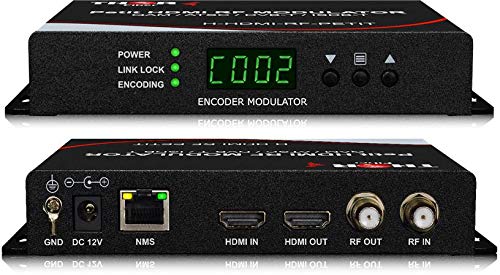
The Thor Broadcast HDMI to Coax Modulator is designed as a cost-effective, networked digital solution. It encodes HD MPEG2 with AC3 Dolby Audio and integrates a digital modulator to convert HDMI sources into RF output suitable for DVB-C, DVB-T, ATSC, ISDB-T, or other RF standards. The unit supports HD video sources up to 1080p and 720p resolutions and can be used with devices such as STBs, satellite receivers, HDMI cameras, DVD players, or computers. This device consolidates multiple stages into a single chassis, simplifying deployment in environments requiring RF distribution across multiple TVs.
Key considerations: integrated encoding and modulation reduce the number of separate components, while broad RF standard support ensures compatibility with various regional broadcast systems. It is well-suited for campus, hospitality, or home entertainment networks that require centralized HDMI-to-RF distribution.
RCA CVBS To RF Modulator For DVD Players And Legacy Hardware

This RCA RF coaxial modulator converts CVBS (composite) signals to RF output, enabling legacy devices and older game consoles to feed displays that only accept RF input. It is compatible with DVD players, Blu-ray players, VCRs, camcorders, satellite set-top boxes, and gaming consoles like PS2/PS3/PS4, Xbox 360, Nintendo Switch, and more. The unit offers a channel switch to minimize interference with existing players and supports sharing content over multiple TVs via RF distribution. It serves as a practical way to extend modern AV sources to vintage or non-HD displays without wired HDMI inputs.
Practical use cases include retro gaming setups, home theaters with older displays, and surveillance or security camera displays that rely on RF coax connections. The device emphasizes straightforward operation and broad compatibility with a variety of AV sources.
HDMI To RF Modulator With VHF And UHF Support

This HDMI to RF modulator accepts HDMI input and CVBS (RCA) inputs, offering both VHF and UHF frequency support. It provides multiple resolutions, including 1080P, 1080i, 720P, 576P, 576i, and 480p, and outputs via F-type coax connectors. The device emphasizes a driver-free experience, allowing direct connection from HDMI sources to RF outputs without software installation. It is suitable for home theaters or setups where users want to feed modern HDMI sources to older TVs or projectors that lack HDMI inputs.
Overall, these modulators cover a spectrum from simple, plug-and-play HDMI-to-RF solutions to more integrated, networked encoding options. When choosing, consider the source devices, target display capabilities (HDMI vs RF), regional RF standards (NTSC vs PAL, DVB/ATSC), and whether you need built-in encoding or a straightforward HDMI-to-F output path.
Buying Guide: Key Purchase Considerations And Comparisons
Output formats and regional standards
Identify whether you need NTSC or PAL outputs, and confirm the RF channels (CH3/CH4 or others) supported by your TV or antenna distribution setup. Some modulators offer DVB-C/T/ATSC or similar formats for broader compatibility; ensure the device matches your local broadcast standard.
Input types and device compatibility
Consider whether you require HDMI only, or also CVBS/RCA inputs for legacy devices. If you plan to connect a mix of modern media players and vintage consoles, a model with multiple input options provides more flexibility.
Resolution support
If you intend to transmit high-definition content, ensure the modulator supports 1080p/1080i at minimum. Some devices limit to 720p or standard definition, which may affect your viewing experience on newer TVs.
All-in-one vs modular setups
All-in-one modulators with built-in encoding simplify installation and reduce component count, ideal for multi-room or hospitality environments. More modular solutions may offer higher customization for specific workflows, such as broadcast-grade distribution or complex RF paths.
Ease of use and installation
Plug-and-play options save setup time, especially for non-technical users. Look for devices with clear channel switches, remote control, or simple on-device controls to minimize configuration steps.
Reliability and longevity
Choose modulators from brands with solid support and updated firmware options. Consider the availability of spare parts, warranties, and compatibility with a broad range of legacy devices to maximize long-term usability.
In summary, selecting the right HDMI to RF modulator depends on your mix of modern and legacy devices, your target RF standards, and whether you prefer a simple, plug-and-play approach or a more feature-rich, networked distribution solution. The options listed above provide a spectrum of choices suitable for home entertainment, retro gaming, and multi-room setups.