HDMI to RF modulators empower you to broadcast HDMI video from any source to multiple televisions over coax. This guide highlights reliable, widely available options and explains how to choose the right model for your setup, whether you’re converting a small office, a classroom, or a home entertainment system. Below are five high-value modulators with different feature sets, from networked HD encoders to simple one-channel transmitters, so you can compare capabilities and find the best fit for your needs.
Summary of selected products:
- Thor Broadcast HDMI to Coax Modulator: All-in-one HD MPEG2 encoder with ATSC/DVB outputs.
- MINIMOD 2 Vecoax: Simple HDMI input with channel assignment over existing coax.
- RQG HDMI to RF Modulator: VHF/UHF support with multiple resolutions and no driver install required.
- ASHATA HDM69L Modulator: Portable, adjustable multi-resolution HDMI AV to RF converter.
- ADRFClub HDMI/RCA to RF Modulator: Broad compatibility with CVBS and HDMI inputs for legacy and modern devices.
Thor Broadcast HDMI To Coax Modulator
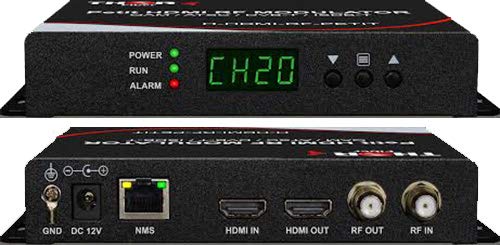
The Thor Broadcast device combines HD MPEG2 encoding with a digital modulator in a single unit, enabling HDMI sources such as STBs, cameras, or computers to be broadcast over DVB-C/T/ATSC/ISDB-T RF outputs. It supports HD video at 720p, 1080i, and 1080p, and includes AC3 Dolby audio. This makes it suitable for converting a high-definition HDMI source into a broadcast channel for multiple TVs without separate encoders or decoders.
MINIMOD 2 Vecoax HDMI To Coax Modulator
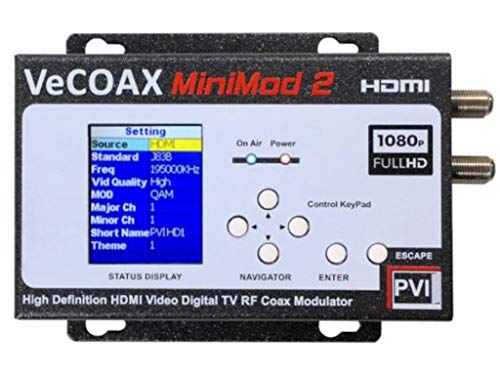
The Minimod-2 from Vecoax offers a straightforward path to distribute a HDMI source across existing TV coax. Connect the HDMI video source to the Minimod-2, then inject its coax output into your TV distribution network. The unit features a color display to SET CHANNEL NUMBER and name the channel, providing a simple, compact solution for distributing a single HDMI source across multiple TVs over coax.
RQG HDMI To RF Modulator

RQG’s HDMI to RF Modulator supports both VHF and UHF frequencies with HDMI and CVBS RCA inputs. It handles multiple resolutions up to 1080p and provides direct RF output via F female connectors without requiring driver installation. This model suits setups that need flexible input options and a simple plug-and-play RF output path for legacy TVs or distributed displays.
ASHATA HDM69L Modulator

The HDM69L from ASHATA focuses on portability and flexibility. It supports multiple resolutions such as 1080P, 1080i, 720P, and 576/480 formats, with optional output channel settings and both HDMI and AV inputs. Its compact build makes it suitable for temporary setups, classrooms, or travel scenarios where a lightweight RF modulator is needed without sacrificing control over output quality.
ADRFClub HDMI/RCA To RF Modulator

ADRFClub’s device supports both HDMI and CVBS inputs with an RF output suitable for coax networks. It’s designed to work with a range of modern streaming sticks and legacy players, including Blu-ray players and game consoles. The unit emphasizes broad compatibility and a straightforward path from digital sources to RF channels, making it a versatile option for mixed AV environments.
Thor Fiber 4 Channel HDMI Modulator
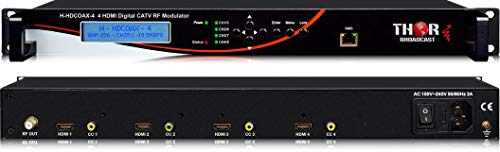
The Thor Fiber 4 Channel HDMI Modulator creates up to four individual CATV channels from four HDMI inputs with HDCP compliance. It supports QAM, ATSC, DVB-T, ISDB-t modulation types, allowing a high-density distribution across a network. This model is ideal for environments requiring simultaneous broadcasting from multiple HDMI sources while maintaining strong video quality and flexible modulation standards.
1 Channel HDMI RF Petit Modulator

The 1 Channel HDMI RF Petit Modulator from Thor Fiber provides a compact, two-pack option for single-channel HDMI RF distribution. It includes HDMI input with HDCP compatibility, an Ethernet management port for control, and the ability to output in QAM, ATSC, DVB-T, or ISDB-T formats. This option is well-suited for small-scale deployments where a single channel is sufficient and space is at a premium.
Buying Guide: Key Considerations And Comparisons
When choosing an HDMI to RF modulator, consider the following factors to ensure compatibility with your existing equipment and future needs:
- Input and output formats: Verify HDMI compatibility and the RF standards you require (ATSC, QAM, DVB-T, ISDB-T). Some devices also support CVBS/RCA inputs for legacy gear.
- Channel capacity: Decide if you need a single-channel modulator or a multi-channel solution for simultaneous sources. Multi-channel units are more efficient for distributing multiple HDMI sources across a building.
- Resolutions supported: Ensure the modulator handles your video resolution (1080p, 1080i, 720p, etc.). Higher resolutions may require more processing power and bandwidth.
- Audio support: Check whether the device carries embedded audio formats such as AC3 or AAC, and ensure compatibility with your TVs or set-top boxes.
- Ease of integration: Some units offer built-in encoding and no driver installation, while others require management software or network access. Consider your IT capabilities and maintenance needs.
- Control interface: Look for devices with onboard displays, color menus, or Ethernet management for remote control and monitoring.
- Physical footprint and power: If space is limited, prefer compact modulators with robust build quality and reasonable power consumption.
- Future-proofing: If you anticipate expanding to more sources or changing standards, a modular or multi-channel system may save trouble later.
- Support and warranty: Choose brands with clear documentation, customer support, and warranty coverage to handle setup or field issues quickly.
In summary, the best choice depends on your distribution scale, source variety, and RF environment. For a simple, cost-effective setup with a single HDMI source, a compact model with HDMI input and one RF channel may suffice. For offices or classrooms needing multiple inputs, a multi-channel Thor Fiber or Thor Broadcast option can deliver more robust distribution and management features. Finally, ensure you can align the modulator’s outputs with your existing coax network and televisions to deliver clean, reliable HD signals.